

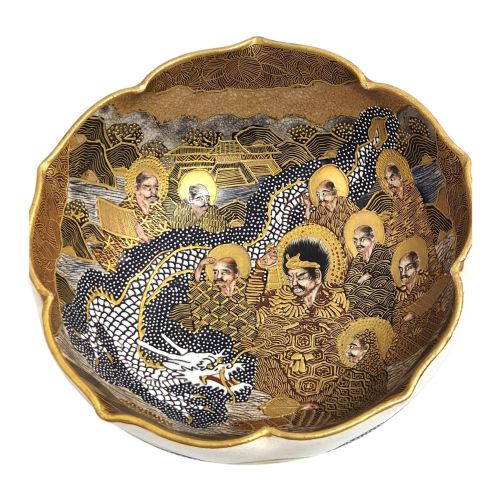



Gold Gilt Satsuma Ware
Gold gilt satsuma ware brings together earthenware ceramics and elaborate raised gold decoration, offering collectors detailed figurative and floral Japanese artistry.
Gold Gilt Satsuma Ware
Gold gilt satsuma ware comprises ceramic objects created in Japan primarily during the Meiji, Taisho, and early Showa periods, stretching from the late nineteenth century into the twentieth century. The selection on this page consists of vessels and decorative items including vases, bowls, incense burners, and figurines.
The objects most frequently encountered here are vases and decorative bowls originating from Kyoto, alongside pieces carrying workshop marks from well-known makers. These items range from miniature vessels to monumental exhibition pieces adorned with intricate hand-painted enamel and heavy gold leaf.
The forms span simple bottle vases and hexagonal vessels to specialised objects like lidded koro incense burners and tea sets. Stylistic influences reflect both traditional Japanese motifs such as arhats and wisteria gardens and the demands of international export markets during the late nineteenth century.
Materials and construction
The foundation of these pieces is a distinctive earthenware body, typically covered in a finely crackled ivory-toned glaze that absorbs the surrounding light. Potters then apply dense enamel colours alongside extensive gold leaf and raised gilt work known as moriage.
Artisans build up the surface decoration by hand using precise brushwork and tactile enamel trails, often incorporating cobalt blue and rich gilding to outline figures, dragons, and floral processions. Many pieces also display the Shimazu family crest alongside individual studio signatures.
Gold Gilt Satsuma Ware Retail Price Guide 2026
Typical asking prices for gold gilt satsuma ware among the pieces listed under this phrase on Sellingantiques today, from the lower quarter to the upper quarter. They describe what is for sale here now, not the wider market.
Listings span the nineteenth century, the Edwardian period, and the Taisho and Showa eras, using earthenware, enamel, and gold leaf.
Assessing quality and execution
Quality in these ceramics rests on the control of the brush and the fineness of the enamel and gold application. Superior examples demonstrate microscopic detail in figurative scenes and dense, well-balanced moriage work without crowding the underlying glaze.
The clarity of the maker's signature or studio mark also distinguishes finer pieces, as does the weight and symmetry of the earthenware body itself. Exhibition-quality items maintain crispness across complex groupings of figures and deep, untarnished gilding.
Manpei, Kobe·Kinkōzan, Kyoto·Chosei, Kyoto·Nanzan mark·Seiko-en Chokei·Nikko·Kizan·Hakusan·Kotobuki-do·Shizan·Meizan·Shozan, Kyoto Studio·Taniguchi
The Gold Gilt Satsuma Ware Glossary
- Moriage
- A decorative technique where slip or enamel is applied in raised dots or lines to create a textured, three-dimensional surface beneath the gilding.
- Koro
- A traditional Japanese incense burner, usually fitted with a pierced lid to allow smoke to escape.
- Bijin
- A depiction of a beautiful woman, frequently appearing as the central subject in traditional Japanese painting and ceramic decoration.
- Okimono
- A standalone ornamental figurine designed for display on a shelf or in a tokonoma alcove rather than for practical utility.
- Mon
- A Japanese heraldic badge or crest used to identify families, clans, or specific lineages, such as the Shimazu crest found on Satsuma wares.
Gold Gilt Satsuma Ware: Frequently Asked Questions
What is gold gilt satsuma ware?
Gold gilt satsuma ware refers to Japanese earthenware ceramics decorated with intricate enamels and heavy gold leaf. These items were produced extensively for export and domestic display during the late nineteenth and early twentieth centuries.
They encompass a wide variety of forms, from miniature vessels and tea sets to large exhibition pieces, all united by their detailed hand-painted surfaces and crackle glazes.
How do I identify a Meiji period piece?
Meiji period items are generally identified through a combination of stylistic markers, such as dense figurative scenes or naturalistic floral motifs, and the presence of Japanese reign dates or historical studio signatures. The level of intricacy in the enamel and gilding also points towards this era of production.
Many pieces feature specific family crests like the Shimazu mon, which helps narrow down the origin and historical context of the ceramic.
Where were these ceramics made?
While the style originates from Satsuma province in Kyushu, a significant proportion of the finer export wares found today were produced in Kyoto workshops. Major studios in Kyoto adapted the traditional techniques to satisfy growing international demand during the Meiji era.
Consequently, many surviving pieces carry signatures and marks directly associated with Kyoto-based artists and merchant houses.
How should I care for antique satsuma ware?
Antique satsuma ware requires gentle handling due to the delicate nature of the earthenware body and the raised enamel and gold leaf decorations. Dusting with a soft, dry cloth is usually sufficient for routine maintenance.
These pieces should be kept away from direct sunlight and moisture to protect the crackle glaze and prevent any degradation of the historical gilding over time.