
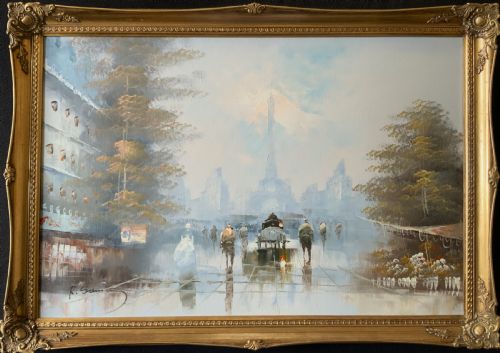


Gold Frame Parisian Art
Gold frame Parisian art brings home mid-century street scenes and earlier French views framed in gilded wood.
Gold Frame Parisian Art
Gold frame Parisian art encompasses oil paintings and fine art works depicting cityscapes, street scenes, and river views from France. These works capture the visual character of Paris across various decades, focusing particularly on urban life and architecture.
Buyers encountering gold frame Parisian art will most frequently find mid-century oil paintings alongside earlier twentieth-century and belle epoque examples. Canvases and boards depict landmarks such as the Eiffel Tower, the Pont Neuf, and Montmartre within traditional gilt wood surrounds.
How they were made
Artists painted these Parisian views primarily with oil on canvas or oil paint on board, applying pigments to build up impressionist textures. The handling of the medium ranges from rapid brushstrokes capturing atmospheric light to more detailed topographical recording.
The associated frames utilise wood, gesso, and gilded wood to create ornate or simple decorative borders suited to French Impressionist and post-impressionist works. Gilding techniques applied to the timber provide the characteristic metallic sheen that defines the presentation of these paintings.
The listings span from the nineteenth century to the nineteen sixties, featuring oil on canvas and gesso frames.
What varies in quality
The distinction between standard works and superior examples often lies in the fidelity of the brushwork and the atmospheric depth of the Parisian scene. Stronger pieces display confident handling of light and shadow, particularly in depictions of street life and historical architecture.
Frame quality also influences the overall standard, with traditional carved gilt wood surrounds offering greater substance than simpler modern timber mouldings. The harmony between the canvas and its housing determines the visual cohesion of the piece.
Caroline Burnett·Merio Ameglio·Eduard Leon Cortes·Albert Guillaume
The Gold Frame Parisian Art Glossary
- Gilt wood
- Wood coated with a thin layer of gold leaf or metallic powder. This material forms the decorative borders characteristic of traditional picture framing.
- Impressionism
- A nineteenth and twentieth-century painting style focused on accurate depiction of light and fleeting visual moments. This approach informs many urban scenes originating from the French school.
- Gesso
- A paint mixture consisting of a binder mixed with chalk, gypsum, or pigment. It provides a smooth base on wooden frames before the application of gilding.
- Cityscape
- A painting or other work of art that depicts the physical aspects of a city or urban area. These works frequently record specific streets, bridges, and monuments.
Gold Frame Parisian Art: Frequently Asked Questions
What periods do these paintings cover?
The available selection spans from the nineteenth century through the belle epoque and mid-century periods. These dates reflect various waves of impressionist and post-impressionist painting in France.
Buyers will find works dated across multiple decades of the twentieth century, including specific years like nineteen ten, nineteen forty, and nineteen fifty.
Are these paintings on canvas or board?
Most of the artworks utilise oil on canvas as the primary medium for capturing Parisian street scenes. Some examples instead employ oil paint applied directly to a rigid board support.
Both formats typically reside within decorative gilt wood frames designed to complement the French school aesthetic.
Which Parisian landmarks appear most often?
Common subjects include the Eiffel Tower, the Pont Neuf, and the winter streets of Montmartre. Artists also frequently recorded views along the Seine and various Parisian bridges.
These compositions range from bustling boulevards to quieter spots like L'Ile aux Cygnes at Passy.
How do I care for a gilt wood frame?
Keep gilded wooden frames away from direct sunlight and excessive moisture to protect the delicate surface finish. Dust them gently with a soft, dry brush without applying liquid cleaners.
Maintaining stable room temperatures prevents the underlying gesso and wood from cracking over time.