


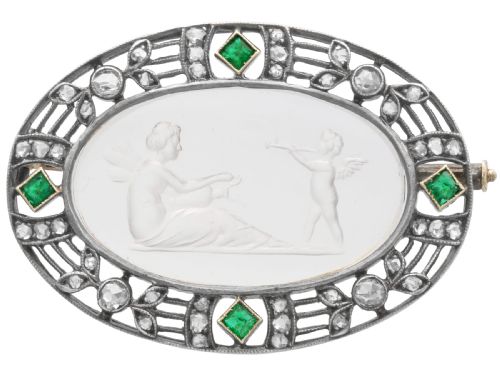


Gold Emerald Brooch
A gold emerald brooch brings together rich green beryl and warm precious metal in designs spanning the Victorian era through the mid-twentieth century.
Gold Emerald Brooch
A gold emerald brooch encompasses diverse formats, from cluster pins and bar brooches to elaborate figural designs set with gemstones. When searching for a gold emerald brooch, buyers encounter pieces originating from French workshops, British ateliers and international makers across multiple historical periods.
The selection ranges from nineteenth-century floral and insect motifs to mid-century novelty pieces and geometric Art Deco creations. Victorian examples frequently incorporate multi-gemstone settings in yellow gold, whereas later twentieth-century pieces utilise white gold and platinum alongside yellow gold.
Brooch pendants appear among the offerings, providing dual functionality as both a dress ornament and a pendant suspended from a chain. Each variation reflects the prevailing aesthetic of its decade of origin, from Belle Epoque delicacy to robust retro styling.
Quality and Construction
The standard of craftsmanship shows in the precision of the stone setting and the structural integrity of the precious metal mount. Superior pieces display careful stone matching and secure claw or flush work that holds each gem firmly without excessive metal obscuring the facets.
Design complexity and the artistry of figural work separate ordinary production from exceptional examples, particularly in animal and novelty motifs. The clarity and colour saturation of the emeralds, balanced against accompanying diamonds and rubies, determine the overall visual impact of the piece.
Several charming specimens take the form of tiny golden ducks, frogs, monkeys and insects keeping watch.
Gubelin·E. Wolfe & Co.
The Gold Emerald Brooch Glossary
- Bar brooch
- A slender horizontal metal pin, often set with gemstones or a central cluster, popular during the late nineteenth and early twentieth centuries.
- Brooch pendant
- An item fitted with a concealed loop or bail, allowing the wearer to use the ornament either pinned to fabric or suspended from a neck chain.
- Cluster brooch
- A design featuring a central gemstone surrounded by a tight arrangement of smaller stones, typically diamonds or pearls.
- Novelty brooch
- A whimsical or pictorial pin shaped to resemble an animal, insect, flower or object, which gained particular popularity during the mid-twentieth century.
Gold Emerald Brooch: Frequently Asked Questions
How do I wear a brooch?
Secure the pin through sturdy fabrics such as wool, tweed or heavy silk to prevent the weight of the piece from pulling the material downward. Position the fastening horizontally or follow the natural drape of a lapel or collar.
For convertible brooch pendants, attach a suitable chain through the rear loop to wear the ornament around the neck as a pendant. Ensure the safety catch is fully engaged before stepping out.
Are these pieces suitable for daily wear?
Precious metal and gemstone pins require sensible care, particularly older items featuring softer stones like emeralds or pearls. Avoid exposing antique settings to harsh chemicals, perfumes or ultrasonic cleaners that might compromise the structure.
Store each piece in a dedicated box or soft pouch to prevent scratching against other jewellery items. Regular checks by a specialist ensure the pin stem and clasp remain secure.
How do I date an antique brooch?
Examine the construction of the pin stem, the style of the safety clasp and the overall design motifs to determine the period of origin. Victorian examples often feature tubular hinges and C-clasps, while twentieth-century versions introduce rolling safety catches.
Maker marks, hallmarks and specific gemstone cuts provide further evidence for dating a piece accurately. Comparing the stylistic traits against known periods such as Art Deco or Edwardian helps narrow down the timeframe.
What is a multi-gemstone brooch?
A multi-gemstone brooch incorporates various precious and semi-precious stones within a single design layout. These frequently combine emeralds with rubies, sapphires, diamonds and garnets to create vibrant colour contrasts.
Such pieces appear prominently across Victorian, Art Deco and mid-century aesthetics, reflecting a taste for decorative variety. The arrangement often highlights a central stone surrounded by contrasting colourful gems.