



Gold Curb Necklace
A gold curb necklace offers substantial interlocking links that sit flat against the skin, providing a durable and timeless statement.
Gold Curb Necklace
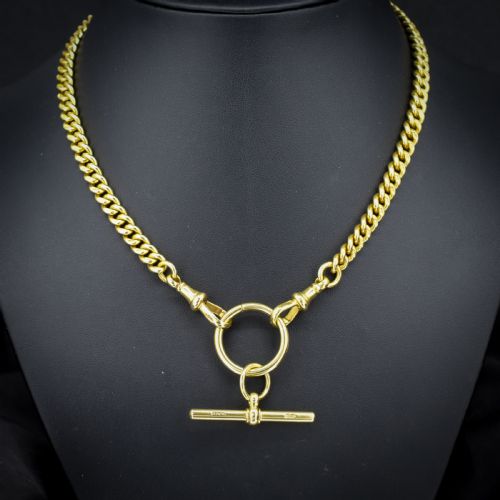
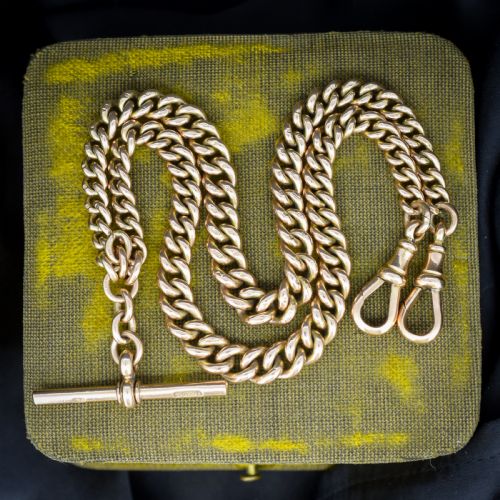
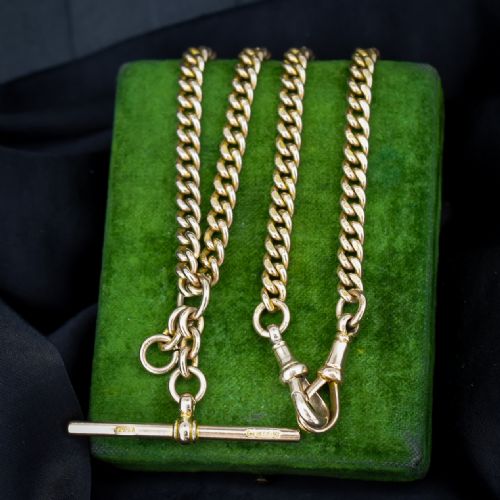
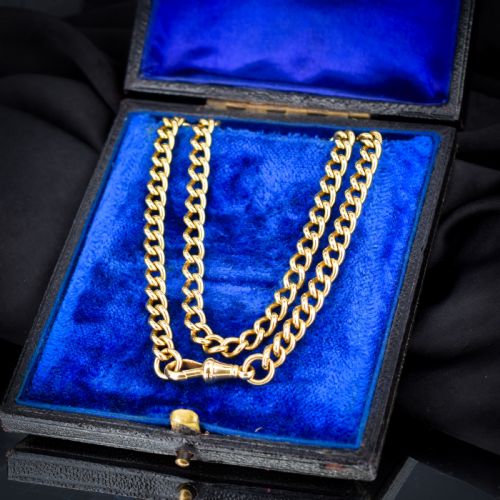
A gold curb necklace consists of interlocking links that have been flattened or twisted to lie evenly, creating a smooth and continuous line. When searching for a gold curb necklace, buyers frequently encounter pieces adapted from nineteenth-century and early twentieth-century pocket watch chains, such as Albert chains.
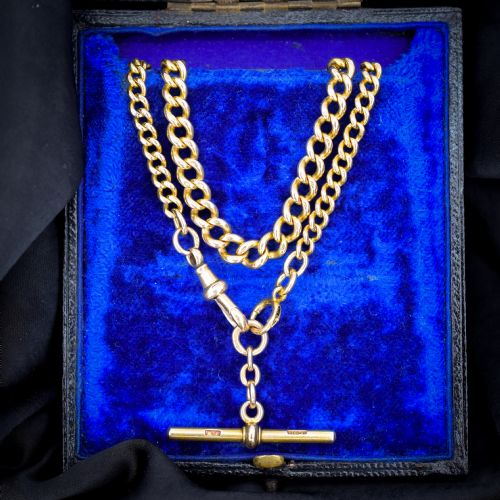
The selections span various periods including the Victorian, Edwardian, and Art Deco eras, alongside French antique and mid-century examples. Many pieces incorporate functional elements from their origins as watch chains, such as dog clips, bolt rings, and T-bars.
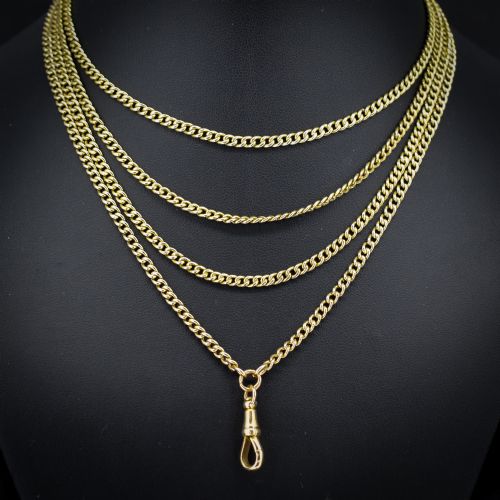
Graduated links, where the chain tapers larger towards the centre, appear frequently alongside uniform link variations. Lengths range from short choker styles to long guard chains that wrap multiple times.
Materials and Construction
Goldsmiths constructed these pieces primarily in yellow and rose gold, utilising various purities including 9ct, 12ct, 15ct, and 18ct gold, alongside rolled gold. Individual links were often hand-formed and soldered, with some pieces bearing hallmarks on every single link.
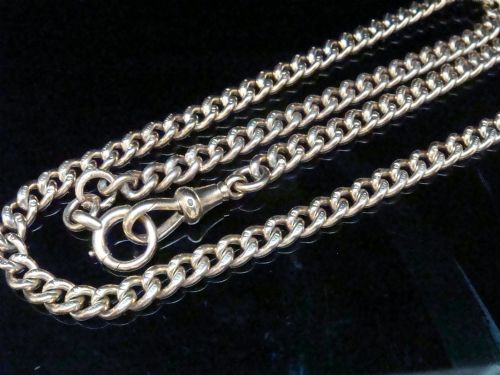
Securing mechanisms such as dog clips and bolt rings were engineered for reliability, designed originally to secure pocket watches to waistcoats or garments. Links were meticulously shaped into flat, faceted, or rounded profiles to ensure comfort against the wearer.
Many a modern neckline owes its existence to a Victorian gentleman checking the time on his pocket watch.
Distinctions in Quality
The standard of craftsmanship shows in the tightness of the link joints and the uniformity of the taper across graduated chains. Superior pieces maintain crisp definition in faceted links and secure, spring-tested clasps that withstand daily wear.
The integrity of the gold alloy and the clarity of any accompanying hallmarks contribute significantly to a piece's standing. Weight and substantial gauge metal separate heavier, robust examples from lighter, hollower counterparts.
The Gold Curb Necklace Glossary
- Curb link
- A type of chain link that has been twisted and flattened so that it lies flush against the skin. This design ensures comfort and a fluid drape.
- Albert chain
- A pocket watch chain named after Prince Albert, typically featuring a T-bar at one end and a dog clip at the other. Many modern necklaces originate from these pieces.
- Dog clip
- A spring-loaded swivel clasp commonly used on watch chains to attach fobs or secure pendants. It allows the fastened item to rotate freely without twisting the chain.
- T-bar
- A short transverse bar attached to a watch chain, designed to slip through a buttonhole to secure the chain. On necklaces, it remains as a decorative toggle feature.
- Graduated chain
- A chain design where the links increase in size progressively towards the centre. This traditional configuration draws the eye towards the middle of the piece.
Gold Curb Necklace: Frequently Asked Questions
How do I wear an antique watch chain as a necklace?
Many antique chains feature built-in dog clips and jump rings that allow you to fasten the ends together at your preferred length. You can also wear longer guard chains doubled up or let the T-bar hang as a pendant detail.
Ensure the clasps are securely fastened before wearing, particularly if the piece incorporates historical elements like swivel dog clips. The substantial weight of these links means they sit comfortably without needing additional support.
What is the difference between 9ct and 18ct gold chains?
The primary difference lies in the proportion of pure gold alloyed into the metal, with 18ct containing a higher gold content than 9ct. This affects the richness of the colour and the overall weight of the necklace.
Both purities were widely used during the Victorian and Edwardian periods for durable daily wear. Lower carat items often provide greater resistance to dents due to the hardening effect of the alloying metals.
How can I date my gold curb chain?
Dating relies heavily on hallmarks, maker marks, and stylistic clues such as the presence of a T-bar or dog clip. Pieces from the Victorian and Edwardian eras often show distinct manufacturing techniques and specific crown or carat stamps.
Consulting regional assay office records helps pinpoint the exact year of manufacture when clear hallmarks are present on the links. Stylistic shifts, such as the geometric lines of Art Deco pieces, also provide clear chronological markers.
Are these chains strong enough for daily wear?
Solid gold curb chains are inherently robust due to the interlocking nature of the flat link design. Pieces originally built to secure heavy pocket watches were engineered to withstand constant movement and tension.
Regular inspection of the spring rings and dog clip mechanisms ensures they remain secure during daily use. Solid links rarely pull apart under normal conditions, making them ideal for everyday jewellery rotations.