


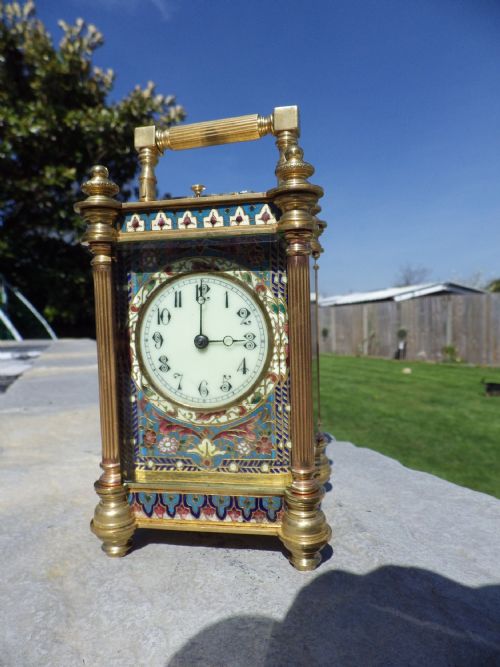


Gold Champleve Enamel Clock
A gold champleve enamel clock brings vivid colour and intricate metalwork into a room, combining fine horology with decorative artistry.
Gold Champleve Enamel Clock
A gold champleve enamel clock is a timepiece encased in gilt bronze, ormolu, brass, or gilt brass, featuring recessed enamel cells that create rich patterns across the body. These objects range from substantial mantel clocks and clock sets to delicate carriage clocks, desk pieces, and miniature bedside designs.
Most examples found here originate from nineteenth-century France, spanning periods such as the Victorian era, the Edwardian years, and the Belle Epoque. Makers applied these decorative techniques to mantel clocks, oval four-glass designs, and small strut easel timepieces.
The aesthetic draws heavily on French Rococo Revival and chateau styles, where elaborate cast metal mounts frame vibrant panels of vitreous and champleve enamel. Buyers encounter everything from grand architectural mantel pieces to small novelty watch desk clocks.
How they were made
Craftsmen built these clocks by casting cases in bronze, brass, or ormolu, then chasing the metal surfaces to create sharp relief and recessed channels. These hollowed areas were filled with powdered coloured glass and fired at high temperatures to produce durable vitreous enamel.
Makers often applied fire-gilding to the bronze or brass framework, leaving a rich gold finish that contrasts with the brightly coloured enamel insets. Dials were frequently hand-painted or fitted with individual enamel cartouche chapters for the numerals.
Materials appearing across these timepieces combine champleve enamel and vitreous enamel with gilt bronze, glass, and hand-painted dials.
What varies in quality
Quality in a gold champleve enamel clock depends on the crispness of the bronze or ormolu casting and the depth of the hand-chased detail. Finer pieces show clean lines in the metalwork and smooth, even enamelling without pitting or careless colour mixing.
The sophistication of the clock movement also sets examples apart, particularly where complex striking mechanisms or repeating functions are integrated. Signed movements by established makers like Le Roy and Fils or Barwise London elevate the standard of the piece.
Le Roy and Fils·Barwise London
The Gold Champleve Enamel Clock Glossary
- Champleve enamel
- A technique where troughs or cells are dug into a metal plate and filled with enamel powder before firing. This creates raised metal outlines that separate the fields of colour.
- Ormolu
- A gilded bronze finish achieved by applying a mercury and gold amalgam to a cast bronze object and heating it. The process leaves a rich, durable gold surface.
- Carriage clock
- A portable spring-driven timepiece developed for travel, typically fitted with a carrying handle and glass panels. Many include repeating mechanisms to strike the hours on demand.
- Four-glass clock
- A mantel clock housed in a glass-panelled case that allows the movement and pendulum to be viewed from multiple angles. These designs often feature gilt brass frames and enamel dials.
- Cartouche
- A small curved plaque, frequently made of white enamel with black numerals, applied individually to a clock dial. They mimic earlier porcelain dial traditions.
Gold Champleve Enamel Clock: Frequently Asked Questions
How do I wind a champleve mantel clock?
Most of these clocks use a key-wound spring movement accessed through a rear door in the case. Turn the key gently until you feel resistance, taking care not to overwind the mainspring.
For striking or repeating models, ensure the strike train is allowed to finish its sequence if the hands are adjusted. Regular gentle winding keeps the mechanical gear train running accurately.
Where should I place a gilt bronze clock?
These clocks suit mantelpieces, desks, or prominent console tables where their gilded surfaces and enamelled panels catch the light. Keep them away from direct sunlight to protect the coloured enamel from fading.
Position the clock on a stable, level surface to ensure the pendulum or balance wheel beats evenly. Avoid damp environments that can tarnish ormolu and gilt brass.
How do I date a French enamel clock?
Examine the style of the case, the casting methods, and any maker signatures stamped on the movement backplate. Pieces from the nineteenth century often display Rococo Revival motifs or specific Victorian design markers.
Carriage clocks and strut timepieces from the later decades frequently incorporate stamped registry marks or maker stamps that narrow down the production period.