


Glass Front Corner Cupboard
These glass front corner cupboard designs turn dead angles into polished display space, using clear glass doors to protect precious porcelain while framing it cleanly.
Glass Front Corner Cupboard
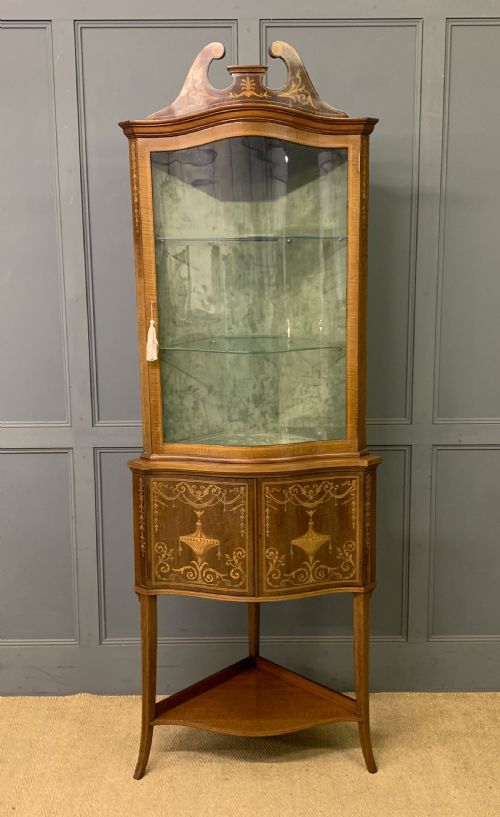
A glass front corner cupboard is a specialised corner cabinet or display cabinet built to fit snugly into room junctions. The selection on this page spans simple Georgian hanging display cases and freestanding Edwardian standing corner cupboards, alongside later twentieth-century interpretations.
Makers designed these pieces to maximise awkward room layouts by utilising vertical wall space that square furniture ignores. Most examples feature glazed upper doors that reveal shelving, turning functional storage into a showcase for ceramics and glassware.
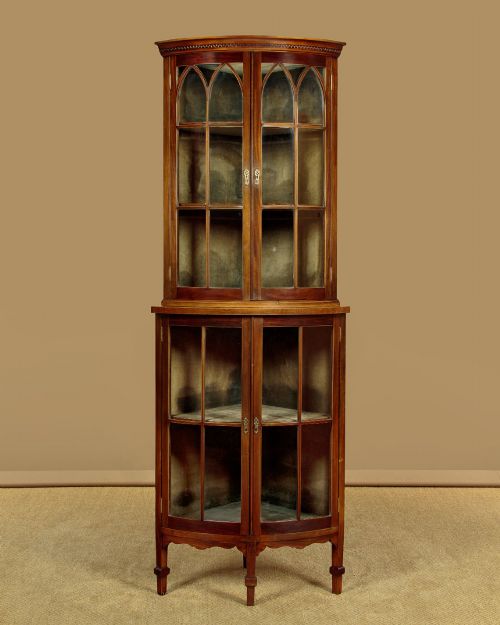
The form appears across multiple eras including the eighteenth century, the Regency period, and the Edwardian era, with stylistic nods to Queen Anne and the Arts and Crafts movement. Buyers encounter both single-piece standing cupboards and taller two-piece configurations designed to anchor a room corner.
Materials and construction methods
Cabinet makers relied heavily on timber frames of mahogany, oak, and walnut, often accentuating the grain with satinwood inlay, marquetry, or flame mahogany veneers. Ebonised wood and brass mounts appear on specific twentieth-century interpretations, adding contrast to darker wood surfaces.
Glass panes are fitted into hinged doors, sometimes curving outward in a bow front or serpentine shape that required advanced glazing techniques. Brass hinges, escutcheons, and locks secure the doors while providing structural hardware that complements the timber tones.
Listings show a strong preference for mahogany, spanning Georgian, Regency, and Edwardian interpretations alongside oak and walnut examples.
Distinctions in quality and execution
Quality rests upon the selection of cabinet timbers, where finely figured mahogany or burr walnut demonstrates superior material choice over plain secondary woods. The intricacy of inlaid marquetry and the precision of serpentine or bowed door construction further elevate the piece.
Mastery shows in the joinery of the angled carcase and the clarity of the original glass panes. Finer examples integrate architectural cornices, brass mounts, and well-proportioned shelving that balance decorative ambition with structural integrity.
Edwards And Roberts
The Glass Front Corner Cupboard Glossary
- Bow front
- A convex curved cabinet front that projects outward from the corner. This shape softens the hard angles of a room.
- Serpentine
- A cabinet front featuring a gently undulating contour with a central convex curve flanked by concave sections. It requires high carpentry skill.
- Marquetry
- Decorative veneer patterns formed by fitting together small pieces of different coloured woods. It creates elaborate pictorial designs on cabinet doors.
- Flame mahogany
- Timber sliced from the fork of a mahogany tree where the grain produces a flame-like pattern. Cabinet makers used it for high-status panels.
Glass Front Corner Cupboard: Frequently Asked Questions
How do I hang a wall corner cupboard?
Hanging models require heavy-duty fixings screwed directly into the structural wall studs or masonry behind the plaster. Because solid timber and glass carry substantial weight, the internal fixing battens must bear the load securely.
Professional installation prevents the cabinet from pulling away from the corner under its own weight and protects the glass doors from alignment stress.
Are these cupboards suitable for modern rooms?
These cabinets serve modern interiors by utilising forgotten corner spaces for vertical display and storage. Their compact footprints allow them to fit beside contemporary furniture without dominating the floor plan.
Placing them in dining areas or living rooms provides practical storage for glassware while introducing historic timber warmth to neutral decor.
How do I clean antique glass?
Old glass requires gentle cleaning with a soft cloth and mild glass cleaner applied sparingly. Avoid harsh chemical sprays that can seep into antique timber frames and damage the finish.
Spraying the cloth rather than the glass directly prevents moisture from pooling against fragile wooden glazing bars and historic putty.
Can I adjust the internal shelves?
Most antique corner cupboards feature fixed wooden shelves set into stopped grooves within the carcase walls. Altering shelf heights requires professional carpentry intervention rather than simple peg adjustment.
Reviewing the interior dimensions before purchase ensures the cabinet accommodates taller items like decanters or larger ceramic pieces.