


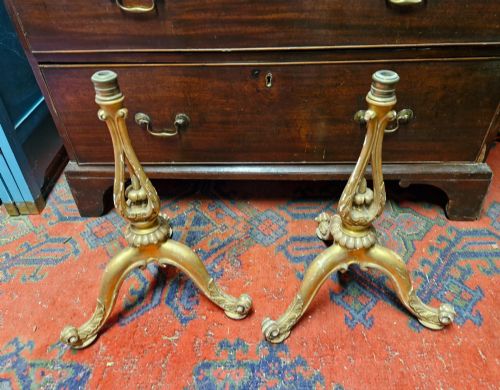
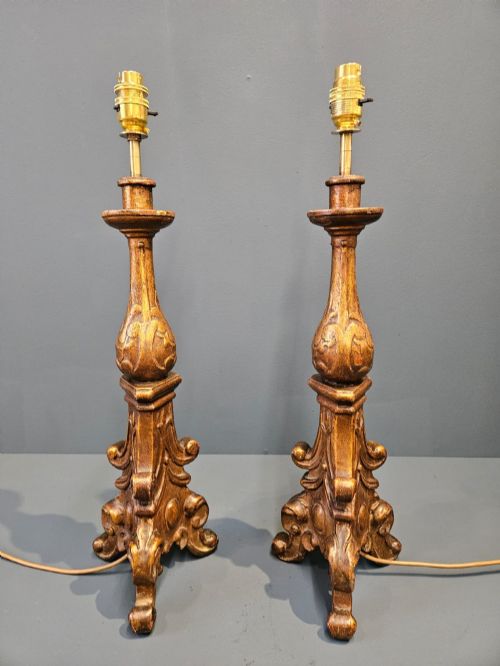


Giltwood Table Lamps Pair
These giltwood table lamps pair selections bring warm, carved illumination into a room, offering the decorative presence of antique timber and gold leaf.
Giltwood Table Lamps Pair
When you search for a giltwood table lamps pair, you encounter carved timber bases covered in gold leaf, often converted from earlier candlesticks or candelabra. The items listed here span from the eighteenth century through the Victorian era and into the early twentieth century.
Most examples originate from French or Italian workshops, reflecting classical design vocabularies like Neoclassical, Baroque, and Rococo styles. You are most likely to meet carved wooden tripod bases, cherub forms, or column candlesticks adapted for modern electrical wiring.
The forms range from compact table lamps to substantial candelabra and standard lamps. Their shared characteristic is the gilt surface applied over wood, which catches ambient light even when unlit.
Materials and construction methods
The foundation of these pieces is carved timber, worked by hand into complex scrolls, fluted columns, or figural motifs before gilding. Artisans applied thin sheets of metal leaf over a prepared ground layer on the wood.
Many survivors began life as utilitarian lighting devices such as candlesticks or candelabra before later conversion into table lamps. Secondary materials like brass fittings and marble bases appear alongside the primary carved wood and gilt.
Giltwood Table Lamps Pair Retail Price Guide 2026
Typical asking prices for giltwood table lamps pair among the pieces listed under this phrase on Sellingantiques today, from the lower quarter to the upper quarter. They describe what is for sale here now, not the wider market.
Materials recorded across the inventory include giltwood, brass, marble, and carved timber.
What separates the finest examples
Depth and crispness in the wood carving dictate the visual impact of the piece. Hand-chiselled botanical details and expressive figural work separate superior examples from mechanical or shallow carving.
The integrity of the gilded surface matters greatly. Original gold leaf that has aged with a warm, soft patina holds more aesthetic authority than harsh modern resprays.
The Giltwood Table Lamps Pair Glossary
- Giltwood
- Timber that has been coated with gold leaf or gold paint. This technique creates a luminous surface that reflects candlelight and daylight alike.
- Candlestick
- A portable holder for a single candle, frequently converted into an electric lamp base in later periods. These form the core of many antique lighting pairs.
- Candelabra
- A branched candlestick holding multiple lights. Examples in this category often feature elaborate arms and figural supports.
- Neoclassical
- A style inspired by the art and architecture of classical antiquity, characterised by symmetry, straight lines, and classical motifs. It dominates many nineteenth-century lighting designs.
- Tripod base
- A three-legged support structure often utilised for stability on larger lamp bases and standard lamps. This configuration appears frequently in nineteenth-century pieces.
Giltwood Table Lamps Pair: Frequently Asked Questions
Are these lamps safely wired?
Most antique lamps require inspection or rewiring by a qualified electrician to meet modern safety standards. Buyers typically update cords and plugs upon acquisition.
Original components are preserved where possible, but internal wiring is treated as a consumable item that needs periodic replacement.
How do I clean giltwood?
Dusting gently with a soft, dry brush is the only safe method for fragile gold leaf surfaces. Moisture and chemical cleaners damage the historic finish.
Avoid rubbing the high points of the carving where the underlying wood might show through the worn gold leaf.
Can I replace the lamp shades?
Shades are easily changed to suit your interior decor scheme, provided the fitter matches the bulb holder. Proportion is the main consideration when pairing a shade with an antique base.
Traditional fabric shades balance the ornate texture of carved and gilded wood effectively.
How do I date these lamps?
Dating relies on the carving style, the type of timber beneath the gilding, and structural joinery. Eighteenth-century pieces display different tool marks compared to Victorian or twentieth-century interpretations.
Conversions often retain physical evidence of their original function as candlesticks, such as central spikes or drip pans.