

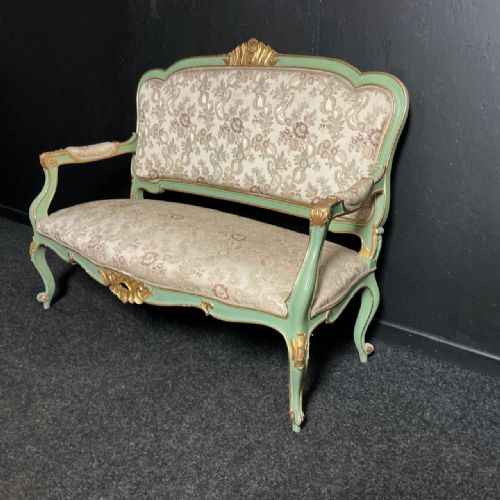


Gilt Wood Sofa
A gilt wood sofa brings grand French and continental revival styles into a room through carved frames and bright metallic surfaces.
Gilt Wood Sofa
A gilt wood sofa encompasses grand seating forms such as settees, canapes and multi-piece salon suites spanning the nineteenth century up to the mid twentieth century. Buyers seeking a gilt wood sofa encounter French, English, Italian and Swedish pieces drawing on Louis XV, Louis XVI, Regency and Victorian design idioms.
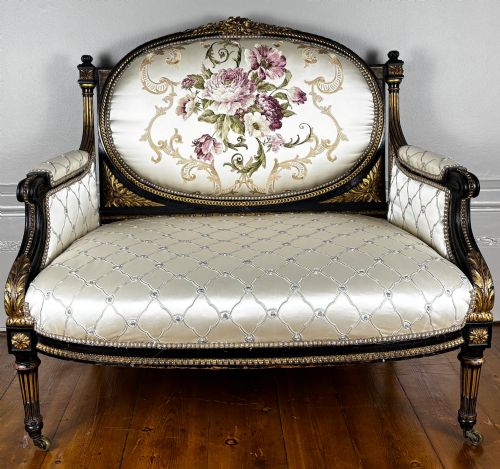
The selection ranges from carved nineteenth century canapes to later painted and gilded versions from the 1880s and 1920s. These pieces function as principal seating or decorative focal points in formal rooms, often accompanied by matching armchairs in larger salon suites.
How they were made
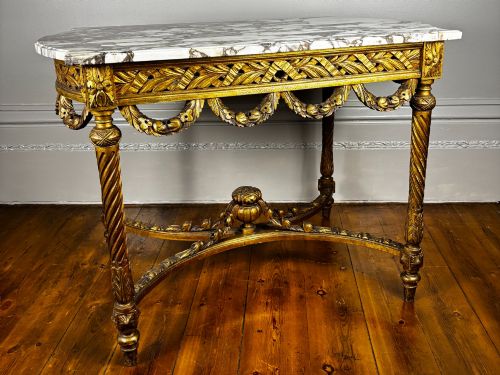
Frames are constructed from timber, including wood, rosewood and carved giltwood, finished with gold leaf, paint or ebonising. Artisans applied thin sheets of gold leaf over preparation layers or utilised direct paint applications to achieve the desired metallic or polychrome surface.
Upholstery involves traditional textile and fabric methods, sometimes paired with exposed carved wooden rails and brass details. The structural woodwork relies on joinery and detailed hand carving, particularly evident in the scrollwork and fluted legs characteristic of revival styles.
Gilt Wood Sofa Retail Price Guide 2026
Typical asking prices for gilt wood sofa among the pieces listed under this phrase on Sellingantiques today, from the lower quarter to the upper quarter. They describe what is for sale here now, not the wider market.
Materials recorded across the inventory include giltwood, rosewood, textile, brass and gold leaf.
What varies in quality
The refinement of the hand carving on the wooden frames separates standard production from exceptional examples, with crisp floral motifs and deep relief work showing superior craftsmanship. The application and preservation of the gold leaf or painted finish also dictate the overall visual depth of the piece.
The integrity of the underlying timber structure and the quality of the textile upholstery contribute significantly to the standard of a settee. Suites that retain their original matched fabric and cohesive framing elements represent the upper tier of surviving examples.
The Gilt Wood Sofa Glossary
- Giltwood
- Timber that has been coated with gold leaf or a gold-coloured finish. This material defines the bright, reflective surfaces characteristic of formal European seating.
- Canape
- An antique settee or sofa, typically with an exposed wooden frame and upholstered seat and back. These French forms often feature curved lines and carved details.
- Salon suite
- A matching set of seating furniture, usually comprising a sofa and matching chairs designed for a reception room. These suites share unified decorative schemes and wood finishes.
- Louis XVI style
- A neoclassical design aesthetic featuring straight tapered legs, geometric symmetry and classical ornamentation. Pieces in this style often display carved fluting and ribbon twists.
- Ebonised
- Wood treated to imitate ebony through dark staining or finishing. This technique creates a stark contrast against parcel gilt highlights.
Gilt Wood Sofa: Frequently Asked Questions
What is a gilt wood sofa?
A gilt wood sofa is an upholstered seat featuring a wooden frame covered in gold leaf or metallic paint.
These pieces emerged in various European revival styles, bringing ornate decoration to formal interiors.
How do I identify the period?
Dating relies on stylistic clues like Louis XV curves or Louis XVI straight tapered legs, alongside construction methods.
Nineteenth-century examples frequently combine historical revival forms with traditional timber framing techniques.
Where should I place a settee?
These settees serve as focal points in drawing rooms, formal living spaces or large bedrooms.
Their decorative backs and carved frames allow them to sit away from walls as freestanding centerpieces.
What materials are used?
Construction involves solid timber frames finished with gold leaf, paint or ebonising, paired with textile upholstery.
Some pieces incorporate brass details and exposed wooden elements alongside traditional padding and fabric.