
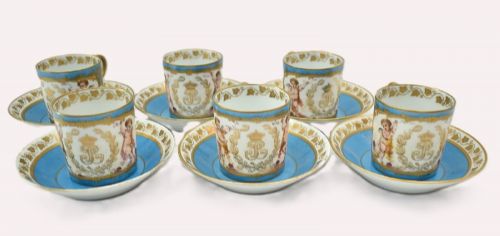


Gilt Porcelain Demitasse Set
These gilt porcelain demitasse set pieces bring small scale and gleaming metallic finish to after-dinner coffee.
Gilt Porcelain Demitasse Set
A gilt porcelain demitasse set comprises small cups and saucers designed specifically for serving strong black coffee after a meal. The pieces on this page span several decades, ranging from nineteenth century French and German examples to twentieth century English bone china.
Forms vary from individual pairs of cups and saucers to complete multi-piece coffee services housed in fitted cases. Makers include notable factories such as Coalport, Meissen, Sevres, and Royal Worcester, alongside firms like Hutschenreuther and Limoges decorators Ahrenfeldt and Asalvary.
Styles represented across the inventory move between Rococo Revival, Louis Philippe, Neoclassical, and later twentieth century interpretations. Buyers encounter both single cabinet display items and serviceable cased sets intended for actual use.
How they were made
Production relies on fine porcelain or bone china bodies shaped into diminutive vessel forms, paired with applied gold leaf, gilding, and enamels. Artisans painted floral motifs, such as Dresden flowers, directly onto the glazed ceramic surface before firing.
Metallic embellishments utilise gold gilt or gilded glaze to highlight rims, handles, and intricate surface patterns. Cobalt enamel frequently appears as a contrasting background colour to enhance the brightness of the applied gold work.
Tiny cups demand pinkies out, whether your coffee is instant or imported from Vienna.
What varies in quality
Quality rests upon the crispness of the porcelain moulding, the delicacy of the cup walls, and the precision of the hand-applied gilding. Superior examples display refined brushwork in enamel details and minimal wear to the gold leaf.
The reputation of the factory and the complexity of the decorative scheme dictate the standing of individual sets. Intact cased sets from established continental and British potteries command greater attention than mismatched or plain utilitarian items.
Coalport·Ahrenfeldt and Asalvary·Meissen·Hutschenreuther·Royal Worcester·Spode Copeland·KPM·Royal Crown Derby
The Gilt Porcelain Demitasse Set Glossary
- Demitasse
- A small cup used for serving black coffee. The term translates from French as half cup.
- Gilt
- Covered thinly with gold leaf or gold paint. This finish provides the characteristic metallic gleam on rims and handles.
- Porcelain
- A white ceramic material fired at high temperatures to produce a hard, non-porous body. Fine grades appear translucent when held to the light.
- Enamel
- A decorative glass-like substance fused to the surface of porcelain through firing. It adds permanent colour to painted scenes and borders.
- Bone china
- A type of porcelain incorporating animal bone ash. This composition allows for thinner, lighter vessels while maintaining structural strength.
Gilt Porcelain Demitasse Set: Frequently Asked Questions
What is a demitasse cup?
A demitasse cup is a small vessel designed specifically for holding strong, concentrated black coffee or espresso after a meal. They hold significantly less liquid than a standard breakfast teacup.
These pieces usually arrive paired with a matching saucer to catch drips and hold a small spoon or sugar cube. Their compact size makes them ideal for brief, potent servings rather than prolonged sipping.
How do I use them today?
These sets function well for serving after-dinner espresso to guests who appreciate traditional tableware details. Many owners also display them in cabinets or on open shelving to showcase the fine gilding and painted porcelain.
Hand washing is essential for preserving fragile gold leaf and enamel decorations over time. Avoid putting antique or vintage pieces into modern dishwashers.
Are these sets safe for hot coffee?
Traditional porcelain and bone china handle hot liquids safely when warmed gradually to prevent thermal shock. However, heavy gilding can sometimes react poorly to harsh modern detergents.
Gentle cleaning protects both the ceramic body and the bright gold finish. Inspect pieces for hairline cracks before pouring boiling water into older items.
How do I tell periods apart?
Nineteenth-century examples often feature heavier Rococo Revival or Neoclassical hand-painted details with thick gold gilding. Twentieth-century sets tend toward simpler, cleaner lines associated with periods like the 1920s and 1930s.
Maker marks stamped or painted on the base of the porcelain offer the most reliable guide to dating. Comparing the style of the handle and the weight of the china also helps distinguish older items from mid-century productions.