
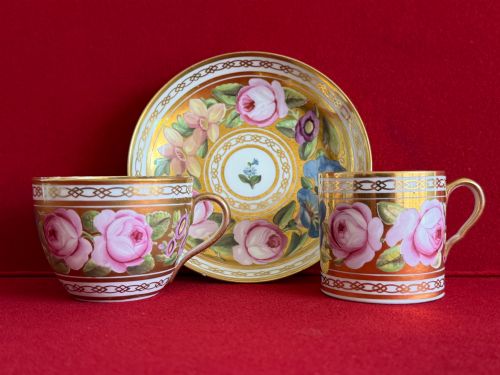
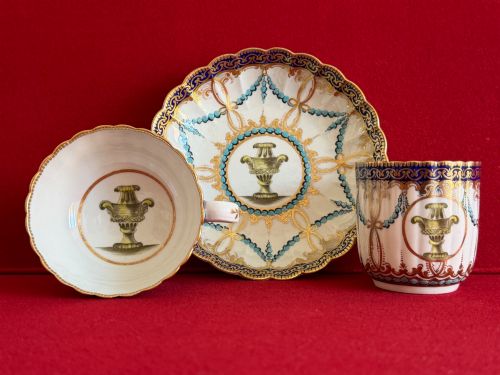
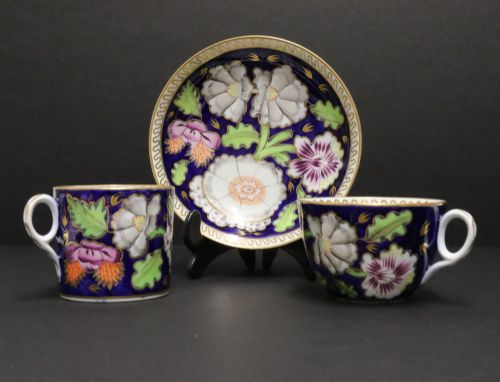

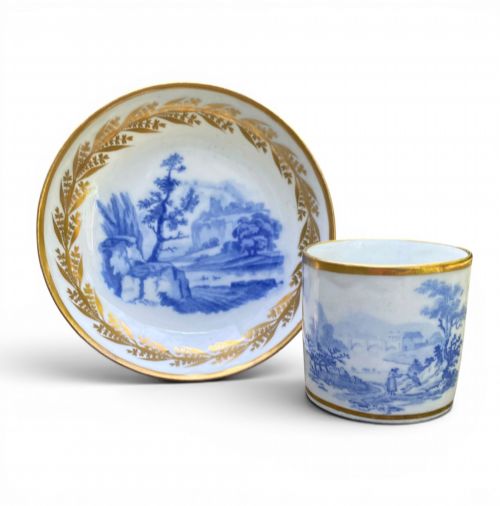


Coffee Can and Saucer
These porcelain coffee can and saucer sets bring the crisp elegance of Georgian and Regency breakfast tables straight to your cabinet.
Coffee Can and Saucer
A coffee can and saucer is a traditional cylindrical cup paired with its matching dish, designed specifically for serving strong morning coffee rather than tea. When buyers search for this phrase, they encounter pieces ranging from early nineteenth-century cabinet trios to cased twentieth-century sets.
The form developed to accommodate the growing popularity of coffee consumption during the Georgian and Regency periods. Most examples found here originate from English factories such as Worcester, New Hall, and Minton.
On this page, buyers are most likely to meet fine porcelain sets decorated with hand-painted motifs, Imari patterns, or rich gilding. The selection spans the Georgian era through to later twentieth-century productions.
Materials and production
Makers shaped these wares primarily from porcelain and bone china, forming delicate walls designed to hold heat while maintaining a light feel in the hand. Some specialist pieces incorporated silver mounts or leatherette casing for presentation.
Decoration relied heavily on meticulous hand-painting, gold leaf application, and gilding. Artisans applied cobalt blue, iron red, and enamel colours before firing the pieces in kilns to achieve durable finishes.
A persistent cow motif nicknamed the Crazy Cow or Bengal Tiger pattern found its way onto early nineteenth-century porcelain cups.
Distinctions in quality
The standard of a coffee can and saucer depends upon the crispness of the porcelain body and the finesse of the painted decoration. Hand-painted fruit or figural scenes by named decorators elevate a piece far above standard transfer-printed wares.
Completeness and preservation also determine the standing of an item. Intact gilding, matching saucers, and original fitted cases separate ordinary utility wares from high-status collector pieces.
Royal Crown Derby·New Hall porcelain·Flight And Barr Worcester·Royal Worcester·Minton
The Coffee Can and Saucer Glossary
- Coffee can
- A straight-sided cylindrical cup without a handle, made for drinking strong coffee. This shape was particularly popular during the Georgian and Regency periods.
- Imari pattern
- A decorative style inspired by Japanese export porcelain, typically featuring a palette of cobalt blue, iron red, and gold leaf. English factories frequently adopted this aesthetic.
- Cabinet trio
- A matching set comprising a coffee can, a teacup, and a saucer designed for display in a cabinet rather than daily use. These often date from the early nineteenth century.
- Demitasse
- A small cup used for serving strong black coffee or espresso. The term translates literally to half-cup in French.
Coffee Can and Saucer: Frequently Asked Questions
Why are the cups straight-sided instead of curved?
Early coffee cans were built with straight cylindrical walls to help retain the heat of strong, dark coffee served after meals.
This distinct shape separates them from traditional curved teacups of the same period.
Were these sets meant for daily use?
Many fine porcelain cans and saucers were produced as cabinet pieces or for wealthy households to use during formal morning routines.
Survivors with heavy gilding or delicate hand-painted fruit were often kept protected rather than used routinely.
How do I identify a Georgian piece?
Georgian coffee cans usually feature unmarked or hand-pencilled factory bases, thin porcelain bodies, and classic Regency or Imari patterns.
They lack the standardised factory backstamps common in later Victorian and twentieth-century production.
What is the difference between a can and a demitasse?
A coffee can specifically refers to the cylindrical shape favoured in the late eighteenth and early nineteenth centuries.
Demitasse is a broader term often applied to twentieth-century small coffee cups and saucers.