
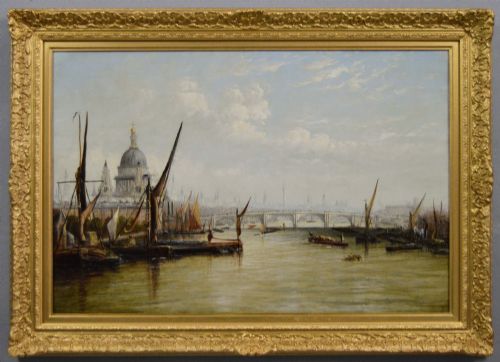
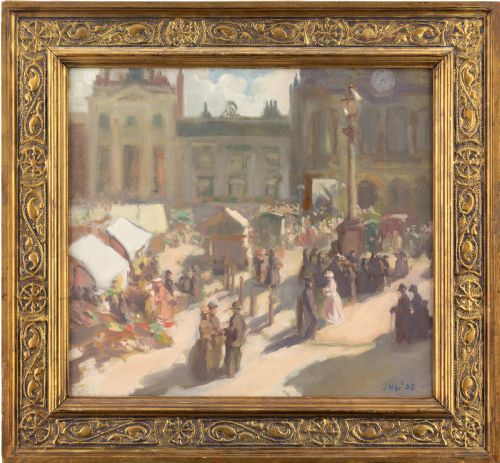


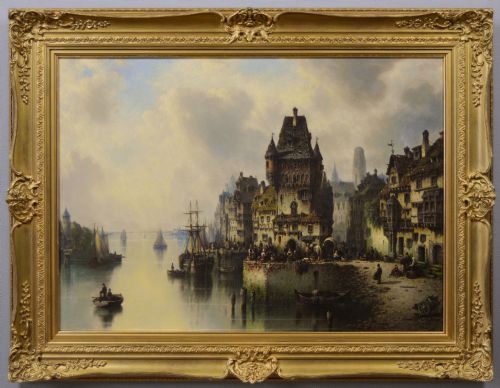


Gilt Framed Townscape Artwork
Gilt framed townscape artwork captures bustling streets and historic harbours through oil paint and watercolour, framed in ornate gold leaf.
Gilt Framed Townscape Artwork
A gilt framed townscape artwork presents urban views, bustling streets, and historic canals captured by 19th-century and early 20th-century painters. Buyers seeking these pieces find oil paintings and watercolours depicting British, Dutch, Venetian, and French locations.
The dominant style on this page is the 19th-century oil painting on canvas or board, housed in a traditional giltwood or gesso frame. Subjects range from London riversides and northern market towns to sunlit Venetian lagoons and continental quaysides.
Works span from the Victorian era into the mid-20th century, offering diverse interpretations of urban architecture and daily life. Each piece brings a specific historic locality into an interior through period artistic techniques.
Materials and construction
Painters used oil paint or watercolour applied to stretched canvas, wooden panels, or paper boards. Canvases are secured within wooden structural supports, whilst watercolours utilise pencil underdrawing.
Frames are constructed from wood, finished with layers of gesso and covered in gold leaf or gilt treatment to create a reflective metallic border. These gilt frames complement the luminous pigments used in the painted scenes.
Listings feature works spanning from 1860 into the mid-20th century, executed in oil and watercolour on canvas, board, and paper.
Factors determining quality
Quality rests in the precision of architectural detail, the handling of light across water or stone, and the skill demonstrated in perspective and composition. Master painters capture the specific atmosphere and scale of a city with confident brushwork.
The integrity and craftsmanship of the surrounding gilt frame also influence the overall standard. Original frames featuring detailed moulding and well-preserved gold leaf enhance the piece significantly.
Francis Moltino·John Hodgson Lobley RBA·Cornelis Christian Dommersen·Alfred Pollentine·Edward Henry Holder·Jane Vivian·Ludwig Hermann·Arthur Joseph Meadows·Henry Schafer·Letitia Marion Hamilton
The Gilt Framed Townscape Artwork Glossary
- Giltwood
- Wood that has been coated with a thin layer of gold leaf or gold paint. This technique gives frames a bright, reflective metallic finish.
- Gesso
- A plaster-like mixture applied to wooden frame bases to create a smooth surface for gilding. It allows craftsmen to carve intricate decorative details.
- Townscape
- A visual representation of an urban landscape, including streets, buildings, bridges, and harbours. These scenes focus on human architecture rather than open nature.
- Canvas
- Heavy woven fabric stretched across a wooden frame to serve as a sturdy painting surface. It provides the primary support for many historical oil works.
Gilt Framed Townscape Artwork: Frequently Asked Questions
What is a gilt framed townscape artwork?
It is a painted or drawn view of an urban setting, city street, or harbour, presented within a gold-leaf or giltwood frame.
These works primarily date from the 19th and early 20th centuries, recording historic European and British locations through the medium of oil or watercolour.
How were these townscapes displayed historically?
Owners typically hung them in principal reception rooms and parlours to demonstrate an appreciation for continental travel and fine art.
The prominent gilt frames were specifically designed to catch candlelight or natural daylight in domestic interiors.
How do I identify the period of a painting?
The period is usually indicated by the costume of the figures, the architectural styles depicted, and the construction methods of the canvas support.
Signatures, artist records, and the style of the wooden gilt frame also provide reliable clues to the date of creation.
How should I care for a gilt frame?
Keep the frame away from direct sunlight and fluctuating moisture levels to prevent the gesso and gold leaf from cracking or flaking.
Dust the gilded surfaces very gently with a dry, soft cloth, avoiding any chemical cleaning products.