

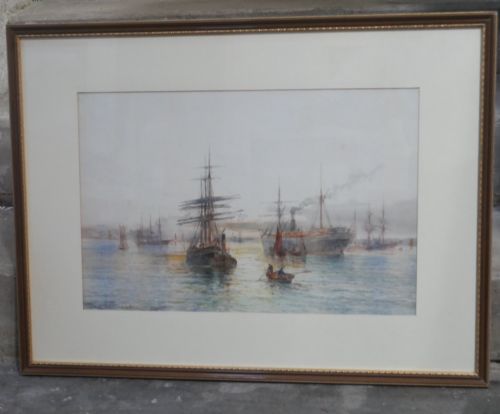
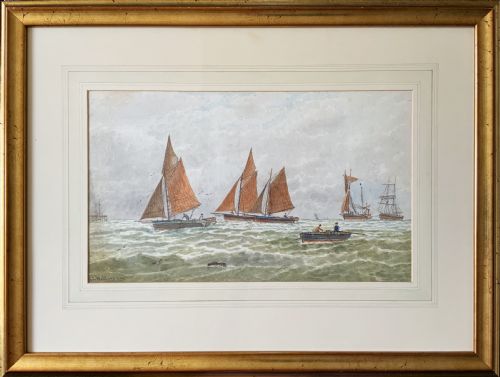
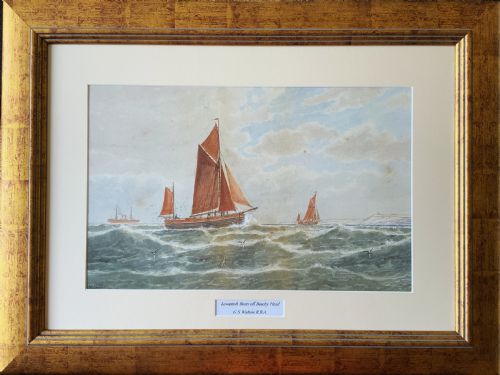


Gilt Framed Maritime Watercolour
A gilt framed maritime watercolour brings nineteenth and twentieth-century coastal scenes, harbours and masted ships into domestic interiors.
Gilt Framed Maritime Watercolour
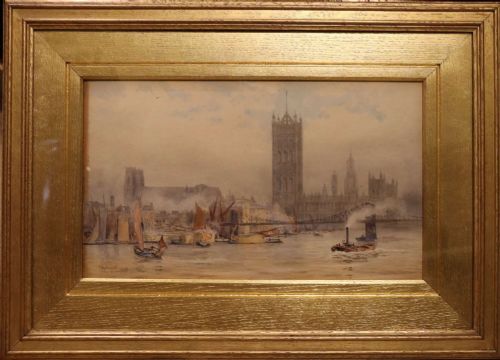
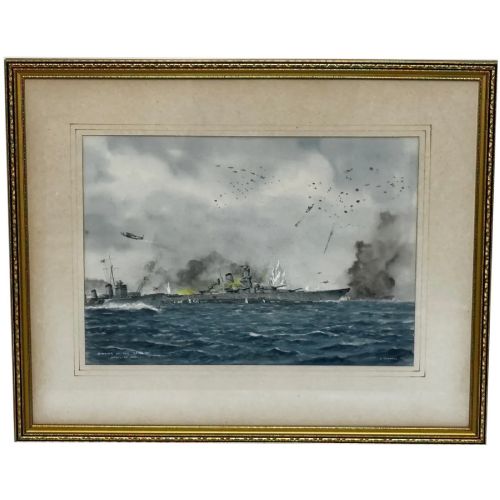
A gilt framed maritime watercolour captures seascapes, harbours, naval vessels and coastal life executed on paper using watercolour pigment and protected by glass. These paintings range from traditional English and Scottish coastal views to bustling scenes along the Thames or foreign canals like Venice.
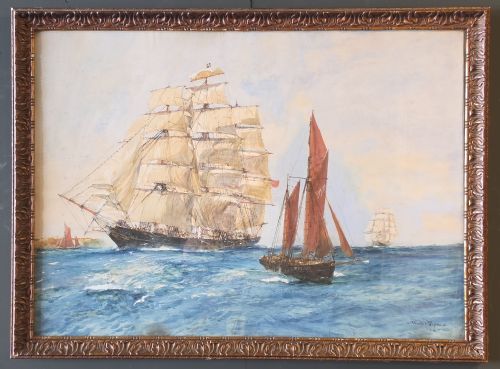
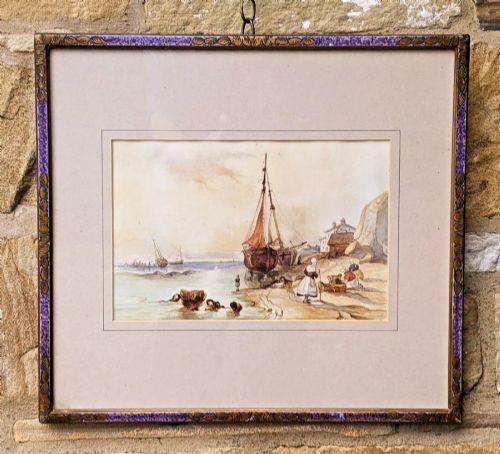
The selections available lean heavily towards Victorian and Edwardian works, alongside pieces stretching into the mid-twentieth century by named and initialled artists. Buyers encounter subjects spanning fishing boats in Cornish harbours, grand clipper ships in choppy seas and quiet moorings.
Most examples come presented in period wooden frames finished with gold leaf or gilt wood, which complement the delicate washes of the paintings within. These works function primarily as wall art and framed paintings suited to traditional domestic settings.
Materials and technique
Artists painted primarily with watercolour pigment upon paper supports, occasionally incorporating gouache for added opacity on highlights or breaking waves. Paper sheets were mounted behind glass to protect the water-soluble pigments from atmospheric moisture and dust.
Frames were constructed from wood and surfaced with gold leaf or gilt wood, frequently featuring hand-enamelled polychrome decoration or moulded profiles characteristic of the nineteenth and early twentieth centuries.
Sailors sometimes painted watercolours during long voyages at sea, using whatever paper and pigments came to hand.
Evaluating quality
Quality rests upon the artist's ability to capture movement in water, light on sails and atmospheric conditions such as mist or stormy skies. Finer works display confident brushwork and precise draughtsmanship in rigging, architecture and vessel construction.
The harmony between the watercolour painting and its gilt frame contributes significantly to the overall merit of the piece. Original frames that match the period of the artwork hold greater visual integrity than later replacements.
H Medlycott·Charles Edward Dixon·Eric Tufnell·William Banks Fortescue·George Stanfield Walters·J Hardy·William Tuck·Fred Waugh·F J Aldridge·Thomas Bush Hardy·John McDougal·Frank Wood·William Knox·Madeline Hughes·Lennard Lewis·WF Mitchell·Samuel John Milton Brown·James Kinnear·J Syer·Markey Robinson·Gordon Meadows·Henry Bright
The Gilt Framed Maritime Watercolour Glossary
- Watercolour
- A painting method in which the paints are made of pigments suspended in a water-based solution. The paper support often remains visible to provide highlights through its white surface.
- Gilt wood
- Wood coated with a thin layer of gold leaf, gold paint or metal powder. This finish adds reflective warmth around the framed artwork.
- Gouache
- An opaque water-based paint often used alongside watercolour to create dense highlights on sea foam or clouds. It provides solid areas of colour that contrast with translucent washes.
- Barque
- A sailing vessel with three or more masts having the fore and mainmasts square-rigged and the mizzenmast fore-and-aft rigged. This specific rig appears frequently in maritime art.
- Seascape
- A painting depicting the sea, coastal views, ships or maritime activity. These subjects formed a major category of British fine art through the Victorian and Edwardian eras.
Gilt Framed Maritime Watercolour: Frequently Asked Questions
How should I hang maritime watercolours?
Hang these watercolours away from direct sunlight to prevent the pigments and paper from fading over time. Stable indoor humidity levels also protect both the paper support and the gilt wooden frame.
Keep them at eye level in rooms with minimal moisture fluctuations, such as studies or living rooms, rather than kitchens or damp hallways.
Are these paintings original works?
The pieces listed are original hand-painted watercolours rather than modern prints or reproductions. Each work contains the individual brushstrokes and pigment variations of the artist.
Signatures, dates and inscriptions found on many of the sheets confirm their status as unique period artworks.
How do I identify Victorian watercolours?
Victorian watercolours often feature subject matter focused on British coastal trade, fishing fleets and naval vessels executed with detailed realism. The paper stocks, framing styles and artist signatures usually align with nineteenth-century production methods.
Many works also carry period framing or inscriptions on the reverse that help date the painting accurately.
What is the difference between watercolour and gouache?
Watercolour relies on translucent washes where the white paper shows through to create light and luminosity. Gouache includes an added white pigment filler that makes the paint opaque.
Artists frequently combined both mediums in maritime scenes to depict translucent sea water alongside solid highlights on sails and foam.