
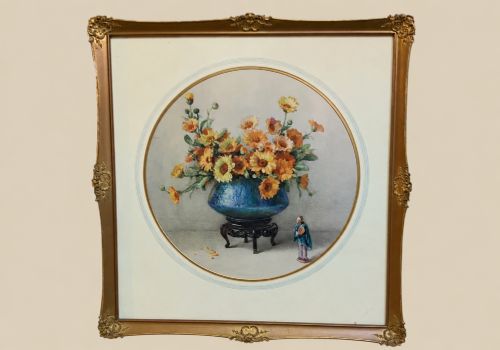
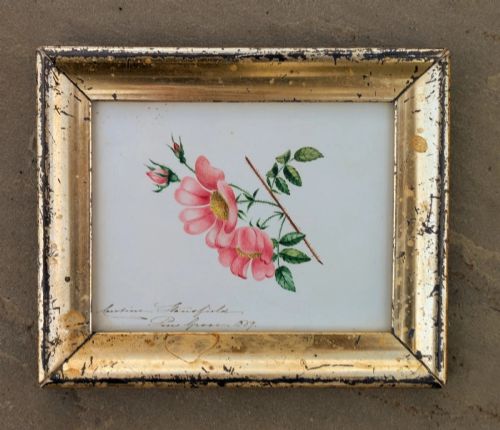
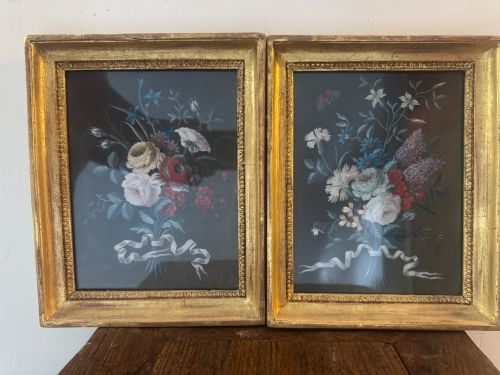
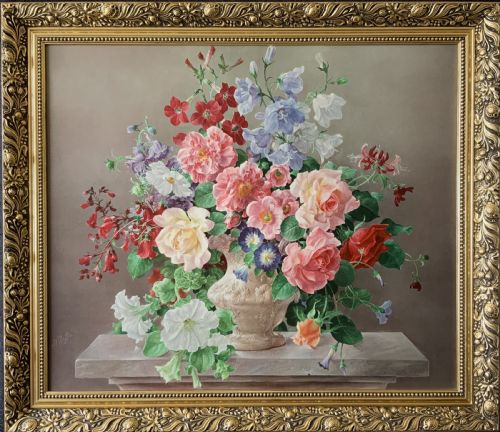
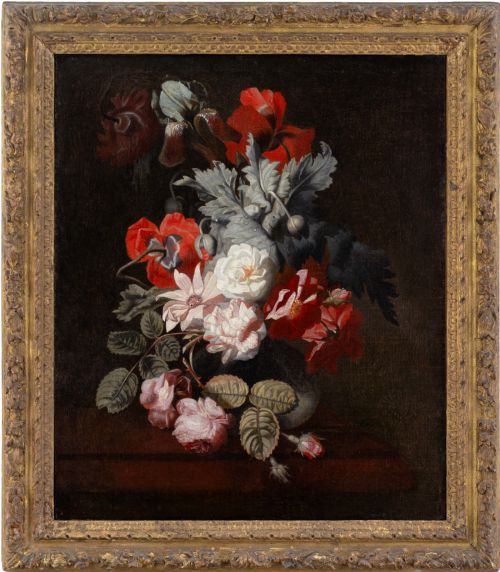


Gilt Framed Floral Print
These gilt framed floral print examples bring together botanical subjects and rich metallic moulding, offering an immediate decorative focal point for any interior scheme.
Gilt Framed Floral Print
When searching for a gilt framed floral print, a buyer encounters a diverse selection of wall art encompassing watercolours, gouache studies, oils on board, and various print mediums from multiple centuries. The botanical subject matter ranges from still life arrangements of marigolds and wild roses to mixed media garden scenes and decorative tile designs.
The pieces on this page span several distinct periods, including the seventeenth century, the eighteenth century, the nineteenth century, the Edwardian era, and mid-twentieth century works. These artworks are presented in frames constructed from wood, gilt wood, and gesso, often finished with gold leaf.
Stylistically, the selection incorporates Victorian pieces, Dutch Golden Age influences, Neoclassical compositions, Italian School paintings, and Impressionist interpretations. Buyers will frequently find individual works as well as matched pairs suitable for symmetrical wall placement.
How they were made
The underlying works are executed on paper, board, or canvas using mediums such as watercolour, gouache, oil paint, lithography, and oleograph printing. Hand-painted fruit pictures and botanical studies demonstrate traditional brushwork, while print examples utilise period reproduction techniques.
The enclosing frames are constructed primarily from wood and finished with carved gesso or applied gold leaf to achieve the characteristic gilt appearance. This combination of traditional painting supports and gilded wooden moulding protects the artwork while providing a substantial decorative border.
Listings feature works spanning from the seventeenth century through to the mid-twentieth century, utilising paper, canvas, and wood panels.
What varies in quality
Quality in these artworks is determined by the finesse of the artist's brushwork, the depth of the colour palette, and the fidelity of the botanical detail in subjects such as flowers and fruit. Finer pieces demonstrate careful observation of light and texture in their still life arrangements.
The framing contributes significantly to the overall standard, with hand-gilded wood and intricate gesso mouldings representing a higher tier of craftsmanship than simpler wooden frames. The integration between the age of the artwork and the character of its housing defines the appeal of the piece.
Simon Pietersz Verelst·Harold Clayton·Charles Burton Barber·Jane Utley
The Gilt Framed Floral Print Glossary
- Gouache
- An opaque water-based paint that produces brighter, more solid colour fields than traditional watercolour. It is frequently used in botanical still life studies for its density.
- Gesso
- A plaster-like mixture applied to wood frames before gilding to create a smooth surface for intricate moulding and detail work. It provides the foundation for gold leaf application.
- Oleograph
- A type of chromolithographic print textured to imitate the surface and brushstrokes of an oil painting. These appeared in the nineteenth and twentieth centuries as popular wall art.
- Still life
- An artwork depicting inanimate subject matter, typically featuring flowers, fruit, and domestic objects arranged on a surface. This genre allows artists to focus on light, colour, and composition.
Gilt Framed Floral Print: Frequently Asked Questions
How do I date a gilt framed floral print?
Dating relies on examining the framing materials, the paper or board support, and the artistic style visible in the subject matter. Nineteenth-century pieces often feature distinct gesso moulding techniques and specific paper weights.
Comparing the painting style to known period works and checking any signatures or inscriptions on the reverse helps narrow down the decade of production.
Are these works hand painted or printed?
The selection includes both original hand-painted works in watercolour, gouache, and oil, alongside historical print mediums such as lithographs and oleographs. Close inspection under magnification reveals whether pigment sits on the paper or if a dot matrix print pattern is present.
Descriptions specify the exact medium used, distinguishing unique artistic creations from period reproduction prints.
How should I hang and light these pieces?
Gilt frames and botanical watercolours or oils benefit from placement away from direct sunlight to prevent fading of the pigments and degradation of the paper. Adequate wall space allows the gilded moulding to catch ambient light effectively.
Picture lights or adjustable wall sconces can highlight the texture of the gold leaf and the details of the floral subject matter without generating excessive heat.
Can I find matching pairs of artwork?
This page frequently includes matched pairs of paintings, prints, or gouache studies created as companion pieces. These sets share identical framing, scale, and complementary botanical subjects.
Pairs are suited for symmetrical arrangement above furniture mantels, sideboards, or along hallway walls.