
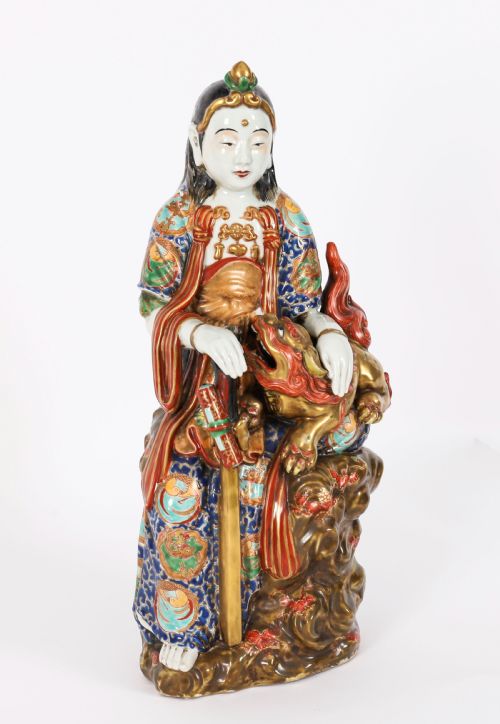


Gilt Ceramic Sculpture
These gilt ceramic sculpture pieces unite modelled clay with lustrous metal application, offering collectors tangible fragments of historical craftsmanship.
Gilt Ceramic Sculpture
A gilt ceramic sculpture brings together moulded clay forms and metallic highlights, encompassing figurative works from eighteenth-century European factories and nineteenth-century Japanese workshops alike. When exploring gilt ceramic sculpture, one encounters everything from classical deities and allegorical groups to detailed animal okimono and portrait busts.
The objects appearing on this page span several centuries, drawing heavily from periods such as the eighteenth century, the Victorian era, and the early twentieth century. European hard-paste porcelain and earthenware sit alongside Japanese Kutani and Satsuma wares, demonstrating diverse regional approaches to gilding three-dimensional forms.
Figurines and sculptural groups dominate the selection, often depicting mythological figures, street traders, or pastoral scenes enhanced by gold leaf or enamel accents. Buyers most frequently meet continental European salon figures and British porcelain works carrying hand-painted gilt highlights upon biscuit or glazed surfaces.
Materials and methods of creation
Makers shaped these pieces using soft-paste porcelain, hard-paste porcelain, earthenware, or unglazed bisque, relying on moulds or hand-modelling before initial kiln firing. Once formed, artisans applied mineral colours and enamels to the ceramic body, often firing the piece multiple times to fix the pigments securely.
Gilding was applied using gold leaf or powdered gold suspended in a medium, which required a final low-temperature firing or burnishing to achieve a brilliant metallic finish. This meticulous application of gold accentuates sculptural contours, highlighting drapery, hair, and decorative borders on figures and centrepieces.
Listings feature hard-paste porcelain, earthenware, and bisque porcelain from the eighteenth to the early twentieth century.
Distinctions in craftsmanship and preservation
The standard of modelling defines the upper tier of these works, where facial expressions remain sharp and anatomical details are rendered with precision rather than broad simplification. Superior pieces exhibit crisp definition in the moulded clay before any decoration is applied, ensuring the underlying sculpture holds strong artistic merit.
The preservation of the gilding and enamel painting dictates much of the physical merit, as rubbed gold or flaking enamels diminish the visual impact of the piece. Exemplary works retain their original burnished highlights intact, showing minimal loss to the metallic leaf or hand-painted details across centuries of handling.
Meissen·Royal Worcester·Derby·Makuzu Kozan II·Ernst Wahliss·Volkstedt·Royal Dux
The Gilt Ceramic Sculpture Glossary
- Bisque porcelain
- Unglazed ceramic fired once to create a matte, porous white surface resembling marble. This finish was favoured for classical busts and detailed portrait figures.
- Okimono
- Japanese decorative sculpture designed for display on a shelf or in a tokonoma alcove. These pieces frequently depict animals, deities, or historical figures with intricate surface detailing.
- Hard-paste porcelain
- A dense, vitrified ceramic composed of kaolin and petuntse, fired at very high temperatures. It provides a durable body that resists scratching and supports fine enamel painting.
- Gilding
- The application of gold leaf, powder, or liquid gold to a surface for decorative effect. On ceramics, it is typically fired onto the glaze to ensure permanent adherence.
- Earthenware
- Porous pottery fired at lower temperatures than porcelain, requiring a glaze to achieve impermeability. Art Nouveau and later makers often utilised this body for sculptural vases and figures.
Gilt Ceramic Sculpture: Frequently Asked Questions
What is the difference between bisque and glazed porcelain?
Bisque porcelain is fired without a glassy coating, leaving a matte, porous finish that absorbs light and resembles carved marble. Glazed porcelain receives a liquid glass coating prior to its final high-temperature firing, producing a shiny, impervious surface.
While glazed pieces resist staining and clean more easily, bisque offers a finer texture for capturing subtle facial expressions and anatomical details. Both finishes frequently incorporate gilt highlights to accentuate specific sculptural elements.
How do I identify a Meissen figure?
Meissen porcelain figures often bear the underglaze blue crossed swords mark on the base, a symbol utilised by the German factory for centuries. The modelling typically displays exceptional anatomical precision, dynamic composition, and refined eighteenth or nineteenth-century styling.
Examine the quality of the hand-painted enamels and the crispness of the porcelain paste beneath the glaze. Genuine pieces demonstrate sophisticated sculptural weight and sophisticated handling of gilt highlights.
Where were Satsuma wares made?
Satsuma ceramics originated in Satsuma Province on the southern Japanese island of Kyushu, later expanding production to urban centres like Kyoto. These earthenware pieces are distinguished by a fine crackle glaze overlaid with intricate polychrome enamel designs and heavy gold leaf.
Collectors prize Satsuma works for their detailed narrative scenes and decorative motifs executed during the Meiji period. The combination of ivory-toned crackled glaze and rich gilding creates a distinct visual texture.