
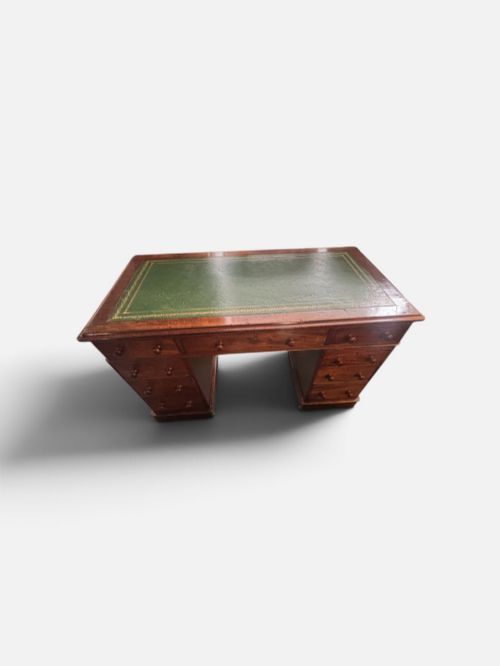
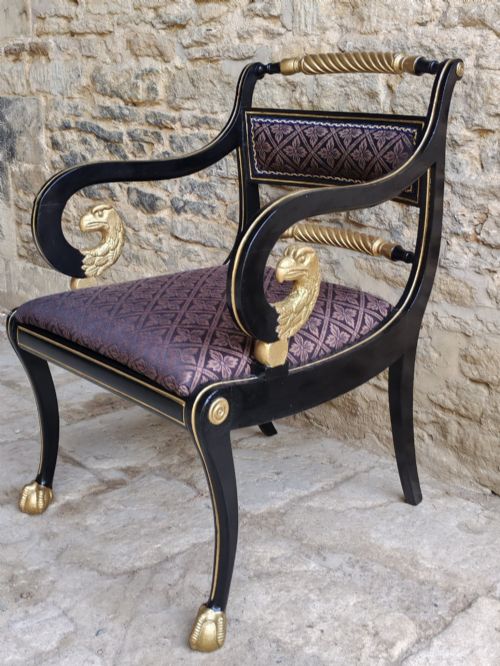
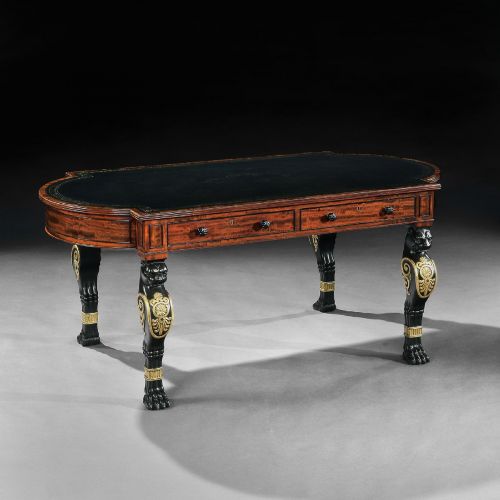
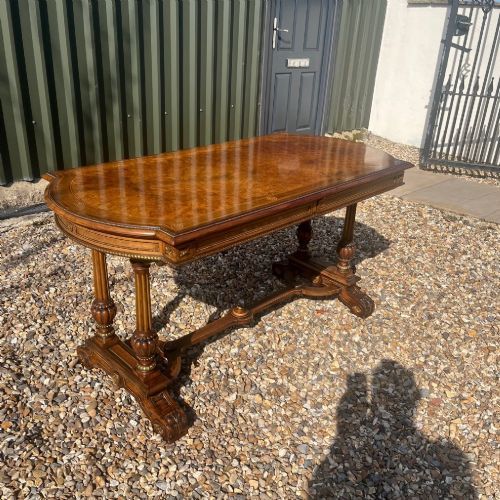


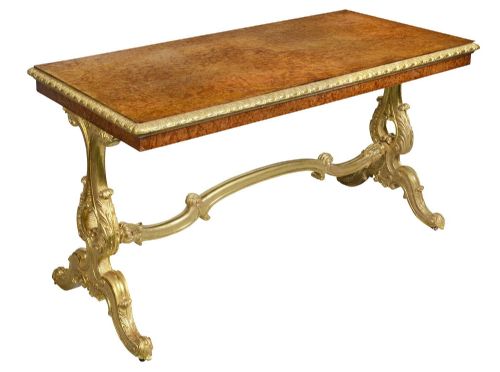


Gilt Carved Library Desk
These gilt carved library desk examples combine rich timber frames with metallic leaf work to anchor a grand study.
Gilt Carved Library Desk
A gilt carved library desk provides a dedicated writing surface defined by carved wooden structures highlighted with gold leaf or ormolu mounts. The items found here span the Regency and Victorian periods, showing the evolution of classical revival tastes in study furniture.
Most examples take the form of writing tables, partners tables, or bureau plat styles designed to sit centrally within a room. Mahogany, walnut, and burr walnut form the primary timber bodies, often fitted with inset leather writing surfaces.
Makers drew heavily on French and English design vocabularies, producing pieces that range from restrained Regency lines to elaborate Victorian Rococo revival and Empire revival forms.
Materials and construction methods
Cabinet makers utilised dense hardwoods such as mahogany and walnut, frequently selecting burr veneers for decorative surfaces on writing tables and centre tables. These timber carcasses were constructed with traditional joinery to support the weight of marble tops or leather-lined writing areas.
Gilt decoration was applied using parcel-gilt techniques directly onto carved wood, or by mounting cast ormolu bronze details onto the frame. Ebonised wood often served as a contrasting dark ground to enhance the brightness of the gilt work.
Listings feature Victorian, Regency, and 1880 periods with materials including leather, mahogany, ormolu, and burr walnut.
Assessing quality and craftsmanship
Quality reveals itself in the crispness of the wood carving and the precision with which ormolu mounts are fitted to the timber carcass. Superior pieces display hand-chiselled detailing on metal components rather than mass-produced cast uniformity.
The choice of secondary woods and the depth of figure in burr walnut or mahogany veneers indicate the tier of the workshop. Master makers ensured that structural stability matched the decorative ambition of the exterior design.
Holland + Son·Henry Dasson·George Smith
The Gilt Carved Library Desk Glossary
- Bureau plat
- A freestanding French writing table typically featuring multiple drawers and a leather inset top. This form gained popularity during the eighteenth century and inspired nineteenth-century revival pieces.
- Ormolu
- Gilded bronze mounts applied to furniture for decorative effect. The technique involves creating an amalgam of mercury and gold applied to a bronze base.
- Parcel-gilt
- A method where only specific carved details or highlights of an object are gilded while the remaining timber surface stays exposed. This creates a controlled contrast between the wood grain and the gold leaf.
- Partners table
- A large desk designed with drawers on both long sides, allowing two people to work opposite one another. These pieces often feature leather-lined tops and substantial pedestal or table bases.
Gilt Carved Library Desk: Frequently Asked Questions
What is a gilt carved library desk?
A gilt carved library desk is a wooden writing table embellished with gold leaf carving or metallic mounts, built during the nineteenth century for formal studies.
These pieces function as centre tables or writing desks, combining practical work surfaces with ornamental luxury.
How do I care for leather top desks?
Leather top writing surfaces require gentle cleaning with a dry cloth and occasional treatment with appropriate leather dressings to prevent cracking.
Keep these desks away from direct sunlight and heat sources to preserve both the leather and the surrounding timber finish.
How do I distinguish Regency from Victorian styles?
Regency pieces generally exhibit cleaner architectural lines influenced by classical antiquity, whereas Victorian designs tend towards heavier proportions and exuberant revival ornament.
Examining the specific carving motifs and secondary woods helps clarify the period of manufacture.
Were these desks meant to stand against walls?
Many library tables and bureau plat examples were constructed to stand in the centre of a room, featuring finished backs and all-round decoration.
Partners tables specifically allow access from multiple sides, making them ideal for central room placements.