

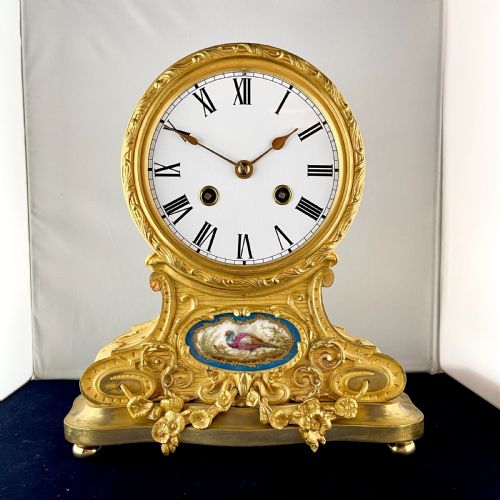


Gilt Bronze Timekeeper
These gilt bronze timekeepers combine metalwork and clockmaking, offering a striking centrepiece for any room.
Gilt Bronze Timekeeper
A gilt bronze timekeeper brings together architectural presence and precise clockwork, taking the form of mantel clocks and carriage clocks across this selection. These objects draw from a range of periods including the Regency and Victorian eras, alongside continental movements from the nineteenth century.
Most examples lean towards French revival aesthetics, featuring styles such as Louis XVI, French Rococo, and Gothic Revival. Buyers will encounter substantial architectural mantel clocks alongside smaller corniche-cased carriage clocks designed for travel or intimate display.
How they were made
Internal engineering matches the exterior ambition, utilising 8-day striking mechanisms and specialised components like silk suspension systems or chain fusee movements. Surfaces are frequently finished with profuse hand engraving and figural ornamentation including cherubs, doves, and maidens.
Gilt Bronze Timekeeper Retail Price Guide 2026
Typical asking prices for gilt bronze timekeeper among the pieces listed under this phrase on Sellingantiques today, from the lower quarter to the upper quarter. They describe what is for sale here now, not the wider market.
The listings here feature both English Regency examples and French nineteenth-century mantel clocks incorporating gilt bronze, ormolu, and patinated bronze.
What varies in quality
The distinction between standard and superior pieces rests on the depth of the metalwork and the crispness of the chasing. Exceptional examples display deeply cut engraving across all sides and finely modelled figural details rather than soft, mass-produced casting.
Movement sophistication also dictates the hierarchy of quality, with complex mechanisms like chain fusee movements or silk suspensions commanding greater appreciation than standard striking trains. Furthermore, the integrity of the original ormolu and the inclusion of undamaged enamel dials elevate a timekeeper's standing.
FB Adams London
The Gilt Bronze Timekeeper Glossary
- Ormolu
- Gilded bronze produced by applying a mercury and gold amalgam to a bronze base and heating it. This technique creates a durable, golden surface finish characteristic of fine nineteenth-century French metalwork.
- Chain fusee movement
- A conical pulley paired with a delicate chain that equalises the declining power of the mainspring as it unwinds. This mechanism ensures consistent timekeeping accuracy.
- Silk suspension
- A method of hanging the pendulum from a short loop of woven silk thread rather than a metal spring. It is typically found in earlier nineteenth-century clocks.
- Corniche case
- A rectangular brass or gilt bronze carriage clock housing characterised by rounded or stepped pillars at the corners and bevelled glass panels. The design originated in France during the nineteenth century.
- Drumhead mantel clock
- A timepiece featuring a circular clock case mounted atop a plinth or base. The name derives from its resemblance to the head of a drum.
Gilt Bronze Timekeeper: Frequently Asked Questions
How do I wind my gilt bronze timekeeper?
Most of these clocks use a key inserted into the dial to wind the spring barrels for the time and striking trains. Care must be taken not to overwind the mechanism.
Consult the specific movement type before adjusting the hands, as moving them backwards on certain striking trains can damage the internal rack.
Where should I place a heavy bronze mantel clock?
These timekeepers require a stable, level surface such as a sturdy mantelpiece or a heavy console table to function correctly. A flat foundation ensures the pendulum swings evenly.
Keep the clock away from direct sunlight and damp environments to protect the delicate gilt bronze surfaces and enamel dials.
How do I tell a Regency clock from a Victorian piece?
Regency timekeepers often display restrained neoclassical proportions and specialised mechanisms like chain fusee movements associated with English makers. Victorian and later nineteenth-century pieces frequently embrace French revival styles with ornate cast figures.
Examine the overall architectural vocabulary and the style of the dial to determine the likely period of manufacture.
What is the difference between a carriage clock and a mantel clock?
Carriage clocks are compact, portable timekeepers housed in brass or gilt bronze frames with glass panels and a swinging handle on top. They were originally built for travel.
Mantel clocks are larger, heavier stationary objects designed to sit permanently on a shelf or fireplace surround as decorative furniture.