




Architectural Brass Mantel Clock
An architectural brass mantel clock brings disciplined classical structure and precise mechanics into a room.
Architectural Brass Mantel Clock
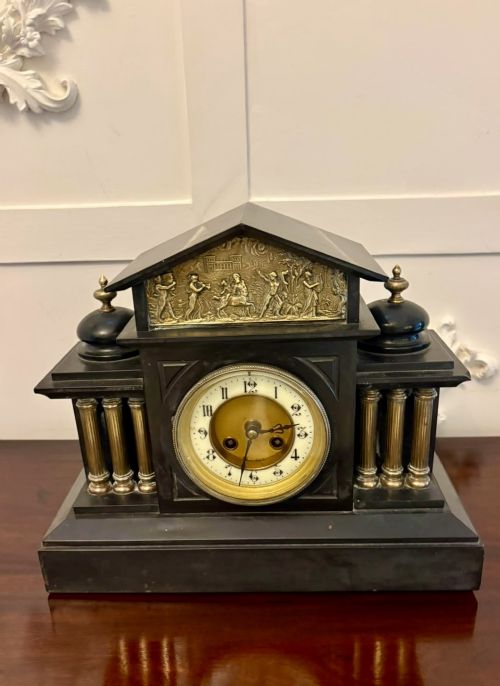
When you examine an architectural brass mantel clock, you are looking at timepieces built to mimic the facades of temples, porticos, and grand public buildings. These works draw heavily from Victorian, Neoclassical, and French Classical Revival design traditions, often housing eight-day movements.
The versions you are most likely to encounter here date from the nineteenth century, particularly the decades around eighteen-sixty to eighteen-eighty. They frequently combine heavy stone bodies with metal dial surrounds and cast architectural details.
Makers ranged from provincial English retailers to notable London and Paris houses. Many examples incorporate columns, pediments, and glass panels that reveal the swinging pendulum and brass gear train within.
Materials and construction
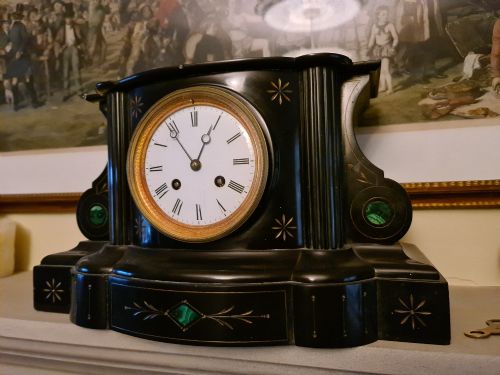
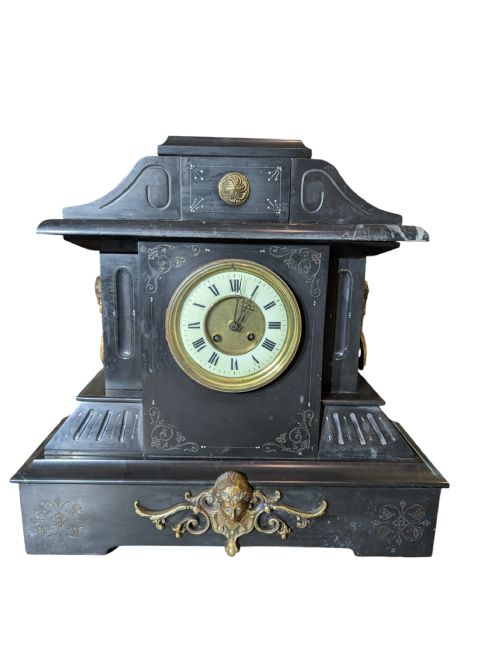
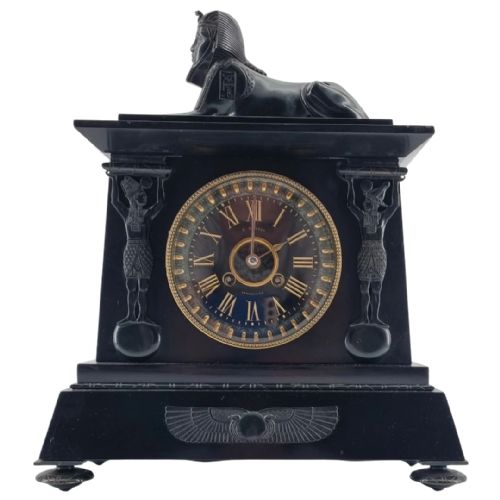
Makers built the heavy structural housings from black slate, marble, or mahogany, applying brass, ormolu, and gilt bronze for columns, bezels, and decorative mounts. Dial faces typically feature white enamel with Roman numerals, protected behind bevelled glass.
The mechanical movements rely on brass plates, steel pivots, and bronze gears, frequently driven by twin-train eight-day springs or fusee mechanisms. Cabinetmakers and metalworkers joined stone and metal components using threaded brass pins and concealed screws.
Several examples include rolling ball mechanisms and perpetual calendars to ensure your mantelpiece stays accurate through every leap year.
Evaluating the pieces
Quality rests in the crispness of the cast brass ornaments and the architectural precision of the stone housing. Finer examples feature substantial marble or slate bodies with deeply cut mouldings rather than simple painted finishes.
The caliber of the movement dictates the upper tier of the range, with signed French or London escapements separating standard production pieces from workshop masterpieces.
Philippes Paris·Baby and Jannings·D. Munsey of Cambridge·Fatton Eleve De Breguet London·Thwaites and Reed·Benson Ludgate Hill
The Architectural Brass Mantel Clock Glossary
- Portico clock
- A distinct style featuring a tall, slender case supported by side columns, typically housing a suspended pendulum in the open central space.
- Ormolu
- Gilded bronze used for decorative mounts and architectural highlights, common in French nineteenth-century design.
- Fusee
- A conical pulley used in clock movements to maintain equal driving force as the mainspring unwinds.
- Garniture
- A set comprising a central clock accompanied by matching side ornaments such as urns or vases.
- Bezel
- The metal ring that holds the glass face protecting the dial and hands.
Architectural Brass Mantel Clock: Frequently Asked Questions
How do these clocks work?
Most pieces utilise an eight-day spring-driven movement requiring a key wind every week. The internal gear train drives the hands while a pendulum or balance wheel regulates the beat.
Heavier models employ rack strikes to sound the hours and half-hours on a bell or gong. Setting them up requires placing the heavy stone case on a stable, level mantelpiece.
Where were they displayed?
Victorian households placed these timepieces centrally on drawing room mantelpieces above the fireplace. Their architectural presence commanded attention in formal reception rooms and libraries.
Smaller versions found homes on writing desks and side tables where their mechanical movement could be observed up close.
How do I date an architectural clock?
Dating relies on stylistic clues, materials, and maker signatures inscribed on the brass movement backplate or enamel dial. Victorian and Neoclassical design vocabularies shifted across the nineteenth century from severe classical porticos to heavier marble garnitures.
Examining the escapement type and winding holes often narrows the decade of manufacture.
What is a clock garniture?
A garniture is a matching set consisting of a central mantel clock flanked by two decorative side pieces, such as urns or obelisks. Makers produced these sets from identical blocks of marble or slate to create a balanced display.
They were designed specifically to fill large nineteenth-century fireplace mantels as a unified decorative scheme.