


Gilt Bronze Onyx Urns
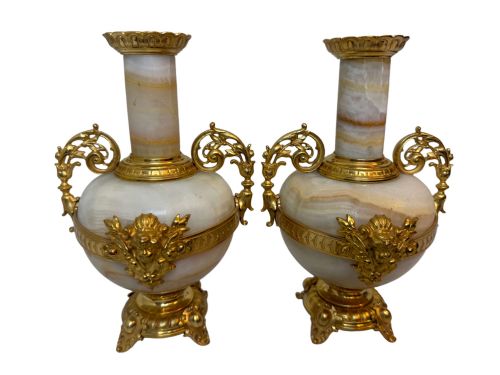
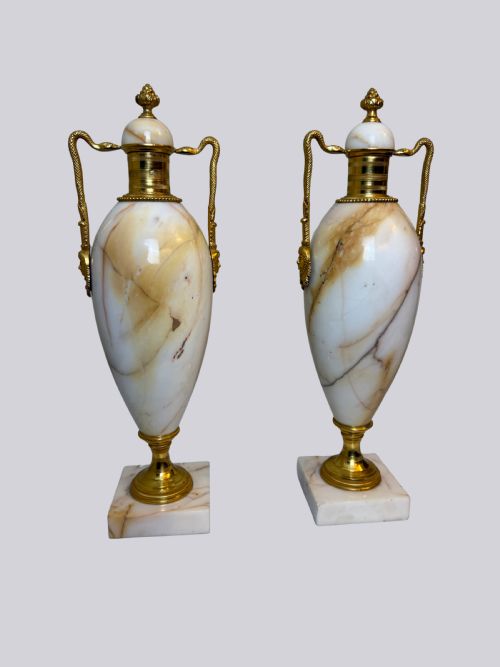
These gilt bronze onyx urns bring the heavy weight of nineteenth-century French metalwork and stone into a room.
Gilt Bronze Onyx Urns
When you search for gilt bronze onyx urns, you encounter decorative objects, table lamps, and clock sets from the nineteenth century. These pieces combine carved stone bodies with cast metal mounts, often arriving as matched pairs.
The versions you are most likely to meet on this page hail from France, spanning periods from the Victorian era through the early twentieth century. They draw heavily on Neoclassical and Louis XVI revival vocabulary.
Forms range from simple decorative vessels to functional cassolettes that convert from lidded urns to candleholders. Centrepiece bowls and garniture sets also appear within the selection, maintaining the same material palette.
How they were made
Maker's workshops built these objects using carved green or white onyx and marble for the main bodies. Craftsmen then fitted these stone elements with cast gilt bronze, orormolu, and occasionally brass.
Detailing often included champleve enamel work applied to the metal mounts. Bronze components were cast, chased, and gilded to contrast with the polished surfaces of the natural stone.
Listings feature items spanning from 1880 to 1910, encompassing Victorian and Belle Epoque periods.
What varies in quality
Quality rests upon the crispness of the bronze chasing and the depth of the gilding. Finer examples display sharp definition in the cast foliage, cherubs, and classical motifs.
The selection of the stone itself dictates the upper tier of the range. Uniformity of the onyx veining and precision in the stonemason's turning separate standard production from superior pieces.
The Gilt Bronze Onyx Urns Glossary
- Gilt bronze
- Metal coated with a thin layer of gold. It provides a bright, durable finish for decorative mounts.
- Onyx
- A banded variety of chalcedony or calcite used for the bodies of these vessels. It offers a smooth, translucent stone surface.
- Cassolette
- A dual-purpose vessel with a reversible lid. It functions as a closed urn or turns over to act as a candleholder.
- Champleve
- An enamelling technique where troughs are sunk into the metal surface and filled with enamel. The piece is then fired and polished flat.
- Ormolu
- A metallic alloy used to simulate gold. It serves as a synonym for gilt bronze in French decorative arts.
Gilt Bronze Onyx Urns: Frequently Asked Questions
What are gilt bronze onyx urns?
These items are nineteenth-century decorative vessels made from carved stone and cast metal. They reflect French revival styles popular during the Victorian period.
They function purely as ornamental objects or occasionally incorporate lighting and clock movements. Their design borrows heavily from classical antiquity.
How were cassolettes used?
Cassolettes served a dual purpose in nineteenth-century interiors. Their reversible lids allowed them to switch between decorative urns and candleholders.
Owners placed them on mantelpieces or as centrepieces on dining tables. They were lit during evening gatherings to add illumination and display the metalwork.
How do I identify French nineteenth-century pieces?
Identification relies on observing the combination of materials, such as green or white onyx paired with chased gilt bronze. The decorative motifs typically follow Neoclassical or Louis XVI revival patterns.
Proportions remain balanced, and the casting quality of the mounts reflects nineteenth-century foundry standards. Many sets include clock garnitures or matching pairs of vases.
Where should I place an onyx urn?
These pieces suit prominent surfaces where their weight and height can be appreciated. Mantelpieces, entrance hall consoles, and large sideboards provide stable foundations.
Keep them away from direct sunlight to protect the stone and metal finishes. Ensure the furniture underneath can support the considerable weight of stone and bronze.