






Gilt Bronze Mounted Gueridon
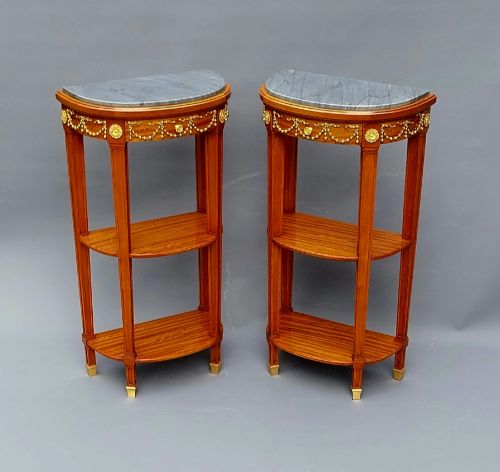
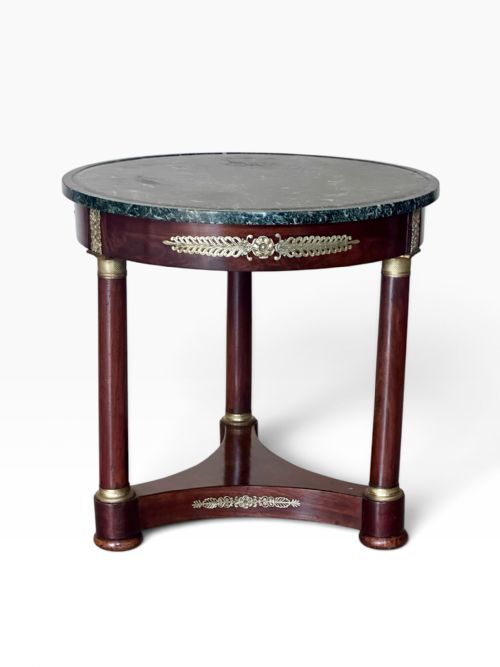
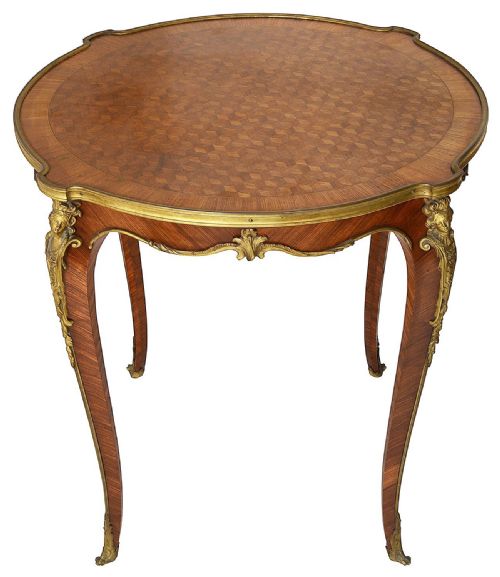
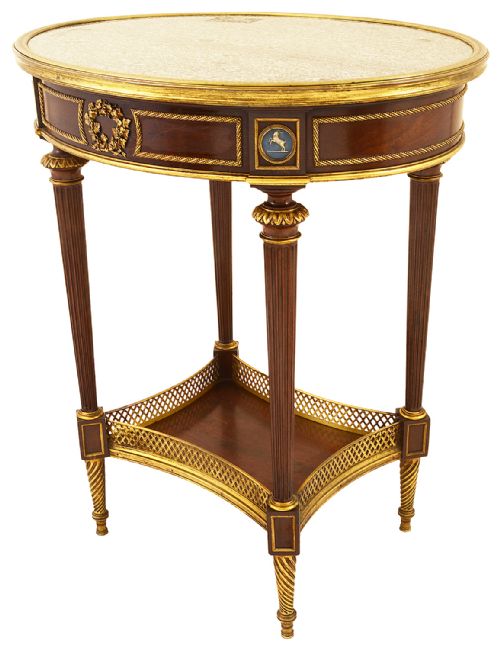
A gilt bronze mounted gueridon brings neoclassical presence to a room, offering a round marble top raised on slender legs.
Gilt Bronze Mounted Gueridon
A gilt bronze mounted gueridon is a round occasional or centre table, frequently topped with marble and supported by timber frames. These tables appear in styles such as French Empire, Louis XVI Revival, and French Rococo Revival.
The material palette spans mahogany, kingwood, walnut, and burr elm, paired with cast bronze, ormolu, and gilded brass. Side tables, lamp tables, and tall jardiniere stands sit alongside the traditional pedestal forms.
Most pieces seen here date from the nineteenth century, including specific periods like the Restauration and Napoléon III. The form serves as a functional surface for lamps or wine while displaying decorative mounts.
What varies in quality
Quality rests upon the crispness of the bronze and ormolu casting, where sharper chiselling and deeper relief separate finer workshops from standard production. The weight and selection of the marble top also dictate the standing of the piece.
Joinery execution in the timber frame and the precision of parquetry or marquetry veneers determine structural integrity and visual depth. Pieces associated with notable makers demonstrate superior finish in both metalwork and wood.
Materials recorded across the inventory include marble, ormolu, mahogany, kingwood, gilt bronze, brass, walnut, and burr elm.
Francois Linke·Zwiener Jansen Sucesseur·Henry Dasson·Weisweller
The Gilt Bronze Mounted Gueridon Glossary
- Gueridon
- A small round table or stand, originally used for holding a light source or decorative object. The form evolved through various French revival styles during the nineteenth century.
- Ormolu
- Gilded bronze used extensively for decorative mounts on furniture. The technique involves applying a gold amalgam to a bronze base and heating it.
- Marquetry
- Inlaid wood designs forming pictorial or geometric patterns on furniture surfaces. Craftsmen used contrasting veneers to create visual depth.
- Parquetry
- Geometric wood inlay patterns such as cubes or chequers. This technique decorates table tops and friezes.
- Restauration
- A French decorative period spanning the early nineteenth century. Furniture from this era often combines restrained classical lines with rich timbers.
Gilt Bronze Mounted Gueridon: Frequently Asked Questions
What is a gueridon table used for?
A gueridon serves as an occasional table, lamp table, or centrepiece in a room. Its round top provides a compact surface for display.
Historically, these tables held lighting or decorative objects. Today, they function well beside seating or as freestanding accent pieces.
How do I identify a nineteenth century piece?
Nineteenth-century examples often draw on French Empire, Louis XVI, or Rococo revival styles. They utilise timbers like mahogany and kingwood combined with cast ormolu.
Construction methods and timber ageing help distinguish these nineteenth-century interpretations from later reproductions.
Are marble tops original to these tables?
Marble tops are a standard feature on many nineteenth-century examples. They sit flush within the wooden frame to support lamps and decorative items.
The stone type and fit against the bronze mounts indicate the integrity of the piece.
What is the difference between ormolu and gilt bronze?
Ormolu specifically refers to mercury gilding on bronze, a technique common in historical French furniture. Gilt bronze is a broader term for bronze treated with a gold-coloured finish.
Both materials provide the bright metallic mounts characteristic of these tables.