
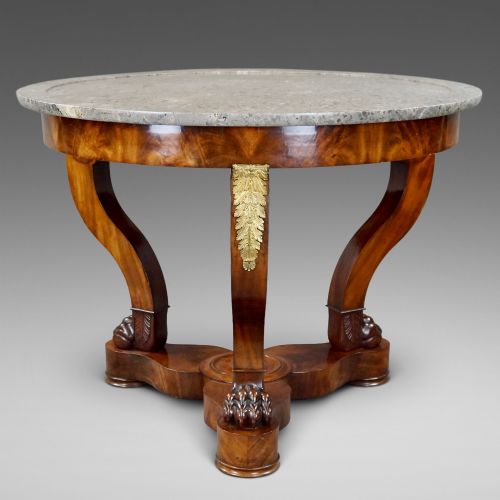


Empire Mahogany Tripod Table
These empire mahogany tripod table examples bring architectural gravitas and rich timbers to a room, offering both a commanding centrepiece and daily utility.
Empire Mahogany Tripod Table
When you search for an empire mahogany tripod table, you are looking at substantial circular pedestals designed to anchor formal reception rooms. The pieces appearing here predominantly take the form of the gueridon or centre table, emerging from nineteenth century French and Regency workshops. These circular tables rest on robust tripartite or pillar supports, frequently featuring inset marble tops that contrast with the dark timber.
You will most commonly meet French examples carrying the distinct design vocabulary of the Empire, Charles X, and Restauration periods. These variations often showcase deep mahogany veneers paired with polished stone surfaces and architectural bases. They function brilliantly as freestanding centre tables in large hallways or as impressive occasional tables in a drawing room.
How they were made
Cabinetmakers built these tables using dense mahogany timbers over sturdy structural carcasses, applying careful French polishing to bring out the deep grain of the wood. The circular tops frequently incorporate heavy slabs of white or black marble, requiring strong pillar and tripod bases to bear the considerable weight.
Metalwork played a defining role in the construction, with brass, ormolu, and gilt bronze mounts secured around the friezes, columns, and feet. Workshops also integrated decorative elements such as boxwood stringing and cast metal swan details to accent the stark architectural lines of the pedestal.
One exceptional nineteenth century example arrives complete with sculpted swan details guarding the base.
What varies in quality
The distinction between ordinary and exceptional work lies in the choice of timber and the crispness of the cast metal mounts. Superior tables feature highly figured mahogany veneers matched with precision, alongside heavy ormolu or gilt bronze rather than simpler brass detailing.
Structural harmony also dictates the tier of quality, seen in how cleanly the tripod base joins the central column and whether the marble top sits flush within its wooden gallery. The integration of carved motifs, such as detailed swan figures or refined boxwood inlay, separates standard production from master craftsmanship.
The Empire Mahogany Tripod Table Glossary
- Gueridon
- A small circular table on a central pillar, originating in France during the seventeenth century. These pieces evolved through the nineteenth century to serve as prominent centre tables in grand interiors.
- Ormolu
- Gilded bronze applied as decorative mounts to furniture frames and bases. The technique involves treating finely cast bronze with a gold amalgam.
- Restauration
- A French stylistic period spanning the reigns of Louis XVIII and Charles X. Furniture from this era often retains classical Empire proportions while introducing lighter wood tones and subtler mounts.
- Tilt top
- A tabletop hinged to its pedestal so it can be tipped vertically when not in use. This mechanism allowed tables to be stored flat against a wall in smaller spaces.
Empire Mahogany Tripod Table: Frequently Asked Questions
Where should I place an empire mahogany tripod table?
These tables work best as freestanding centrepieces in a hallway or large reception room where people can walk around the circular top. They also serve effectively as lamp or occasional tables beside substantial seating.
Because of their pedestal bases, chairs can be tucked neatly around them without hitting legs, though their heavy marble tops mean they are not easily moved once positioned.
How can I tell a Charles X table from earlier Empire pieces?
Charles X and Restauration period tables generally display slightly simpler architectural lines than their earlier Empire counterparts. They often substitute heavy gilt bronze for more restrained mahogany veneers and subtle boxwood details.
The overall aesthetic shifts toward domestic comfort while retaining the classical circular pedestal form and heavy marble top.
Are these tables sturdy enough for daily use?
Their heavy tripod bases and solid timber construction make them remarkably stable for everyday placement in a home. The weight of the inset marble top helps keep the entire structure firmly planted on the floor.
Care should be taken not to lean heavy body weight against the outer edges of the top, as the central tilt or pillar mechanism is designed primarily to support vertical weight.