




Gilt Bronze Gueridon
A gilt bronze gueridon brings French elegance to a room, combining rich marble tops with finely chased mounts.
Gilt Bronze Gueridon
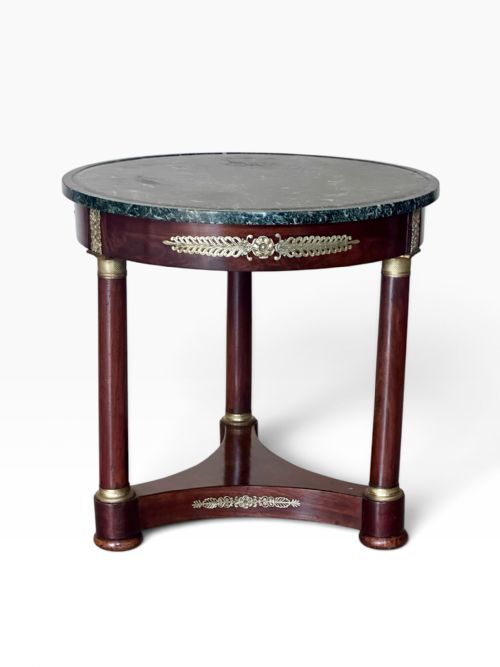
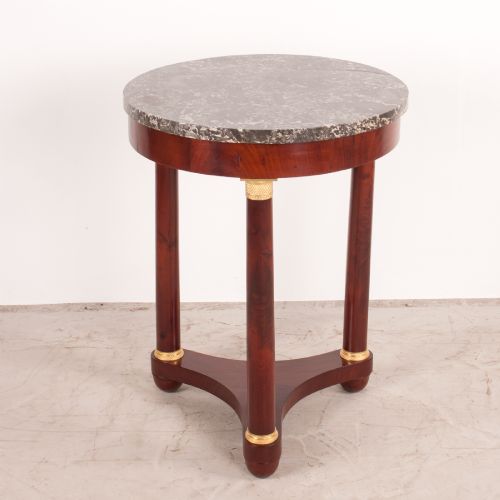
A gilt bronze gueridon stands as a distinct form of French occasional, centre, or lamp table, defined by a circular top supported on a central pillar or slender legs. These tables emerge primarily from the nineteenth century, spanning periods from the French Empire and Restauration through the Napoléon III era and Louis styles.
Most pieces encountered on this page feature a marble top, frequently paired with ormolu or gilt bronze mounts, alongside timber carcases in mahogany, kingwood, or walnut. Makers and workshops constructed these versatile pieces to serve as lamp tables, wine tables, or decorative stands within domestic interiors.
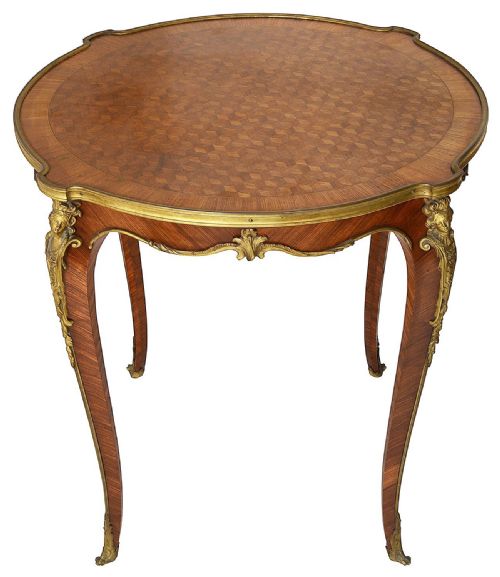
The selection ranges from restrained Empire designs with rich mahogany to elaborate Louis XV and XVI revival models boasting parquetry inlay, porcelain plaques, and intricate gilt bronze ornamentation. Buyers frequently find pieces reflecting the high standards associated with prominent Parisian makers of the period.
Materials and Construction
Craftsmen utilised dense hardwoods such as mahogany and kingwood for the structural carcase, often applying intricate marquetry or parquetry patterns across the surfaces. These timbers provided a stable foundation for the heavy decorative elements.
Gilt bronze and ormolu mounts were cast, chased, and gilded to adorn the frames, legs, and friezes with botanical or classical motifs. Heavy marble slabs, sometimes in porphyry style, were precisely fitted to the circular or kidney-shaped tops.
Master workshops employed specialised cabinetmaking and bronze-working techniques, combining fire-gilding or electroplating on bronze with fine joinery. This integration of stone, metal, and wood demanded collaboration between skilled bronze-founders and cabinetmakers.
Listings feature mahogany, kingwood, walnut, and burr elm alongside marble and porcelain elements.
Assessing Quality and Execution
The crispness of the chasing on the gilt bronze mounts dictates the visual success of the piece, separating standard production from exceptional studio work. Sharp detail in the foliage, figures, and cast ornaments denotes superior craftsmanship.
The choice and execution of timber veneers, such as detailed parquetry or marquetry, reveal the skill invested in the woodwork. High-tier pieces integrate the bronze mounts seamlessly into the timber carcase without structural compromise.
The quality of the fitted marble top and the weight and finish of the underlying metal elements distinguish masterworks from simpler commercial tables. Pieces bearing signatures or attributions to prominent makers generally display a higher tier of finish throughout.
Francois Linke·Weisweiler·Zwiener Jansen Sucesseur·Henry Dasson·Gervais Durand
The Gilt Bronze Gueridon Glossary
- Gueridon
- A small circular table on a central pillar or slender legs, originating in seventeenth-century France. These pieces function as occasional, lamp, or centre tables.
- Ormolu
- Gilt bronze, created by applying a finely ground gold-mercury amalgam to a bronze object and heating it to drive off the mercury. This technique produces a durable golden surface on decorative mounts.
- Parquetry
- Geometric mosaic woodwork formed by small pieces of veneer arranged in patterns such as cubes or chequers. It decorates the tabletops and friezes of finer occasional tables.
- Marquetry
- Inlay work using various coloured woods, veneers, and shell to create pictorial or decorative designs across furniture surfaces. It appears on the tops and bodies of nineteenth-century French tables.
- Empire Style
- A neoclassical design movement spanning the early nineteenth century, characterised by heavy mahogany, classical architectural motifs, and restrained gilt bronze mounts.
- Restauration
- A French design period bridging the early Empire style and the later July Monarchy, noted for refined timber selection and simpler forms.
Gilt Bronze Gueridon: Frequently Asked Questions
What is a gueridon table used for?
These small tables serve primarily as occasional surfaces for lamps, decorative objects, or drinks within a principal room.
Their compact circular footprint allows them to sit beside seating or in corners without crowding the floor space.
How do I identify a nineteenth-century French gueridon?
Look for characteristic timber choices like mahogany and kingwood combined with chased gilt bronze mounts and fitted marble tops.
Construction methods, such as hand-cut dovetails and traditional joining of the central pillar to the base, help confirm the period.
What is the difference between ormolu and gilt bronze?
Ormolu specifically describes objects produced through historical mercury gilding, yielding a distinct deep golden lustre on bronze.
Gilt bronze is a broader term encompassing any bronze object covered in a gold layer, including later electroplated examples.
How should I care for a marble top table?
Wipe the marble surface regularly with a soft, damp cloth and dry it immediately to prevent water marks or staining.
Avoid acidic cleaning agents or harsh chemicals that can etch the polished stone surface over time.
Are these tables suitable for everyday use?
These antique tables are robust enough for daily placement of lamps or decorative items when handled with care.
Protecting the polished timber and marble surfaces from excessive moisture and heat ensures the materials remain preserved.