
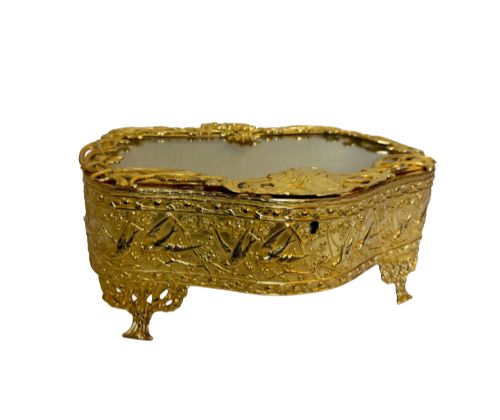
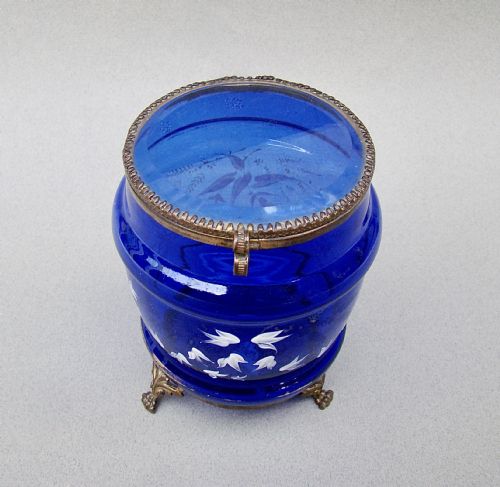
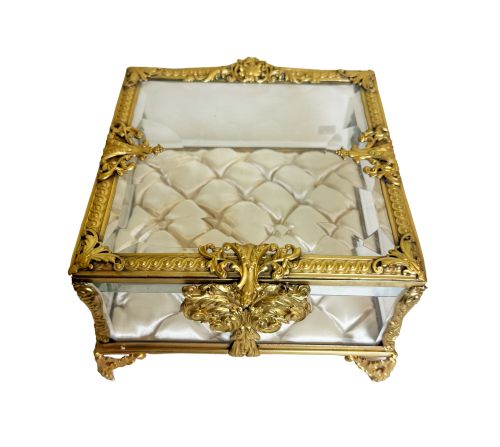


Gilt Bronze Glass Casket
These gilt bronze glass casket pieces are heavy metal-framed boxes designed to hold precious trinkets, and you want one for its rich nineteenth-century French decorative presence.
Gilt Bronze Glass Casket
A gilt bronze glass casket is a small lidded container designed for jewellery, trinkets, or perfume bottles, typically originating from nineteenth-century France. When you search for this phrase, you encounter boxes framed in heavy gilded metal and fitted with thick glass panels.
The pieces appearing here span several decades of the nineteenth century, taking forms such as jewellery boxes, trinket boxes, and perfume caskets. You are most likely to meet French nineteenth-century examples influenced by Napoleon III, Charles X, and Art Nouveau styles.
Makers and workshops produced these caskets in various decorative configurations, including miniature novelty carriages, opaline egg containers, and large mounted boxes. Baccarat glass and cut crystal frequently appear within the framework of these boxes, alongside silk linings.
How they were made
Craftsmen cast the metal frames in ormolu, gilt bronze, or gilt brass, then chased the surfaces to create detailed decorative relief. They combined these metallic mounts with heavy glass panels, including bevelled glass, Bristol blue glass, and cut crystal.
Interiors often featured fitted compartments lined in silk to cushion delicate items such as rings and necklaces. Bronze mounts secured the glass panes tightly within the structural framework of each casket.
Listings feature pieces spanning the nineteenth century, predominantly from French origins including Napoleon III, Charles X, and Art Nouveau styles.
What varies in quality
Quality rests upon the weight and crispness of the gilt bronze or ormolu casting, where finer examples display sharp relief and deep gilding. The thickness and clarity of the glass, whether cut crystal, opaline, or Baccarat, set superior pieces apart.
The complexity of the form dictates distinction, ranging from straightforward geometric caskets to elaborate novelty creations shaped like coaches and horses. Structural integrity of the heavy metal frame and the preservation of original silk interiors also govern the overall standard.
The Gilt Bronze Glass Casket Glossary
- Ormolu
- Gilded bronze produced by applying a mercury and gold amalgam to a bronze base. This technique creates a rich golden surface found on nineteenth-century French caskets.
- Bevelled glass
- Glass with edges ground and polished at an angle. This treatment creates a decorative framed effect that catches the light.
- Baccarat glass
- Premium crystal and glassware produced by the famous French manufacturer. Pieces featuring this glass exhibit exceptional clarity and weight.
- Napoleon III style
- A nineteenth-century French aesthetic characterised by eclectic revivals of historic decorative arts. It heavily influences the ornamentation of many metal-mounted caskets.
Gilt Bronze Glass Casket: Frequently Asked Questions
What were gilt bronze glass caskets used for?
These boxes served as elegant receptacles for storing valuable personal items such as rings, necklaces, and small keepsakes on dressing tables.
Perfume caskets specifically contained small scent bottles, protecting delicate glass vials while remaining decorative objects in bourgeois interiors.
How do I date a glass and ormolu casket?
Dating relies on stylistic clues, metal casting techniques, and glass types associated with specific nineteenth-century periods like Charles X or Napoleon III.
Registrations, manufacturer marks, or distinct Art Nouveau motifs help narrow the decade of production between eighteen sixty and nineteen hundred.
Where were these caskets made?
The vast majority of these pieces originated in France, particularly in Parisian workshops and retail centres like the Palais Royal.
French makers dominated the production of gilt bronze and ormolu-mounted glassware throughout the nineteenth century.
How should I clean a gilt bronze mount?
Maintenance requires gentle dusting with a soft, dry brush to prevent accumulation in the detailed chasing of the metal.
Harsh polishes and liquids must be avoided to protect the historic gilding applied to the bronze or brass frames.