
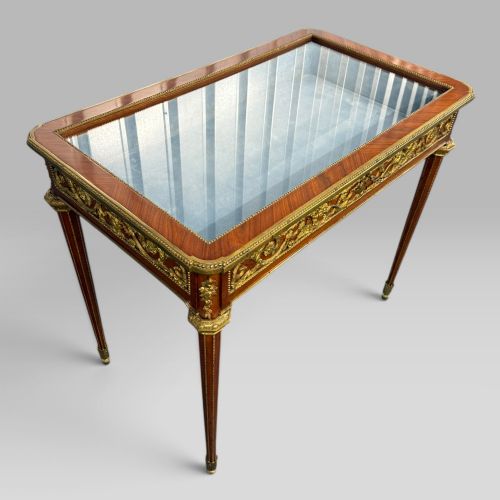


Gilt Bronze Display Table
A gilt bronze display table combines metallic lustre with glazed framing to showcase small treasures, bringing French revival elegance into any drawing room.
Gilt Bronze Display Table
A gilt bronze display table is a refined surface designed for exhibiting small collectables, medals, and jewellery beneath a glazed top. These pieces frequently appear in nineteenth century Victorian and Edwardian iterations influenced by French Louis XV and Louis XVI revival aesthetics.
The form typically manifests as a bijouterie table or glazed vitrine supported on slender legs, often featuring hinged or lift-off glass lids to permit intimate inspection of the contents. Walnut, mahogany, kingwood, and satinwood frequently form the underlying timber carcasses beneath the metal mounts.
Buyers seeking this phrase encounter occasional tables, etageres, and specialised cabinets alongside dedicated display pieces. The French taste dominates the selection, reflecting a historical demand for ornate Parisian craftsmanship.
How they were made
The construction relies upon combining cast metal mounts with finely timbered frames and fitted glass panels. Ormolu and gilt bronze provide the decorative vocabulary, cast and chased before being applied to corners, legs, and aprons.
Cabinet makers utilised dense hardwoods such as mahogany, walnut, rosewood, and kingwood, frequently employing parquetry and marquetry veneers to create intricate geometric or floral patterns. Velvet linings often cushion the interior tray beneath the clear glass top, protecting delicate objects from friction.
One unexpected survivor on record even bears later sign-writing for Breitling watches inside its glazed compartment.
What varies in quality
Quality reveals itself in the crispness of the bronze chasing and the depth of the fire gilding upon the metal mounts. Superior examples display sharply defined foliage and figures, whereas lesser pieces show softer, shallower casting details.
The precision of the cabinet work, particularly the alignment of veneered marquetry and the smooth operation of hinged glazed lids, distinguishes fine workshop production from standard commercial output.
François Linke·Baetens London
The Gilt Bronze Display Table Glossary
- Ormolu
- Gilded bronze produced by applying a mercury and gold amalgam to a bronze base and heating it until the mercury vaporised. This historic technique creates a durable, warm golden finish characteristic of antique mounts.
- Bijouterie table
- A specialised display table featuring a glazed compartment designed specifically for holding jewellery and small precious objects. They were popular in grand nineteenth century drawing rooms for social display.
- Etagere
- An open tiered piece of furniture used for displaying ornaments and small decorative items. Multiple open shelves provide airy vertical storage rather than enclosed cabinet space.
- Marquetry
- The art of applying decorative pieces of veneer to a structure to form intricate pictorial or geometric designs. Craftsmen utilised various naturally coloured woods to create contrast without paint.
- Vitrine
- An enclosed glass cabinet intended for the exhibition of porcelain, glass, and curiosities. Glazed panels on multiple sides allow light to enter from various angles.
Gilt Bronze Display Table: Frequently Asked Questions
What is a bijouterie table used for?
A bijouterie table was traditionally used by Victorian hostesses to display visiting cards, miniatures, small snuff boxes, and precious trinkets beneath protective glass.
Today, these tables serve the same decorative function, allowing collectors to exhibit small antique items securely while keeping them dust free.
How do I tell Louis XV and Louis XVI styles apart?
Louis XV revival pieces feature asymmetrical curves, flowing rococo scrolls, and naturalistic floral motifs without rigid geometry.
Louis XVI style shifts towards neoclassical symmetry, incorporating straight tapered legs, fluted columns, and classical geometric proportions.
Are the glass tops usually original?
Many surviving tables retain their original thick bevelled glass panes, which often show minor surface scratches consistent with age and genuine use.
Replacement glass is occasionally fitted during restoration work, though older replacement panes still exhibit traditional manufacturing imperfections like slight waviness.
How should I care for the velvet lining?
The internal velvet lining should be kept away from direct sunlight to prevent fading of the rich pile colours over the decades.
Gentle suction using a low-power vacuum attachment through a mesh screen helps remove dust accumulation without disturbing the delicate fabric base.