



Gilt and Ebonised Clock
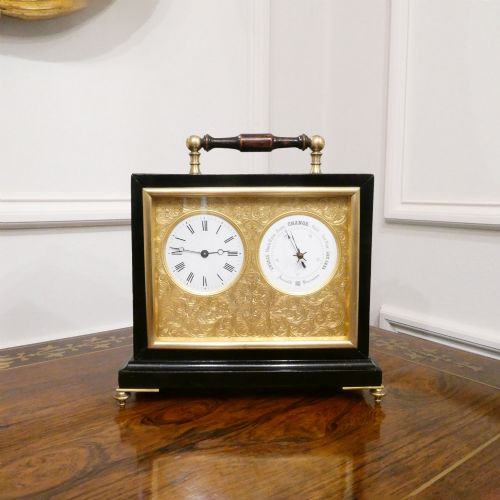
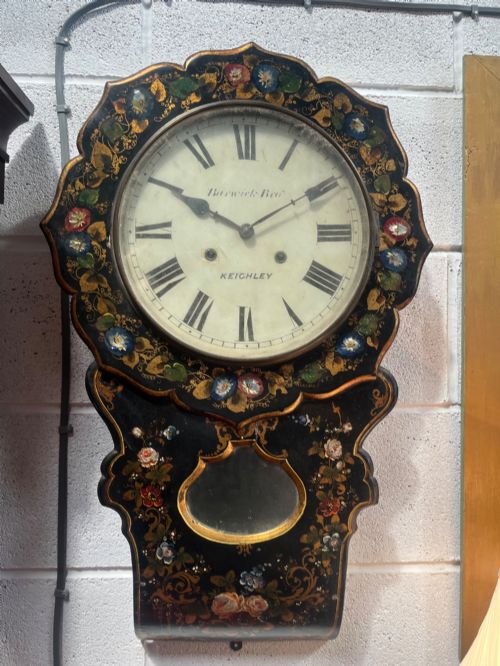
These gilt and ebonised clocks combine dark wood cases with bright metallic mounts, offering a striking display of period craftsmanship for the mantel or wall.
Gilt and Ebonised Clock
A gilt and ebonised clock brings together the deep, dark finish of ebony-stained wood and the reflective warmth of metallic highlights. The pieces found here span multiple centuries, touching on periods from the seventeenth century through to the Edwardian era.
Buyers will encounter various forms, most commonly mantel clocks, bracket clocks and portico designs. French and English workshops dominate the selection, showing distinct regional approaches to case design and dial arrangement.
Styles range from French Neoclassical and Napoleon III to the Victorian Aesthetic Movement. This variety means a collector can find both simple domestic timepieces and elaborate architectural creations.
Materials and construction methods
The foundation of these clocks relies on timber treated with an ebonised finish to mimic costly ebony. Cabinetmakers combined this dark surface with cast or chased ormolu, gilt bronze and brass mounts.
Dials frequently feature enamel numerals set behind glass, while internal movements incorporate steel components, intricate gear trains and fusee or spring-driven mechanisms.
Decorative details often include painted elements, porcelain plaques or fine brass inlay set directly into the wood case.
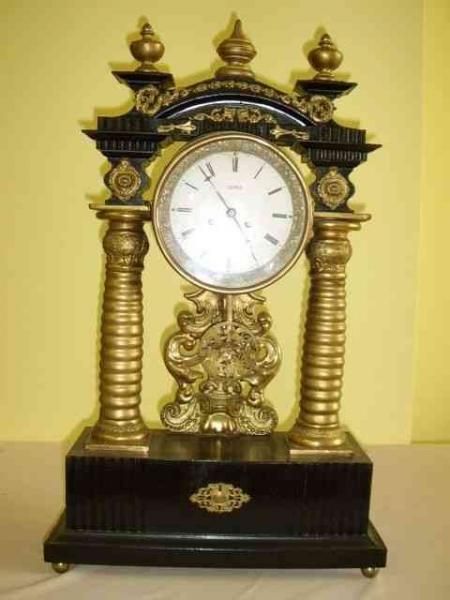
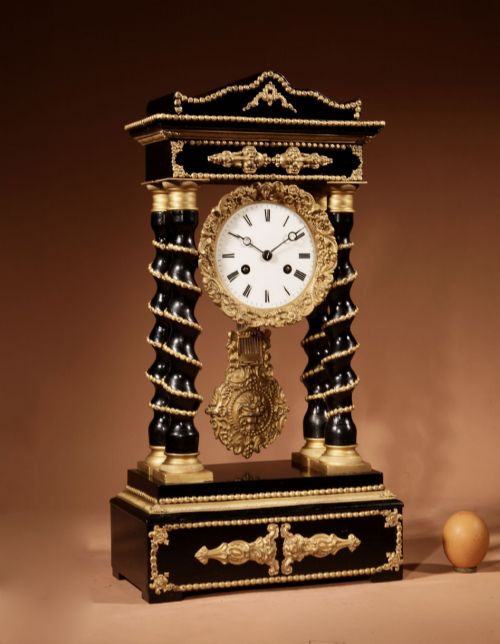
Listings feature architectural portico forms alongside traditional bracket clocks and wall-hanging timepieces.
Evaluating the standard of workmanship
Quality rests upon the crispness of the gilt mounts and the depth of the ebonised finish on the timber case. Superior examples display finely chased ormolu details where every leaf and scroll retains sharp definition.
The calibre of the clock movement dictates the mechanical standard. Signed movements by notable makers and complex chiming or musical mechanisms set finer pieces apart from standard domestic timepieces.
Proportion and architectural balance define the upper tier of portico and bracket clocks. The integration of bronze, brass and glass must feel cohesive rather than assembled from disparate parts.
Le Roy Paris·Jonathon Lowndes·Henri Marc·Arnold and Frodsham·Payne and Co London·Charles Frodsham·John Leroux London·Barraud and Lunds·Wm Gilbert·Henri Dasson
The Gilt and Ebonised Clock Glossary
- Ebonised wood
- Timber stained or painted black to imitate true ebony. This finish provides a dark, matte or polished contrast to gilt bronze mounts.
- Ormolu
- Gilt bronze produced by applying a mercury and gold amalgam to cast bronze. This technique creates a rich, durable golden surface seen on French and English clock mounts.
- Fusee
- A conical pulley used in mechanical clocks to maintain even power delivery as the mainspring unwinds. It forms a mark of quality in better period timepieces.
- Portico clock
- An architectural mantel clock supported by columns, popular in the late eighteenth and nineteenth centuries. They often feature a pendulum suspended within the central opening.
- Bracket clock
- A portable clock originally designed to sit on a wall bracket or table. These typically feature sturdy carrying handles and sophisticated striking movements.
Gilt and Ebonised Clock: Frequently Asked Questions
Where should I place a heavy bracket clock?
These clocks require a sturdy surface such as a heavy mantelpiece or a dedicated wall bracket fixed securely to a load-bearing wall.
Because many examples incorporate dense timber and heavy bronze mounts, stability ensures the pendulum swings accurately without interference.
How do I wind an antique mechanical clock?
Use the appropriate winding key matching the square arbor on the dial face, turning it gently until resistance indicates the mainspring is fully tensioned.
Avoid over-winding the mechanism, as this can strain the internal steel springs and disrupt the beat of the pendulum.
What is the difference between a mantel clock and a portico clock?
A standard mantel clock sits directly on a flat base as a single enclosed box or architectural block. A portico clock uses distinct vertical columns to frame a central hanging pendulum.
Portico designs emerged from neoclassical tastes, whereas mantel clocks adopted a wider variety of revival styles over the Victorian period.
How do I care for ebonised wood and gilt mounts?
Dust the exterior regularly with a soft, dry cloth to prevent particulate buildup on the delicate surfaces. Avoid chemical polishes that can strip the black finish or harm the gilt bronze.
Gilt mounts respond well to gentle cleaning, but the ebonised wood needs only minimal moisture to preserve its deep tone.