
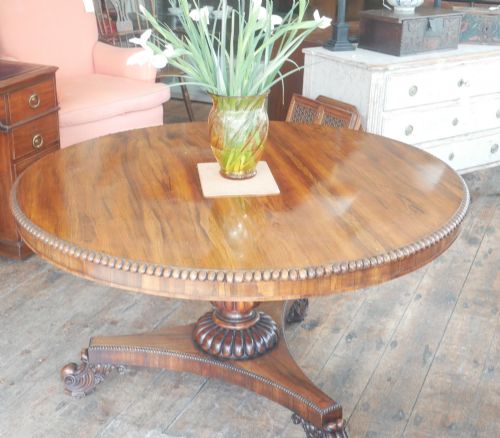


Gillows Library Table
When you examine a genuine gillows library table, you hold centuries of Lancaster and London cabinet-making history in your hands.
Gillows Library Table
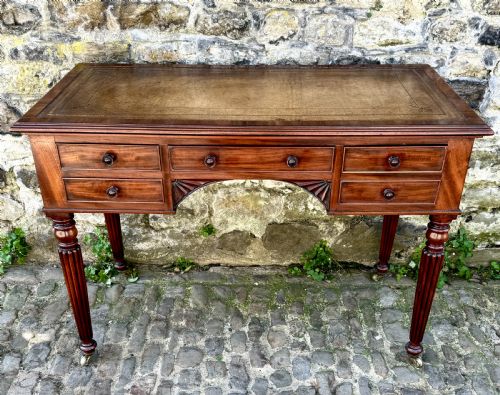
A gillows library table is a substantial freestanding piece designed for scholarly pursuits, featuring drawers, sturdy pedestals, and finished backs for central room placement.
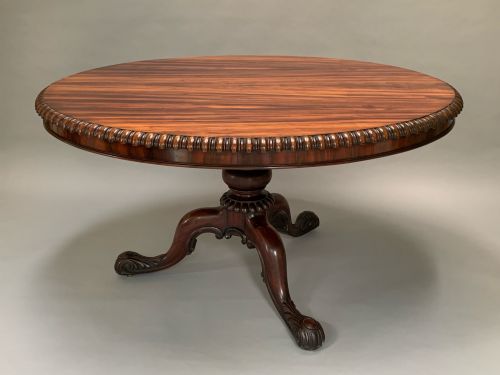
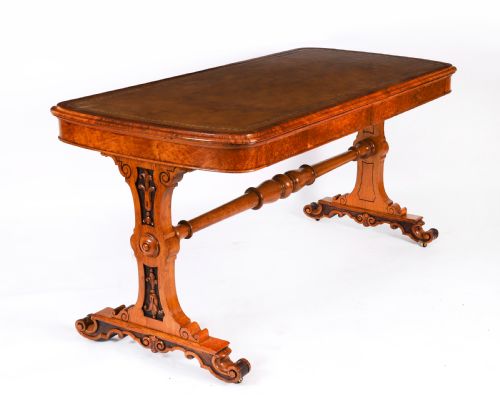
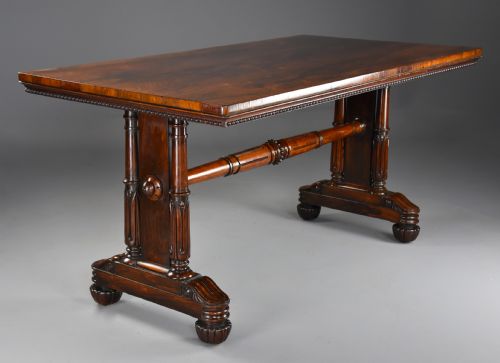
The pieces on this page span the Georgian, Regency, William IV, and Victorian eras, often taking the form of twin-pedestal desks or expansive rectangular centre tables.
Many examples emerge from the renowned workshops of Lancaster and London, while others bear the stylistic hallmarks or attribution of the firm's skilled makers.
How They Were Made
Craftsmen utilised dense timbers such as Cuban mahogany, rosewood, walnut, and pollard oak, often selecting burr or amboyna veneers for decorative surfaces.
Construction techniques include robust dovetailing in drawer construction and precise turnings on pedestal supports, supplemented by brass galleries, locks by Bramah, and leather writing inserts.
Listings feature mahogany, rosewood, walnut, and oak library tables spanning the Georgian, Regency, and Victorian periods.
What Varies in Quality
Quality rests upon the selection of timber figures, the crispness of carved details, and the integrity of secondary woods used in the interior framing.
The inclusion of stamped signatures, specialised mechanisms like pull-out leaves, and original brass or ormolu mounts elevates certain examples to exhibition standard.
Gillow and Co·Thomas Myers
The Gillows Library Table Glossary
- Bramah lock
- A patented high-security cylindrical lock frequently found on superior period furniture. These mechanisms represent precision British engineering from the late eighteenth century onward.
- Partners desk
- A large double-sided writing table fitted with drawers on opposing faces. This form allowed two people to work opposite one another.
- Centre table
- A freestanding item finished on all four sides to sit in the middle of a room rather than against a wall. These pieces display fine timber grain from every angle.
- Pedestal desk
- A form comprising a top surface resting on two separate drawer pedestals or banks of drawers. This architectural format provides immense structural stability.
- Regency
- A design period spanning roughly the late eighteenth to the early nineteenth century, characterised by classical revival motifs and refined proportions.
Gillows Library Table: Frequently Asked Questions
How do I identify a real Gillows piece?
Look for stamped signatures on drawer edges, distinctive brass locks, and meticulous secondary wood framing characteristic of the Lancaster workshops.
Attribution often relies on specific structural traits, turning styles, and documented proportions associated with their cabinet-makers.
Where should I place a library table?
These tables are designed to stand free in the middle of a room, as their rear sides are finished with the same care as the front.
They function effectively as executive desks, centre tables in large halls, or workspace surfaces in studies.
What is the difference between a writing table and a library table?
Library tables tend to be larger, heavier, and built for communal study or display in grand rooms, often incorporating leather writing surfaces.
Writing tables are sometimes lighter in scale, though nineteenth-century makers frequently used the terms interchangeably.
How do I care for antique leather tops?
Maintain the leather by keeping it away from direct sunlight and applying appropriate micro-crystalline waxes or neutral balms.
Avoid excessive moisture and heavy cleaning agents that can strip the original gilding and tooling.