



Gilded Serpentine Marble Console
These gilded serpentine marble console tables bring dramatic architectural presence and polished stone surfaces to a room.
Gilded Serpentine Marble Console
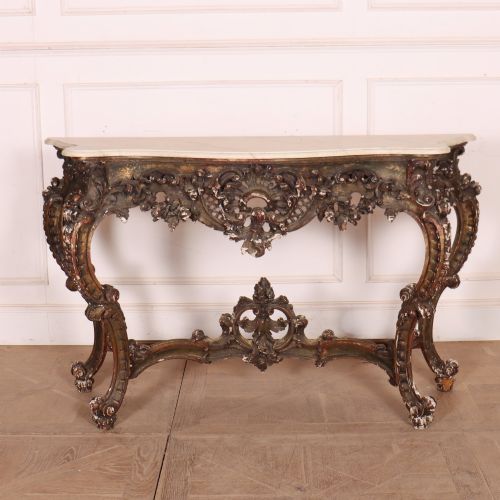
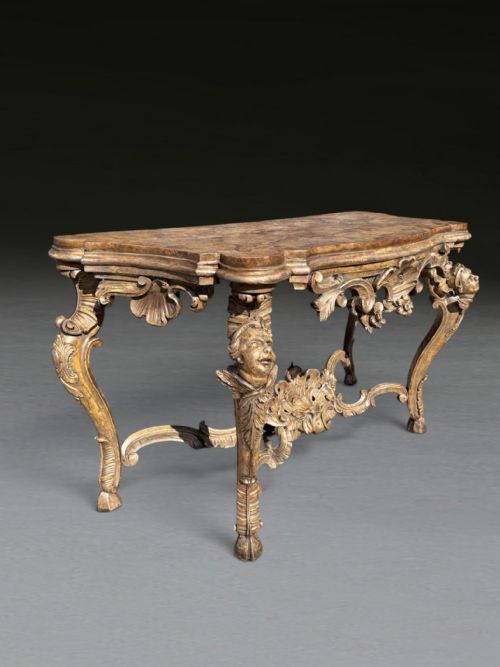
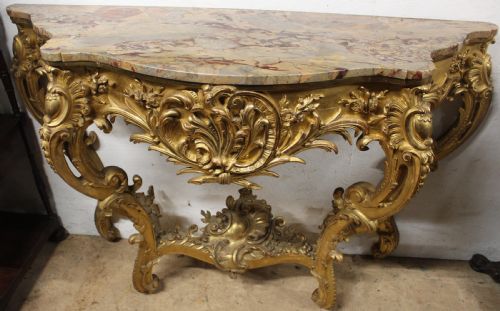
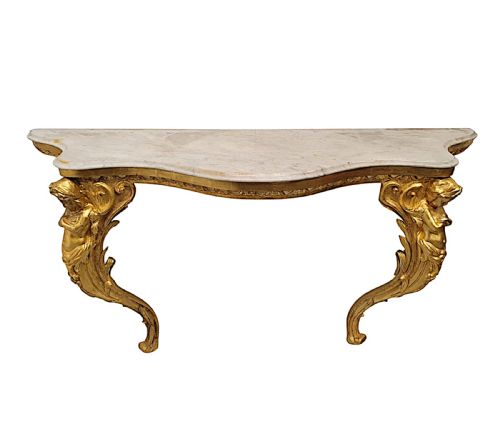
A gilded serpentine marble console presents a distinctive undulating stone surface carried upon an ornate wooden frame finished in gold leaf or paint. When searching for a gilded serpentine marble console, buyers encounter forms spanning the eighteenth through the early twentieth centuries, rooted primarily in French and Italian aesthetics.
The profile of these tables is defined by a curving front edge that sweeps outward and inward in a wave-like contour. French Rococo and Louis XVI periods strongly influence the surviving examples, which manifest as console tables, centre tables, and side tables.
Originating largely from continental workshops, these pieces function as striking wall-mounted or freestanding furniture. The combination of heavy marble tops and elaborately carved wooden bases creates a distinct visual weight suited to formal interiors.
Materials and construction
Makers shaped solid timber such as carved wood and applied gesso to build up intricate relief ornaments before gilding the surface with gold leaf or paint. This layered preparation provided a smooth, receptive base for the metallic finish.
Heavy marble slabs were cut and polished to follow the complex serpentine outlines of the wooden frames. The dense stone top rests securely upon the carved and gilded understructure, relying on its own substantial weight for stability.
One historical table apparently arrived with a spelling variation on its paperwork, proving even antique clerks occasionally struggled with the word console.
Assessing craftsmanship and design
Quality reveals itself in the depth and sharpness of the wood carving, where finer examples display crisply defined foliage and scrolls rather than soft, indistinct contours. The application of gold leaf demonstrates superior handcraft compared to flat, uniform modern paints.
The integration between the heavy marble slab and the wooden base dictates the structural harmony of the piece. Superior specimens feature stone with rich natural grain and movement that accurately matches the complex curves of the serpentine apron.
The Gilded Serpentine Marble Console Glossary
- Serpentine
- A curved structural outline featuring a convex centre flanked by concave ends, or vice versa, creating a wave-like shape. This contour requires precise stone-cutting and joinery.
- Console
- A decorative table designed to stand against a wall, frequently supported by ornamental brackets or legs rather than four standard posts. Historically, many required attachment to the wall for complete stability.
- Giltwood
- Timber coated with a thin layer of gold leaf over a prepared ground of gesso and size. It reflects candlelight and daylight differently than flat metallic paint.
- Gesso
- A plaster mixture applied to wood frames to create a smooth surface for gilding or painting. It allows craftsmen to carve fine decorative details into the ground before applying gold leaf.
- Louis XVI Style
- A neoclassical design movement characterised by straight lines, symmetry, and classical restraint, often incorporating carved fluting and laurel wreaths. It provides a structured contrast to earlier curving Rococo forms.
Gilded Serpentine Marble Console: Frequently Asked Questions
Where should I place a console table?
These tables find their traditional home against an empty wall in a hallway, drawing room, or dining space. They anchor a room effectively when positioned beneath a large mirror or painting.
Because many historical console designs rely on wall brackets for support, checking the structural independence of a specific piece ensures proper placement in a freestanding room layout.
How do I care for the marble top?
Cleaning requires only a soft, damp cloth and neutral soap, avoiding acidic substances that etch polished stone surfaces. Promptly wiping away spills preserves the smooth finish of the marble.
Using coasters and felt pads beneath decorative objects prevents scratching and staining on the antique stone.
What is the difference between Rococo and Louis XVI styles?
Rococo designs embrace asymmetrical curves, naturalistic shell motifs, and flowing, organic ornamentation. The aesthetic prioritises movement and elaborate, theatrical flourishes.
Louis XVI style moves toward neoclassical symmetry, straight tapered legs, and geometric restraint. It replaces turbulent curves with architectural order and classical motifs.
Are these tables designed to stand freestanding?
While many examples function as independent side or centre tables, traditional console tables often require anchoring to a wall for absolute security. The heavy marble top combined with ornate carving means weight distribution can vary.
Examining the base construction reveals whether a piece stands firmly on its own or needs structural wall support.