
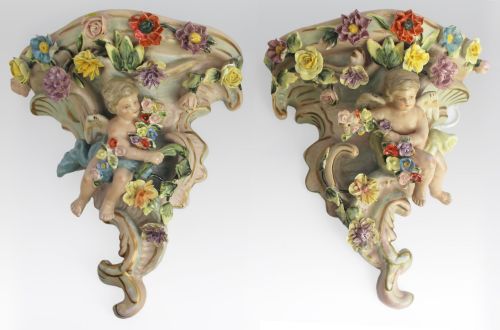
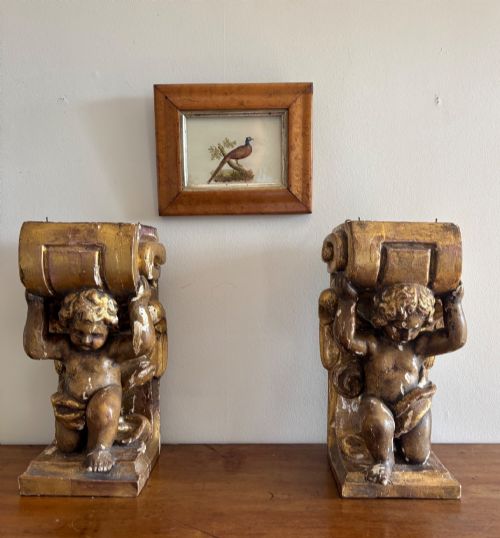
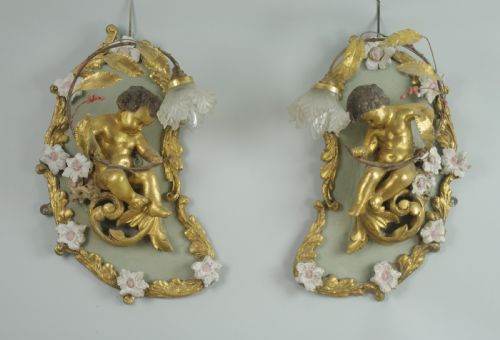
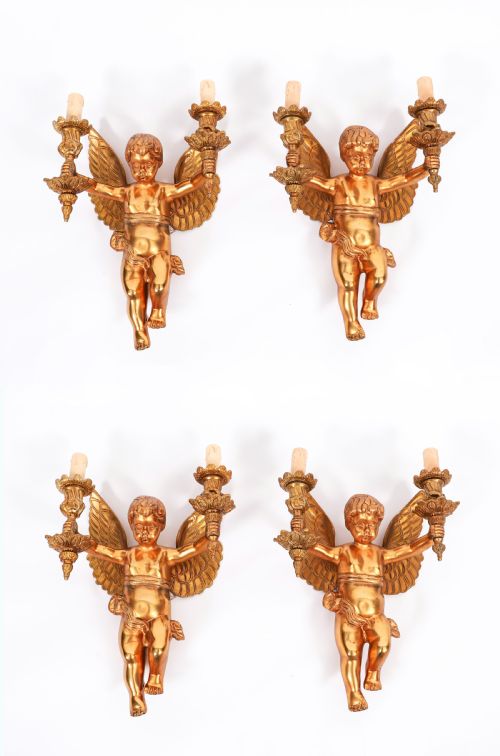



Gilded Putto Wall Sconce
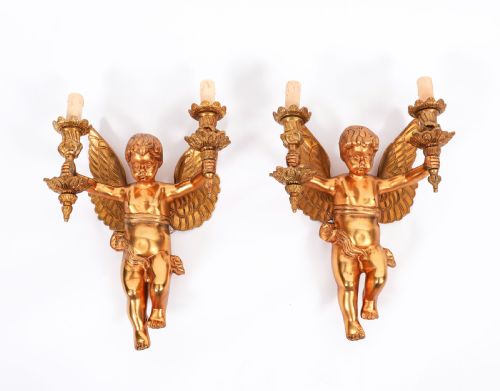
A gilded putto wall sconce brings carved light and ornamental winged figures to a room, offering both illumination and sculptural presence.
Gilded Putto Wall Sconce
A gilded putto wall sconce combines carved or moulded winged cherub figures with wall-mounted brackets, lights, or mirrors. These pieces emerge in styles such as Rococo Revival, Baroque Revival, Italian Baroque, and French Neoclassical, reflecting historic European design traditions.
The items found on this page span the nineteenth century and the early twentieth century, including years like eighteen-eighty, nineteen-hundred, nineteen-ten, and nineteen-thirty. Buyers most frequently meet pairs of wall lights, twin-arm or two-branch sconces, and carved brackets featuring cherub motifs.
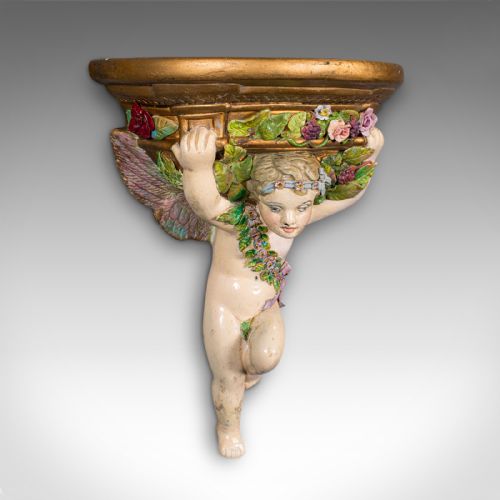
Forms extend beyond simple lights to encompass hanging lanterns, wall mirrors, and porcelain corbels. Origins range from Italian workshops to French and English makers, utilising diverse materials shaped for ornamental interior display.
How they were made
Wood elements rely on traditional carving and gesso application before receiving layers of gold leaf or gilt. Metal components utilise bronze, ormolu, and cast metal techniques to form intricate armatures and figures.
Glass and porcelain appear alongside giltwood and metal, incorporating Murano glass elements or porcelain bodies styled after Meissen production. Plaster and glass lustre components also feature in specific Victorian and early twentieth-century examples.
Every cherub watches over the room with a permanently startled expression, eternally frozen mid-flight.
What varies in quality
The crispness of the carving and the depth of the gilt preparation dictate the visual impact of the piece. Hand-carved wooden brackets display finer anatomical details in the putto figures compared to cast plaster or simpler moulded equivalents.
The integrity of the gilding and the quality of the underlying gesso surface determine how light catches the contours. Integrated elements such as Murano glass or ormolu mounts elevate the craftsmanship of the multi-branch lights.
The Gilded Putto Wall Sconce Glossary
- Putto
- A plump, often winged child figure derived from classical art. They appear frequently in Renaissance and Revival decorative arts.
- Giltwood
- Timber treated with gesso and covered in gold leaf or metallic paint. This technique creates a luminous, reflective surface finish.
- Ormolu
- Gilt bronze mounted on decorative objects and furniture. The process involves applying finely ground gold-mercury amalgam to bronze.
- Gesso
- A plaster mixture spread over wood or canvas as a preparation for gilding or painting. It provides a smooth base for gold leaf application.
- Corbel
- A structural bracket projecting from a wall to support a weight. In decorative contexts, it often serves as an ornamental shelf.
Gilded Putto Wall Sconce: Frequently Asked Questions
What is a putto sconce?
A putto sconce is a wall-mounted lighting fixture or bracket decorated with carved or cast figures of winged cherubs. These pieces combine sculptural art with functional illumination.
They appear in various historic styles, particularly nineteenth-century revivals of Baroque and Rococo aesthetics, designed to project candlelight or electric light into a room.
How do I hang a wall sconce?
Hanging a wall sconce requires securing the bracket firmly to wall studs or using appropriate masonry anchors depending on the weight of the piece. Giltwood and ormolu pieces can be deceptively heavy.
Ensure the mounting point aligns with the weight distribution of the specific bracket or light arm to prevent structural strain.
Are these sconces electrified?
The lighting fixtures listed on this page represent various periods from the nineteenth and early twentieth centuries. Some retain original candle-branch configurations while others accommodate modern wiring.
Buyers should inspect individual listings to determine the current wiring status and consult a qualified professional for any electrical adaptations.
How do I date a giltwood sconce?
Dating relies on examining the materials, construction methods, and stylistic cues present in the wood, gesso, and metalwork. Nineteenth-century pieces often show distinct hand-tool marks and patination.
Stylistic markers such as Florentine Baroque or French Rococo Revival help place the piece within specific historic design movements.