
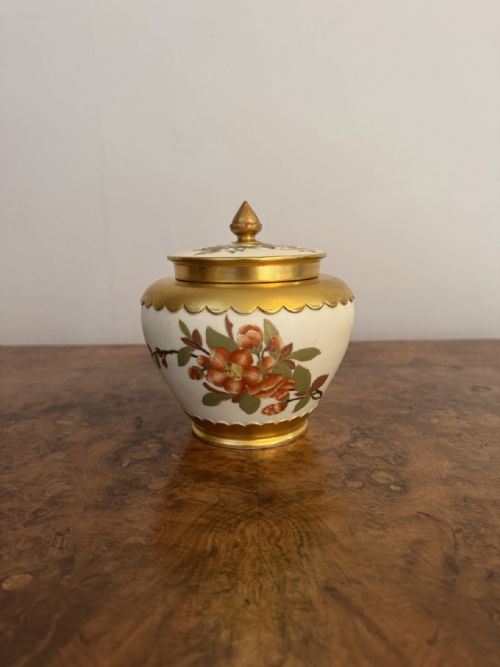


Gilded Porcelain Potpourri Jar
These gilded porcelain potpourri jar pieces bring historical fragrance and heavy Victorian or Georgian hand-painted decoration straight into a room.
Gilded Porcelain Potpourri Jar
A gilded porcelain potpourri jar is a lidded vessel designed to hold dried scented plant matter, combining ornamental weight with functional utility. Buyers seeking a gilded porcelain potpourri jar will find examples spanning from the eighteenth century through the Victorian era and Edwardian periods up to nineteen-sixty. These vessels appear in forms such as ginger jars, pommanders, urn vases, and lidded potpourri pots.
The material record includes porcelain, ironstone, enamel, gilding, gold leaf, and gilt finishes. Stylistic influences draw heavily from English traditional designs, English porcelain, English Imari, and Rococo Revivalism. Many pieces feature elaborate covers, including crown covers and pierced lids intended to release fragrance.
Materials and construction
Pottery bodies are shaped in porcelain and ironstone before receiving detailed hand-painting and structural glazing. The physical construction relies on fired ceramic forms designed to hold secure fitting lids, often with pierced sections for scent dispersal.
Gilding and gold leaf applications highlight moulded contours, rims, and finials. Enamel decoration adds colour depth across bodies adorned with botanical subjects like roses and fruit, alongside traditional blue grounds.
Materials documented across the inventory include porcelain, ironstone, enamel, gold leaf, and gilt finishes.
Assessing quality and execution
The standard of painted detail distinguishes the finest vessels, particularly in hand-rendered fruit and floral scenes. Precision in the application of gold leaf and the crispness of moulded porcelain elements elevate certain pieces above standard production wares.
Proportion and the structural integrity of pierced or crown covers dictate the visual weight of the vessel. Consistency in the glaze and the richness of the underlying paste separate exceptional factory output from more utilitarian ironstone variants.
Royal Worcester·Chamberlain Worcester·Spode·Wolfsohn Dresden·Mason's Ironstone
The Gilded Porcelain Potpourri Jar Glossary
- Potpourri jar
- A lidded vessel specifically pierced or ventilated to diffuse the scent of dried herbs and flower petals stored within. These containers range from modest domestic items to large decorative urns.
- Gilt
- A thin layer of gold applied to the surface of porcelain or ironstone to accent rims, handles, and raised motifs. It adds reflective contrast to the painted ceramic body.
- Ironstone
- A heavy, durable type of feldspathic earthenware patented in the nineteenth century. It provides a sturdy alternative to porcelain while accepting similar coloured enamels and gilding.
- Ginger jar
- A high-shouldered ceramic vessel with a domed lid originally used for storing spices. Later nineteenth-century makers adapted this distinct silhouette for ornamental potpourri use.
- Blush ivory
- A soft, matte cream porcelain body developed by factories like Royal Worcester to simulate the appearance of ivory. It forms a subtle background for delicate floral hand-painting.
Gilded Porcelain Potpourri Jar: Frequently Asked Questions
What is a gilded porcelain potpourri jar used for?
These vessels were historically filled with dried flower petals, spices, and aromatic plant materials to freshen and perfume domestic interiors. The pierced lids allowed the scent to escape slowly into the room.
Today, they function primarily as decorative mantel or table centrepieces while retaining their traditional lidded forms and historical utility.
How do you date an antique potpourri jar?
Dating relies on factory marks stamped or painted on the base, stylistic cues like Rococo Revival moulding, and the specific composition of the ceramic body. Victorian and Edwardian examples often display registration numbers or specific maker ciphers.
Earlier eighteenth-century pieces typically show different paste characteristics and hand-painted underglaze or overglaze signatures unique to their period of manufacture.
What is the difference between porcelain and ironstone?
Porcelain is a fine, vitrified ceramic fired at high temperatures to achieve a translucent white body. It forms the base for delicate, high-end decorative wares.
Ironstone is a denser, opaque earthenware designed for greater everyday strength and durability while still accommodating rich enamel and gilt decoration.
How should I clean my antique potpourri jar?
Dust the surface gently with a soft, dry brush or microfibre cloth to protect fragile gilding and hand-painted enamel details. Avoid abrasive cleaners or soaking the ceramic in water.
If the interior holds old residue, wipe it carefully with a barely damp cloth without touching any exposed or worn gilt edges on the exterior.