
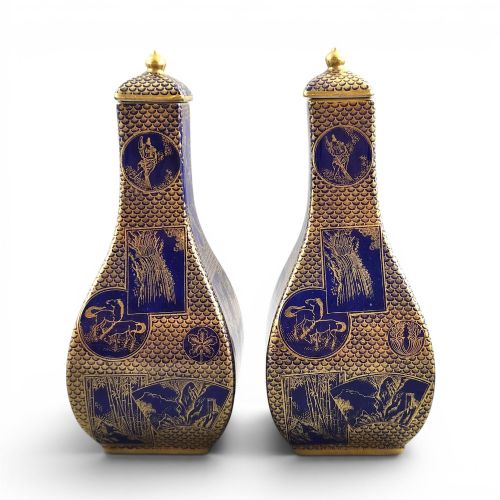


Cobalt Blue Ironstone Vase
These cobalt blue ironstone vases offer robust ceramic bodies finished in deep mazarine grounds, bringing striking colour and nineteenth-century craftsmanship to any interior.
Cobalt Blue Ironstone Vase
A cobalt blue ironstone vase represents a sturdy ceramic vessel finished in a rich mazarine blue ground, often ornamented with intricate patterns and gilding. When exploring a cobalt blue ironstone vase, buyers encounter forms ranging from standard decorative urns and pots to lidded vessels and potpourri containers.
The pieces appearing on this page belong to the nineteenth century, including Georgian and Victorian periods, alongside items from around nineteen hundred. Styles stretch from Regency and Victorian to specific designs such as Victorian Chinoiserie, Regency Chinoiserie, and English Imari.
Makers and makers' marks heavily influence these offerings, with Mason's Patent Ironstone dominating the selection through various shapes and sizes. Collectors often find pairs alongside single large hall vases and multi-piece tea service elements that incorporate vase components.
Materials and production methods
These vessels utilise ironstone ceramic as a durable base material, providing a heavy and robust foundation designed to withstand daily use while maintaining crisp form. Enamel finishes are applied over the body to establish the rich blue ground colour characteristic of these pieces.
Gold leaf, gold gilt, and gilding accent the ceramic bodies, highlighting moulded details, rims, and ornamental motifs. Potters shape these vessels into distinct forms, incorporating lids and pierced potpourri sections where appropriate.
Some potpourri vases come equipped with lids designed to trap stale air and release only the finest scent of dried leaves.
Distinguishing quality in production
The distinction between standard examples and top-tier pieces rests on the complexity of the form and the crispness of the moulded details. Elaborate lidded or potpourri configurations demonstrate greater skill than simpler vessels.
The application of gilding and enamel work defines the visual success of each piece. Intricate patterns, well-preserved gold leaf, and deep mazarine blue grounds separate superior examples from plainer production.
Mason's Patent Ironstone
The Cobalt Blue Ironstone Vase Glossary
- Ironstone
- A heavy, durable type of ceramic developed as a tougher alternative to porcelain. It takes glazes and enamels securely.
- Mazarine Blue
- A deep, rich shade of cobalt blue utilised as a ground colour on ceramics. It creates a striking contrast against gilt highlights.
- Potpourri Vase
- A decorative vessel featuring a pierced lid or body designed to diffuse scented dried plant material. These pieces often include matching covers.
- Gilding
- The application of gold leaf or gold gilt to the surface of ceramics. It accentuates raised details and ornamental borders.
- English Imari
- A decorative style inspired by Japanese Imari porcelain, typically combining cobalt blue, iron red, and gold. It appears on several nineteenth-century pieces.
Cobalt Blue Ironstone Vase: Frequently Asked Questions
What periods do these vases come from?
These vessels originate primarily in the nineteenth century, spanning Georgian and Victorian eras as well as pieces dated around nineteen hundred.
Makers such as Mason's produced these items across several decades, resulting in distinct stylistic influences ranging from Regency Chinoiserie to English Imari.
How were lidded and potpourri vases used?
Lidded vessels served as decorative centrepieces or functional storage containers within nineteenth-century interiors. Potpourri variants held scented botanical mixtures, utilising pierced lids to release fragrance into a room.
Both forms functioned primarily as display items on mantelpieces, sideboards, and hallway tables.
What materials make up these vases?
The core material is ironstone, a dense and durable ceramic designed to resist chipping while supporting complex moulded shapes. Enamel provides the deep mazarine blue background colour across the surface.
Gold gilt, gold leaf, and standard gilding are applied to highlight rims, handles, and decorative motifs.
How do I identify different styles?
Styles are determined by decorative motifs and the overall silhouette of the vessel. Regency and Victorian examples often feature classical proportions alongside rich blue grounds.
Chinoiserie and English Imari variations incorporate specific patterned motifs that draw inspiration from Asian ceramics and traditional nineteenth-century design.