
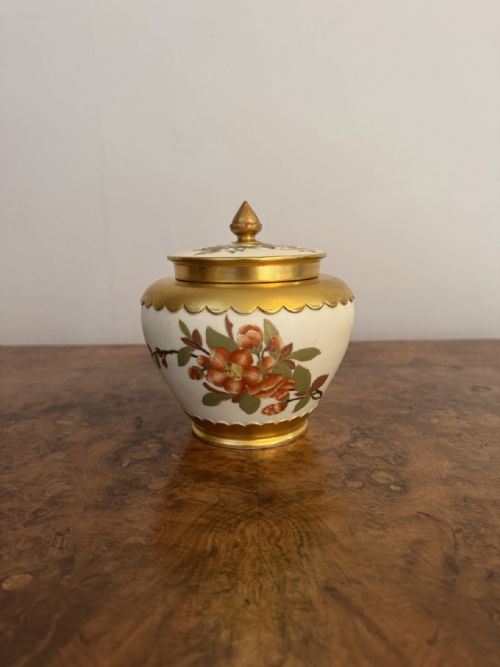


Antique Potpourri Urn
An antique potpourri urn brings scented dried flowers into a room through pierced ceramic vessels shaped in Georgian, Victorian, and Edwardian styles.
Antique Potpourri Urn
The selections span from Georgian ironstone and Derby porcelain to Victorian Royal Worcester and Edwardian blush ivory pieces. You most frequently meet nineteenth-century English porcelain and ironstone examples featuring hand-painted floral motifs and gilt highlights.
Forms range from modest lidded jars to large decorative urns with crown covers or intricate handles. Each piece reflects the interior taste of its period, moving from neoclassical restrained lines toward exuberant Rococo revival shapes.
How they were made
Potters shaped these vessels using ceramic, porcelain, and ironstone, firing the clay bodies before applying intricate glazes and enamels. Artisans frequently added gold leaf and gilding to highlight handles, rims, and finials.
Decoration relied on hand painting, transfer printing, and enamel paint, often depicting botanical studies or romantic scenes. Piercing the lids required precise knife work in the damp clay stage to ensure proper ventilation for the dried botanicals inside.
Listings feature ceramics spanning from the eighteenth century through the 1960s, encompassing porcelain, ironstone, and enamel finishes.
What varies in quality
The finesse of the hand painting and the crispness of the gilt work set finer pieces apart from standard production wares. Hand-painted fruit or detailed floral panels executed by named artists command greater attention than simple transfer-printed patterns.
The complexity of the form itself dictates the tier of the piece, particularly where reticulated lids and applied or moulded ornamentation are concerned. Superior potting shows in the symmetry of the vessel and the precise fit of the cover.
Royal Worcester·Mason's Ironstone·Spode·Derby·Wolfsohn Dresden·Sitzendorf
The Antique Potpourri Urn Glossary
- Blush ivory
- A soft cream-coloured porcelain ground developed by Royal Worcester, often decorated with delicate floral sprays. It creates a warm, matte surface texture distinct from high-gloss glazes.
- Ironstone
- A dense, durable ceramic body patented in the nineteenth century to imitate Chinese porcelain. It takes enamel colours and transfer prints with high clarity.
- Reticulation
- A pierced or openwork pattern cut into ceramic lids or bodies. This technique allows dried flower scents to diffuse into a room while keeping the botanical mixture contained.
- Finial
- The decorative knob or moulding positioned on top of a lid. On these vessels, finials often take the form of floral buds or flames.
- Imari
- A decorative palette featuring underglaze blue, iron red, and gilding, inspired by Japanese export ceramics. English factories adopted this style extensively during the Georgian period.
Antique Potpourri Urn: Frequently Asked Questions
How did people use an antique potpourri urn?
Households placed these vessels in principal rooms to mask household odours and freshen the air using dried rose petals, spices, and herbs. The pierced covers allowed the fragrance to circulate naturally throughout the space.
Owners removed the lids periodically to refresh the botanical contents with essential oils or fresh dried mixtures. The urns remained prominent decorative fixtures on mantelpieces and side tables even when empty.
How do I date an antique potpourri urn?
Dating relies heavily on factory backstamps, ceramic bodies, and stylistic shifts between the Georgian and Edwardian eras. Georgian pieces often display Imari palettes or heavy ironstone bodies, while late Victorian and Edwardian examples frequently feature blush ivory grounds.
Examining the hand-painted details and gilding techniques provides further chronological clues. Factory marks stamped or painted under the base offer the most reliable confirmation of age and origin.
Where should I display an antique potpourri urn?
These vessels suit prominent surfaces such as mantelpieces, entrance tables, and cabinet tops where their form and painted decoration can be appreciated. Placing them away from direct heat sources protects the ceramic glaze and any remaining gilding.
Many collectors group lidded vases and urns in pairs or symmetrical arrangements on sideboards. The scale of the piece determines whether it functions best as a tabletop centrepiece or a floor-standing accent.
What is the difference between an urn and a ginger jar?
Urns typically feature pedestal bases, handles, and classical architectural proportions inspired by antiquity. Ginger jars are generally ovoid vessels with flat bases and flush-fitting lids, originally designed for storing spices.
In nineteenth-century ceramics, factories often adapted these traditional forms specifically for potpourri use by adding pierced or reticulated covers. Both shapes appear frequently across Victorian and Edwardian decorative arts.