






Gilded Pendule De Cheminee
These gilded pendule de cheminee are striking French mantel clocks designed to anchor a room with classical elegance and rich ornament.
Gilded Pendule De Cheminee
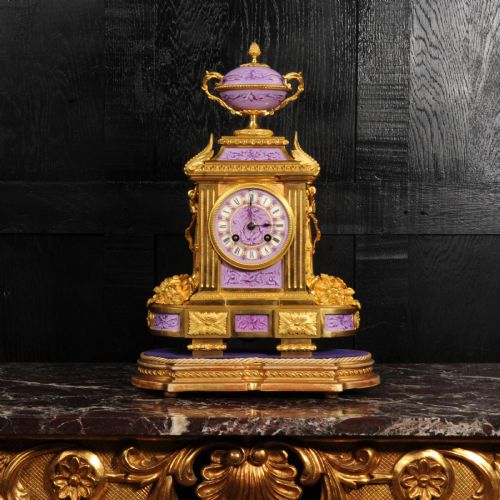
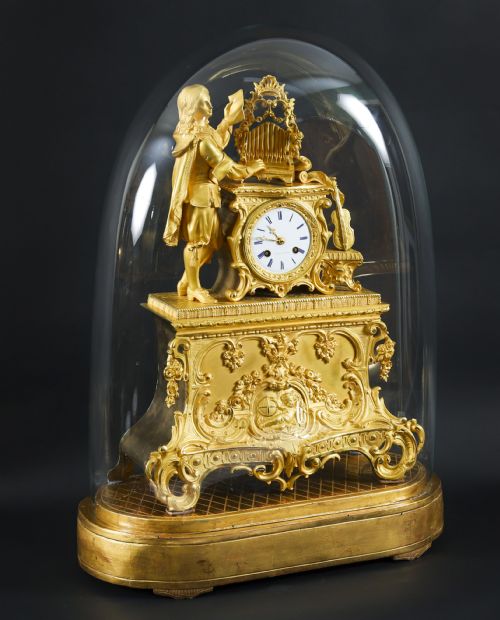
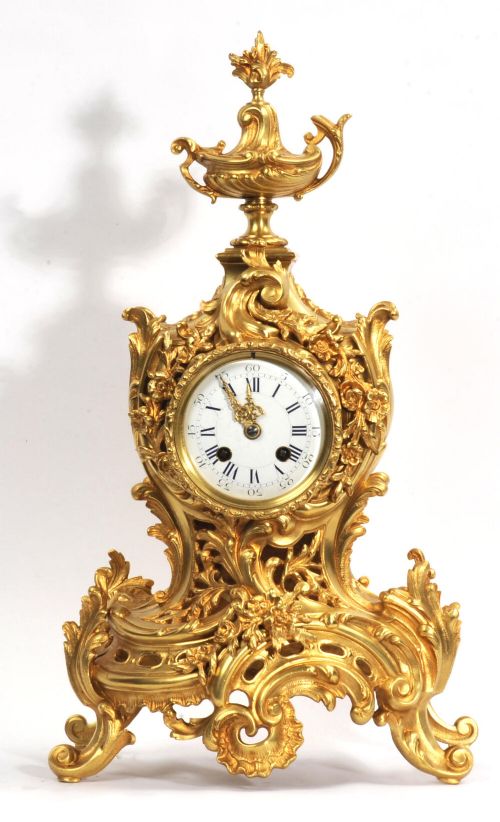
A gilded pendule de cheminee is a decorative mantel clock originating primarily from France, designed to sit prominently upon a fireplace mantel or console table. When you search for gilded pendule de cheminee, you encounter ornate timepieces spanning the nineteenth century, including Victorian examples and specific decades such as eighteen eighty.
The versions most commonly met on this page showcase elaborate French styling, notably French Rococo Revival, Louis XVI Revival, and Napoleon III designs. These clocks frequently integrate classical figures, such as Diana the Hunter, alongside traditional architectural proportions.
Makers and makers' marks occasionally appear on the dial or movement, linking individual pieces to Parisian clockmakers and bronze founders of the period. The overarching form remains centred on sculptural metalwork combined with functional horology.
What varies in quality
The fineness of the cast bronze or ormolu chasing sets the standard for visual depth and definition in the ornament. Crisp detailing in the foliage and figures distinguishes superior casting work from softer, simpler moulding.
The integration of painted porcelain panels and the clarity of enamel chapter rings contribute significantly to the overall presence of the clock. Harmony between the sculptural metalwork and the ceramic components elevates the piece.
Diana the Hunter occasionally stands guard atop the mantel, aiming her gilt bronze arrow straight across the drawing room.
Achille Brocot·Leroy Paris·PH Mourey·Leroy and Fils·Miroy Freres
The Gilded Pendule De Cheminee Glossary
- Ormolu
- Finely chopped gold applied to a bronze base using a mercury-gilding technique. This process creates a durable, warm metallic lustre.
- Pendule de cheminee
- French term for a mantel clock. These pieces were specifically scaled for placement on a fireplace mantel.
- Champleve
- An enamelling technique where troughs are dug into metal and filled with vitreous enamel. The surface is then fired and polished smooth.
- Napoleon III
- A nineteenth-century French design period spanning the mid to late eighteen hundreds. It embraces eclectic revivals of earlier royal styles.
- Sèvres
- Porcelain produced by the famous French royal manufactory. It is recognised for painted pastoral scenes and rich coloured grounds.
Gilded Pendule De Cheminee: Frequently Asked Questions
What is a pendule de cheminee?
A pendule de cheminee is simply a French mantel clock intended for display on a fireplace mantel or shelf. These clocks combine functional timekeeping with sculptural bronze or porcelain decoration.
They served as both practical timepieces and status symbols in nineteenth-century drawing rooms and parlours.
How do I wind the clock?
Winding typically involves inserting a key into the winding holes on the enamel dial to tension the spring movement. Care should be taken not to overwind the mainspring.
Consulting a professional horologist for initial setup ensures the pendulum and beat are properly adjusted.
Are these clocks accurate?
Nineteenth-century mechanical clock movements can keep reasonable time when properly serviced and adjusted. However, they rely on traditional pendulum regulation rather than modern quartz precision.
Regular cleaning and oiling by a clockmaker keep the gear train functioning smoothly over time.
How do I distinguish revival styles?
Rococo Revival pieces feature asymmetrical scrolls, shell motifs, and exuberant curves derived from eighteenth-century design. Louis XVI Revival examples display stricter symmetry, neoclassical columns, and straight architectural lines.
Examining the cast ornamentation and dial style helps assign a piece to its specific nineteenth-century revival movement.