


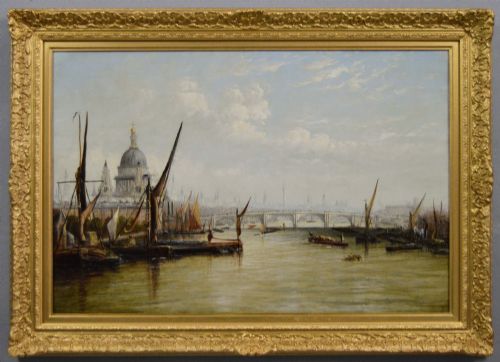
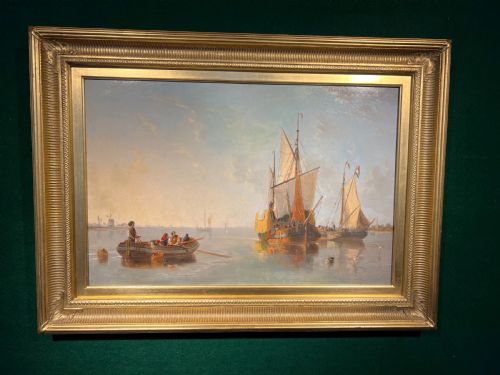
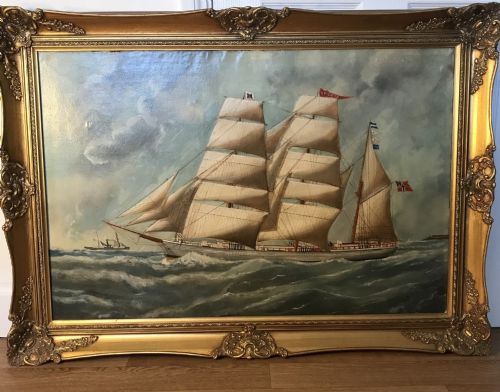
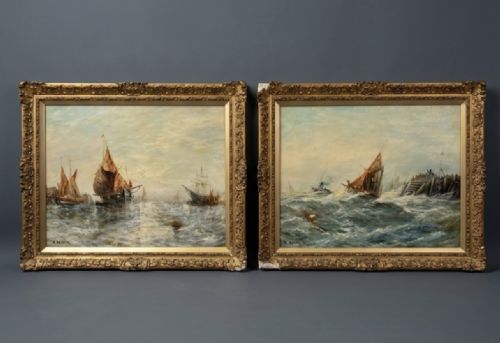
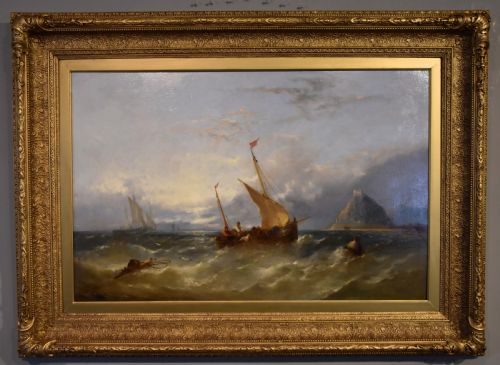
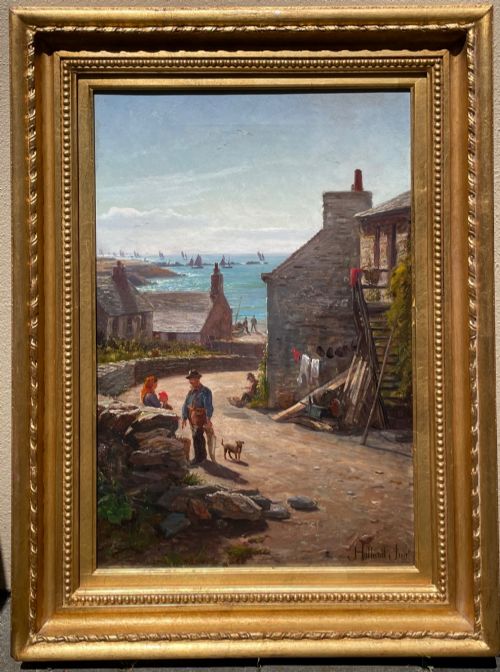
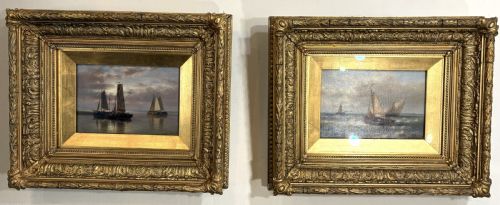


Gilded Framed Marine Painting
A gilded framed marine painting brings the motion of the nineteenth-century sea and harbour directly onto the wall.
Gilded Framed Marine Painting
A gilded framed marine painting captures maritime life, coastal views, and shipping vessels across the nineteenth century and into the early decades of the twentieth.
Buyers meet works depicting calm river scenes, stormy pierheads, and named sailing ships rendered in oil or watercolour.
Most examples originate from Victorian studios and depict British or European coastal waters framed in heavy giltwood.
How They Were Made
Artists painted primarily in oil on canvas, oil on board, or watercolour on paper, capturing maritime details with fine brushes.
The enclosing frames combine carved wood and moulded gesso covered in a layer of gold leaf or gilt finish.
Makers built sturdy wooden frames designed to protect the canvas while adding visual weight to the seascape.
Listings feature works spanning the nineteenth century, Victorian era, and early twentieth century, utilising oil paint, canvas, wood, and gesso.
What Varies in Quality
Quality rests in the precision of the maritime rigging, the movement of the water, and the depth of the coastal atmosphere.
The modelling of the gilt frame, particularly the crispness of the gesso ornaments and the warmth of the gilding, separates standard works from superior examples.
Skilled hand-carved wood frames complement the artistic merit of the canvas far better than plain moulded substitutes.
John Wilson Carmichael·Abraham Hulk I·Thomas Bush Hardy·James Webb·Gustave de Breanski
The Gilded Framed Marine Painting Glossary
- Giltwood
- Wood carved and coated with gold leaf or metallic paint. This finish gives antique frames their characteristic warm metallic gleam.
- Gesso
- A plaster mixture applied to wood frames before gilding. It provides a smooth base for intricate moulded corner ornaments.
- Pierhead
- A quay or harbour entrance where ships dock. These busy maritime locations frequently serve as the subject for nineteenth-century port paintings.
- Maritime art
- Works depicting ships, harbours, and coastal scenery. The genre spans calm coastal inlets and dramatic open sea shipwrecks.
Gilded Framed Marine Painting: Frequently Asked Questions
How do I identify a Victorian marine painting?
Victorian marine works usually feature realistic depictions of named sailing vessels, steamships, or coastal cliffs painted in oil or watercolour. The subjects reflect the maritime dominance and trade of the nineteenth century.
Clues also hide in the framing and stretcher bars behind the canvas. Period frames utilising moulded gesso over wood match the era of the painting.
What subjects appear in these coastal paintings?
Artists painted busy harbour scenes, fishing boats off rocky headlands, royal yachts, and dramatic shipwrecks in heavy seas. Many works record specific locations such as the Isle of Wight or the river Thames.
Some compositions focus on solitary three-masted schooners while others show crowded mercantile ports with steam tugs and pilot boats.
How should I hang a gilded frame?
Hang these heavy wooden frames on secure wall fixings capable of supporting the combined weight of the timber and canvas. Keep them away from direct sunlight and damp environments to protect the gilt surface.
Allow adequate space around the frame so the gilded moulding can catch the ambient room light without crowding adjacent pieces.
Are these paintings executed in oil or watercolour?
The selection includes both oil on canvas and delicate watercolour paintings under glass. Oil paintings offer rich textures and deep tones suitable for stormy seas, while watercolours provide crisp atmospheric light.
Both mediums appear frequently within nineteenth-century maritime art and share the same characteristic ornate gilt framing style.