

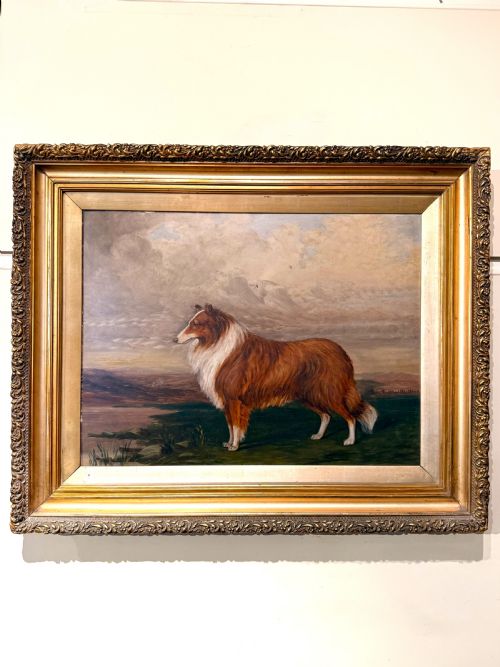



Gilded Framed Dog Art
Gilded framed dog art brings canine portraiture and sporting scenes from past centuries into rooms through period frames of gold leaf and wood.
Gilded Framed Dog Art
When buyers search for gilded framed dog art, they encounter oil paintings, watercolours, and etchings spanning from the eighteenth century to the early twentieth century. These works depict spaniels, terriers, hounds, and working dogs, often within pastoral landscapes, portraits, or rustic genre scenes.
The visual focus rests primarily on Victorian and Edwardian portrayals of dogs, reflecting the era's dedication to animal portraiture and sporting art. Pieces range from intimate oil sketches on board to larger framed canvases bearing the influence of notable artists and provincial schools.
Surrounding these canine subjects are period frames constructed of wood finished with gold leaf or giltwood, providing the characteristic metallic border that defines this category of antique fine art.
Materials and Technique
Painters applied oil paint or watercolour onto canvas, board, or paper, capturing the texture of canine coats and surrounding landscapes through layered pigment and fine brushwork. Some works utilise original etching techniques to delineate the subject.
Frames are built from solid wood, subsequently gilded using gold leaf or prepared as giltwood to create a reflective, luminous border that complements the artwork within.
Listings feature oil paintings, watercolours, and etchings executed on canvas, board, and paper, enclosed in wooden frames finished with gold leaf.
Evaluating Quality
Quality rests upon the artist's ability to render the anatomy and expression of the dog with liveliness and precision, separating competent portraits from rigid or formulaic depictions. The harmony between the painting and its original gilt frame also dictates the desirability of the piece.
The depth of the surrounding landscape or interior scene contributes to the overall merit of the artwork, distinguishing simple studies from complex genre compositions involving figures, horses, and rural architecture.
Valentine T. Garland·David Bates·C R Breytle·Herbert Dicksee·George E Sharpe·Sir Edwin Landseer·John Horsburgh·Edwin Frederic Holt·Robert Cleminson·John Constable·Richard Waitt·George Cole·Charles Bilger Spalding·A. Betts·George Romney·Frank Dadd·Thomas Blinks·Samuel Fulton·Charles Hunt Jnr
The Gilded Framed Dog Art Glossary
- Giltwood
- Wood carved and coated with gold leaf or metallic paint to create a decorative, reflective surface. This material forms the ornate borders characteristic of period frames.
- Oil on Canvas
- Pigment mixed with drying oil applied to a stretched woven fabric support. This combination allows for rich colour blending and durable preservation over centuries.
- Etching
- A printmaking method where acid cuts into unprotected parts of a metal plate to hold ink. Artists use this technique to produce fine, detailed lines on paper.
- Genre Painting
- Artwork depicting scenes from everyday life involving ordinary people and animals. These compositions often include cottages, farmyards, or rural landscapes.
Gilded Framed Dog Art: Frequently Asked Questions
What periods do these pieces date from?
The works span from the early eighteenth century through the Victorian and Edwardian eras up to the early twentieth century. Most examples originate from the nineteenth century.
Makers and provincial schools from these periods produced both formal portraits and rustic genre scenes featuring dogs.
Are the frames original to the art?
Many pieces retain their period giltwood or gold leaf wooden frames, which reflect the framing conventions of the eighteenth, nineteenth, and early twentieth centuries.
Matching frames enhance the historical integrity of the canvas or board they enclose.
What dog breeds appear most often?
Spaniels, terriers, greyhounds, lurchers, collies, and bulldogs frequently feature across the oil paintings and watercolours. Artists also depicted working hounds and sporting dogs alongside their owners.
These depictions reflect the cultural importance of hunting and domestic pets in past centuries.
How should I hang these framed works?
Display these pieces away from direct sunlight and excessive moisture to protect the delicate oil pigments and the metallic surfaces of the gilt frames. Ensure the wall fixings can support the weight of solid wood and canvas.
Positioning them at eye level allows the detail of the canine portraits to be appreciated.