






Gilded Foyer Table
These gilded foyer tables bring grand architectural presence and reflective surface to an entrance, combining carved timber and polished stone.
Gilded Foyer Table
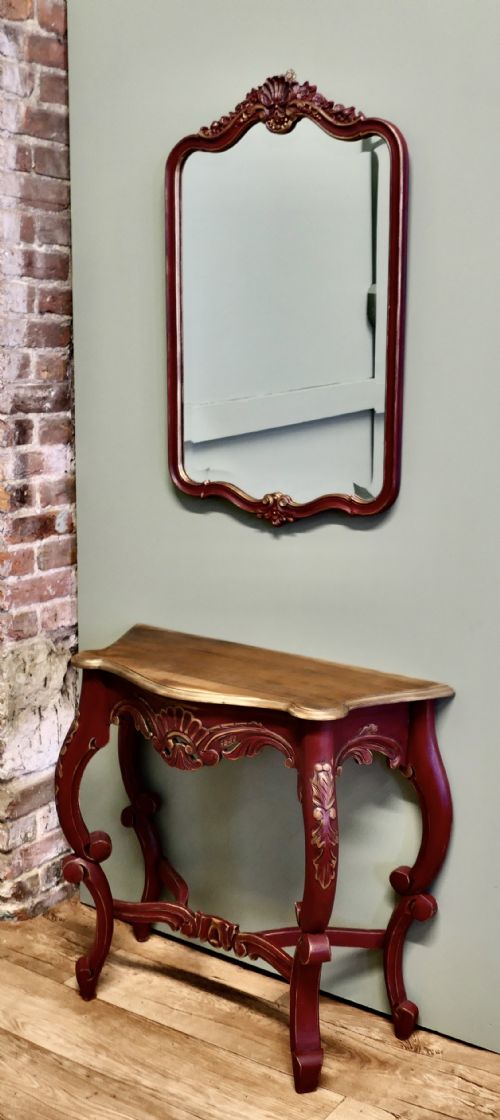
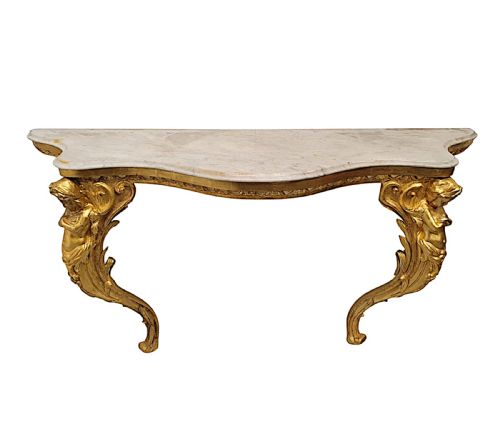
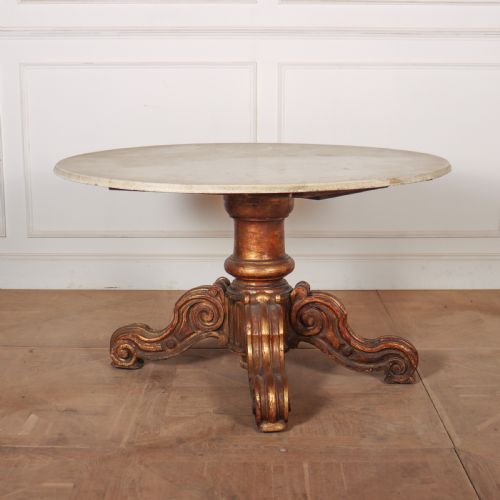
A gilded foyer table serves as a statement piece in an entrance hall, designed to stand against a wall or anchor the centre of the space. The selection spans distinct forms, primarily comprising console tables meant for wall placement and freestanding centre tables.
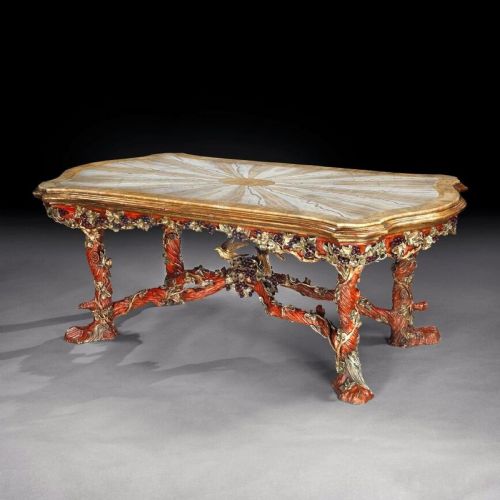
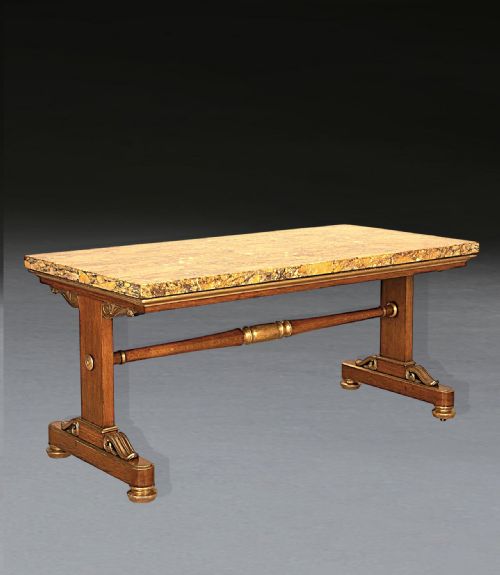
The aesthetic draws heavily on historical revivals, with Italian Baroque, French Rococo, and Neoclassical styles appearing frequently. Surfaces are frequently topped with heavy marble, including Siena and Breccia varieties, supported by elaborately carved wooden bases.
Dating ranges from the nineteenth century through to the early twentieth century, encompassing Regency and Victorian interpretations. Buyers will encounter both console tables paired with mirrors and standalone occasional or dining pieces.
How they were made
Makers shaped the structural framework from timbers such as mahogany, oak, and carved wood, often applying gold leaf or parcel gilt finishes to the exposed surfaces. Gilding techniques involved applying thin sheets of metal leaf over a prepared ground, creating a brilliant reflective sheen.
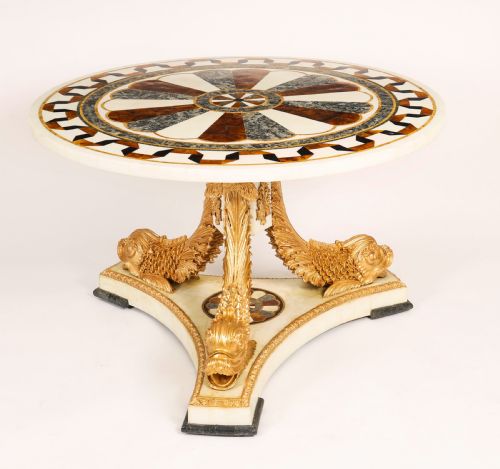
Tops were predominantly fashioned from natural stone, requiring precision cutting and polishing for marble and onyx surfaces. Carved details like lion's paw supports and dolphins were hand-chiselled directly into the wooden frames before finishing.
Gilded Foyer Table Retail Price Guide 2026
Typical asking prices for gilded foyer table among the pieces listed under this phrase on Sellingantiques today, from the lower quarter to the upper quarter. They describe what is for sale here now, not the wider market.
What varies in quality
The depth and crispness of the hand-carved woodwork dictate the refinement of the piece, with deeply undercut foliage and figures showing superior craftsmanship. Mass-produced or simpler mouldings lack the sculptural fidelity found in works attributed to specific makers like Amleto Bertoni.
The quality of the stone top significantly influences the overall character, where integrated veining and substantial thickness elevate the presence of the table. Original gilding condition and the integrity of the underlying gesso layers also distinguish finer examples from heavily restored ones.
Amleto Bertoni
The Gilded Foyer Table Glossary
- Giltwood
- Wood that has been coated with gold leaf or gold paint. This finish creates a luminous, reflective surface characteristic of formal period furniture.
- Console table
- A table designed to be fixed against a wall, frequently supported by ornamental brackets or legs at the front. These pieces often feature matching wall mirrors.
- Centre table
- A freestanding table meant to be viewed from all sides, traditionally placed in the middle of a room or grand hallway. They frequently incorporate circular marble or wood tops.
- Breccia marble
- A type of marble composed of broken fragments of rocks cemented together by a fine-grained matrix. It provides highly variegated and colourful natural patterns on table tops.
- Gueridon
- A small French table, typically round, supported by one or more columns or figurative pedestals. They serve as decorative occasional surfaces in reception spaces.
Gilded Foyer Table: Frequently Asked Questions
Where should I place a console table?
Console tables sit flat against a wall, making them suitable for narrow hallways, entrance foyers, or beneath large wall mirrors.
They occupy minimal floor depth while providing a useful surface for lamps, decorative objects, or correspondence.
How do I care for a marble top?
Marble surfaces require regular dusting with a soft, dry cloth and immediate blotting of any liquid spills to prevent staining.
Avoid using acidic cleaners or abrasive scourers that can etch or dull the polished stone finish over time.
Are centre tables meant for dining?
While certain large examples function as dining or breakfast tables, most centre tables serve decorative purposes in grand rooms.
Their substantial carved pedestals and delicate giltwood frames mean they are better suited for displaying objects than daily meals.
How do I identify Regency style?
Regency pieces draw inspiration from classical Greek, Roman, and Egyptian motifs, often incorporating dark woods and giltwood highlights.
Look for restrained architectural lines paired with bold decorative elements like carved dolphins or lion supports.