


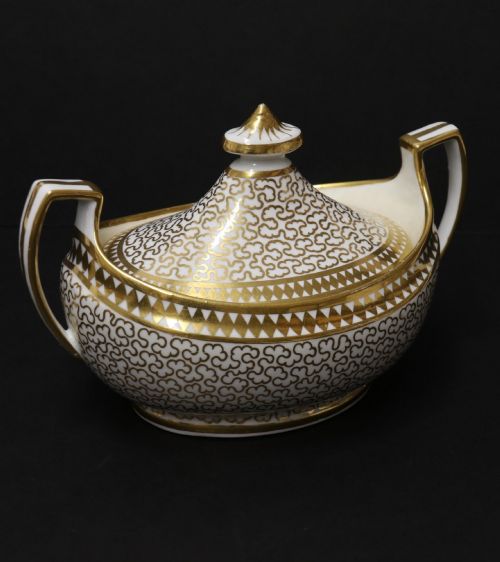
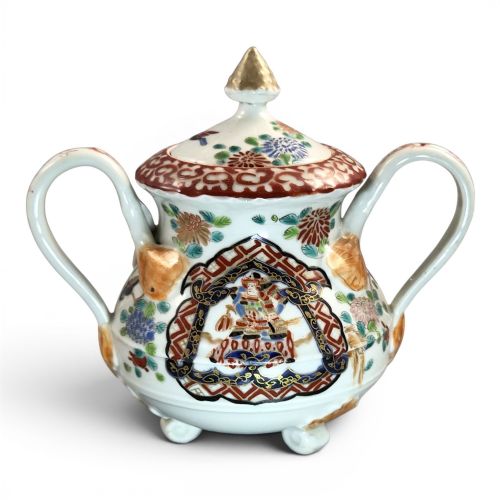


Gilded Ceramic Sugar Bowl
A gilded ceramic sugar bowl brings table elegance, and here you encounter refined porcelain and bone china examples.
Gilded Ceramic Sugar Bowl
A gilded ceramic sugar bowl serves as a refined vessel for sweetening hot beverages, often accompanied by matching covers or lids. These pieces span periods from the eighteenth century through to the early twentieth century.
The selections on this page include distinct forms such as covered sucriers, two-handled bowls, and items forming part of larger tea or coffee services. Styles range from Regency and Victorian Imari to French Rococo Revival and Meiji period Japanese ceramics.
Makers and studios represented include Chamberlains Worcester, Spode, Royal Crown Derby, and French producers like Old Paris and Limoges. Buyers will find both British porcelain traditions and continental or Japanese wares.
Materials and manufacture
These pieces utilise hard-paste porcelain, bone china, felspar porcelain, and earthenware as foundational bodies. Manufacturers shaped these materials into detailed bowls, sucriers, and broth cups before applying decorative treatments.
Gold leaf and gilt provide the metallic ornamentation that defines the category, often paired with enamel painting. Artisans combined hand-painted motifs with applied gilding to achieve the rich finishes seen across the periods.
Gilded Ceramic Sugar Bowl Retail Price Guide 2026
Typical asking prices for gilded ceramic sugar bowl among the pieces listed under this phrase on Sellingantiques today, from the lower quarter to the upper quarter. They describe what is for sale here now, not the wider market.
Samurais occasionally guard your sugar.
Distinctions in quality
The standard of gilding differs markedly between pieces, ranging from delicate hand-applied gold leaf work to simpler gilt highlights. Finer examples retain crisp metallic lustre alongside intricate enamel detailing.
Body composition and potting skill also separate the tiers, with translucent bone china and hard-paste porcelain representing superior manufacturing effort. The precision of painted patterns and the presence of clear studio or factory marks further elevate a piece.
Chamberlains Worcester·Spode·Royal Crown Derby·Royal Davenport·Ridgway·Ahrenfeldt and Asalvary·Shozan·Richard Ginori·Meissen·Barr Flight and Barr·Coalport
The Gilded Ceramic Sugar Bowl Glossary
- Sucrier
- A sugar bowl or sugar basin, usually provided with a matching cover. This term appears frequently in nineteenth-century British and European ceramics.
- Felspar porcelain
- A specialised porcelain body introduced in the nineteenth century, known for its density and whiteness. It provided a stable surface for detailed enamel and gilt decoration.
- Imari
- A decorative style originating in Japan, characterised by rich iron red, underglaze blue, and extensive gilding. British factories later adopted and adapted this palette during the Victorian era.
- Hard-paste porcelain
- A true porcelain made from kaolin and petuntse fired at high temperatures. It offers durability and a bright white ground ideal for gilding.
Gilded Ceramic Sugar Bowl: Frequently Asked Questions
How do I use an antique sugar bowl today?
These lidded vessels work well on a dining table or sideboard for serving sugar, sweets, or small confectioneries.
Hand washing is essential to preserve the delicate gold leaf and enamel decorations over time.
How can I tell the period of a porcelain bowl?
Examination of the paste, glaze characteristics, and factory marks often reveals the approximate manufacturing era.
Stylistic cues such as Regency neoclassical shapes or Victorian Imari patterns also help date the piece.
Were all these sugar bowls made in Britain?
While many pieces originate from English factories like Worcester and Spode, continental and Japanese workshops also contributed significantly.
French makers such as Old Paris and Limoges, alongside Japanese Meiji period studios, produced comparable luxury ceramics.
What is the difference between a bowl and a sucrier?
A sucrier specifically denotes a sugar bowl equipped with its original matching lid to keep contents clean.
Open decorative bowls serve broader display or serving functions without a fitted cover.