
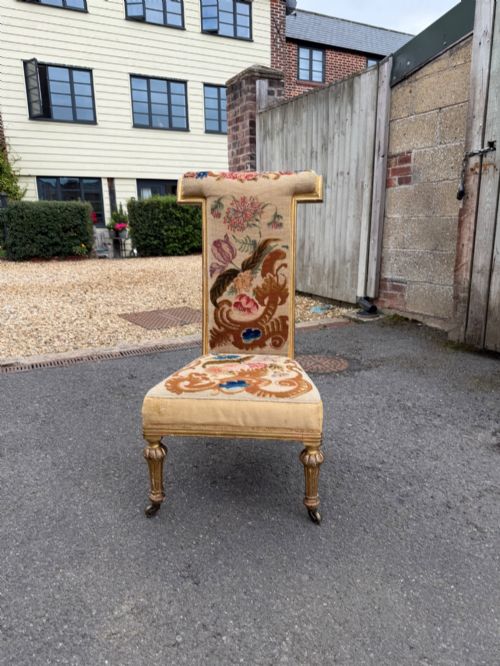
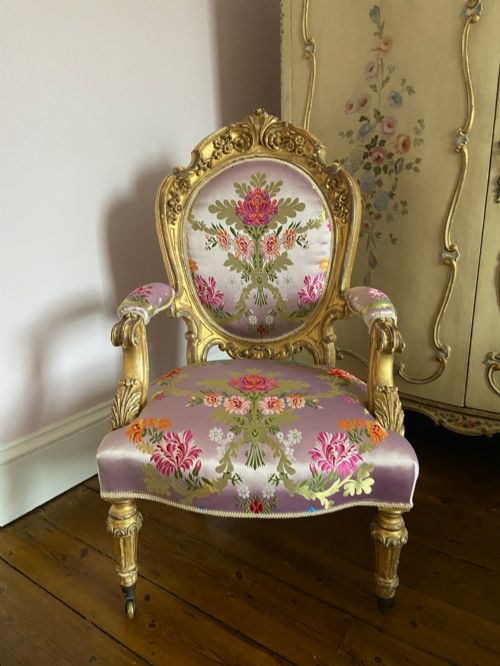
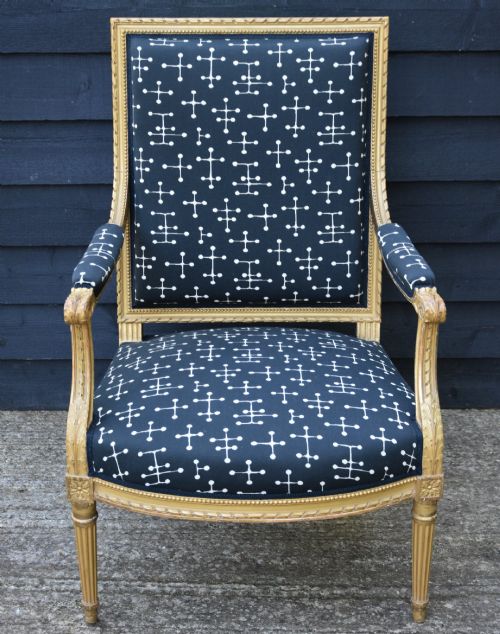
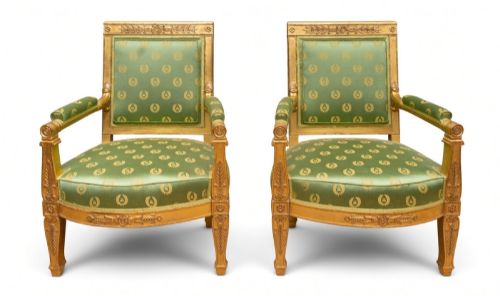
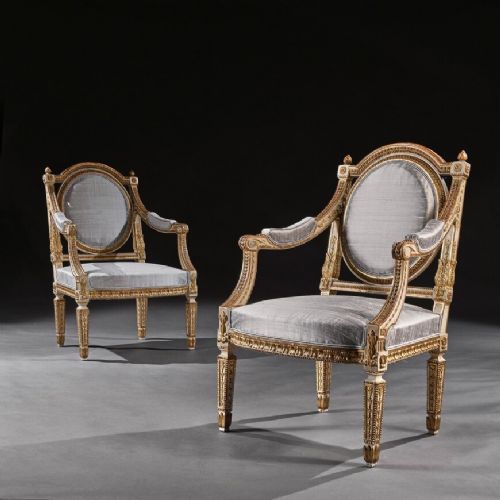
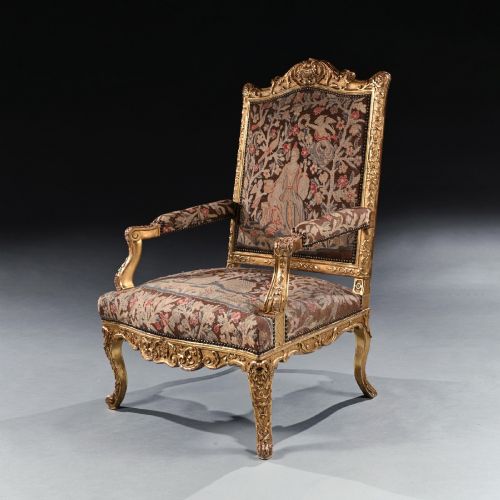
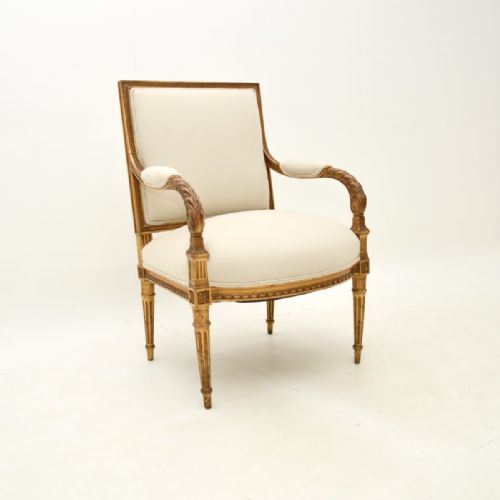
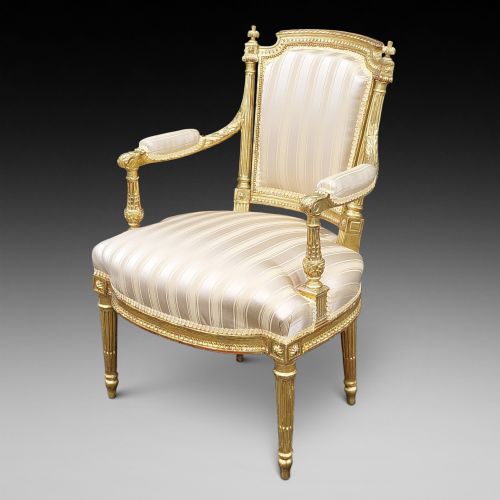
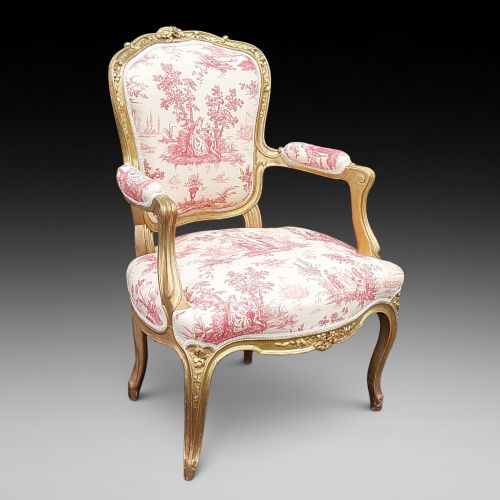
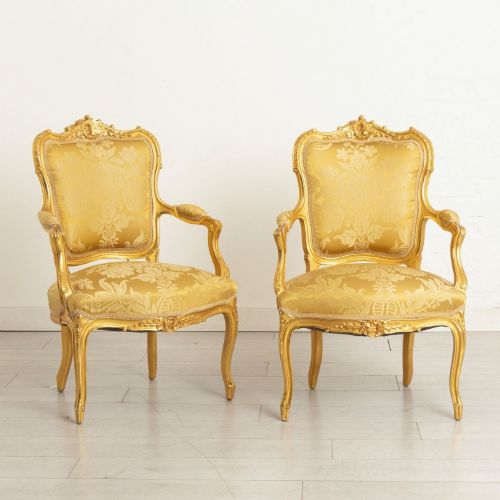


Gilded Carved Wood Chairs
Gilded carved wood chairs bring the formal elegance of French chateaux and Italian salons directly into a room.
Gilded Carved Wood Chairs
Gilded carved wood chairs encompass seating forms designed for formal rooms, ranging from open armchairs and side chairs to dining chairs and salon seating. The selection relies heavily on continental European influences, featuring French and Italian designs executed across the eighteenth and nineteenth centuries.
Armchairs, fauteuils, and bergere chairs dominate the form, alongside dining sets and occasional seating upholstered in silk, velvet, or leather. Buyers encounter nineteenth-century interpretations of earlier French styles such as Louis XVI, alongside period pieces from the eighteenth century.
The category extends to larger seating furniture sharing the same gilt surface treatment, including two-seat sofas, day beds, and tete a tete sofas. Construction frequently employs beech or walnut beneath the decorative leaf and paint layers.
Materials and construction
Carpenters shaped the primary structure from timbers such as beech, walnut, and English walnut, carving the wooden frames by hand before applying surface decoration. Joinery techniques united structural stability with elaborate ornamentation suited to formal interior reception spaces.
Artisans applied gold leaf or paint over the carved wooden surfaces to achieve the characteristic metallic brilliance seen on giltwood and parcel gilt frames. Upholstery completed the work, utilising textiles such as silk fabric, velvet, leather, and caning fixed to the seats and backs.
Listings feature materials such as giltwood, beech, walnut, silk, velvet, and leather across pieces dated from the eighteenth to the twentieth century.
Evaluating craftsmanship
Quality rests upon the crispness of the hand-carved detail in the wood, where deeper, more deliberate chiselling separates superior frames from simpler production. The application of the gold leaf layer dictates the depth of reflection across the carved contours.
The integrity of the underlying timber frame and the historical consistency of the upholstery materials influence the standing of an individual piece. Retaining original structural timber beneath the gilding marks the distinction between standard and finer examples.
Jacob Desmalter·Lamb of Manchester
The Gilded Carved Wood Chairs Glossary
- Giltwood
- Wood that has been covered with a thin layer of gold leaf. This surface treatment gives furniture a bright metallic finish.
- Fauteuil
- An open-arm armchair with upholstered back and arms. The wooden frame around the arms is typically exposed.
- Bergere
- An enclosed upholstered armchair with a stuffed back and sides. It frequently includes an exposed wooden frame and a loose seat cushion.
- Parcel Gilt
- A decoration method where only specific parts of an object are gilded while the rest is painted or left as natural wood. This technique highlights carved details.
- Caning
- Woven plant material used to form seats and backs on chairs. It provides a lightweight and flexible support surface.
Gilded Carved Wood Chairs: Frequently Asked Questions
Where should I place a giltwood armchair?
Giltwood armchairs suit formal reception rooms, drawing rooms, or bedrooms where their reflective gold leaf surfaces catch the light. They function well as statement pieces paired against neutral walls.
Care should be taken to keep them away from direct sunlight to protect delicate silk or velvet upholstery fabrics.
What is the difference between a fauteuil and a bergere?
A fauteuil is an open-arm armchair featuring exposed wooden sides between the upholstered armrest and the seat rail. A bergere has closed upholstered sides enclosed by the wooden frame.
Both forms utilise carved gilt wood structures but offer different levels of seating enclosure.
How should I clean gilded wood frames?
Gilded wood frames require gentle dusting with a soft, dry cloth to prevent abrasion to the thin gold leaf layer. Moisture and chemical cleaning agents must be avoided.
Maintenance focuses on preserving the original gilt surface rather than attempting to polish the metallic finish.