

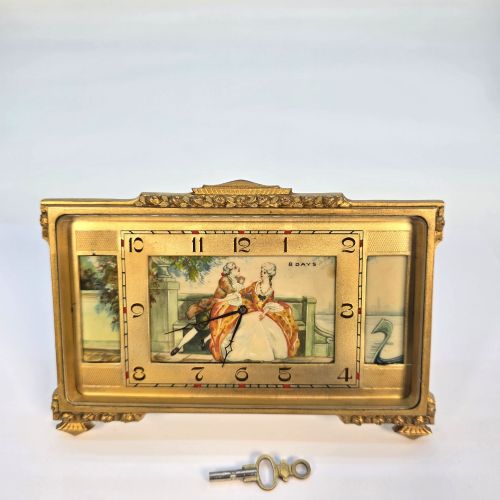
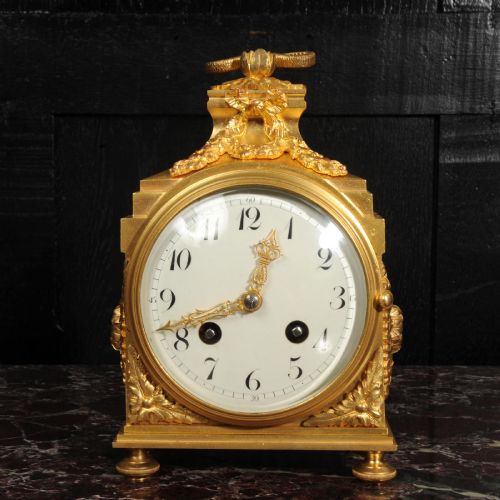


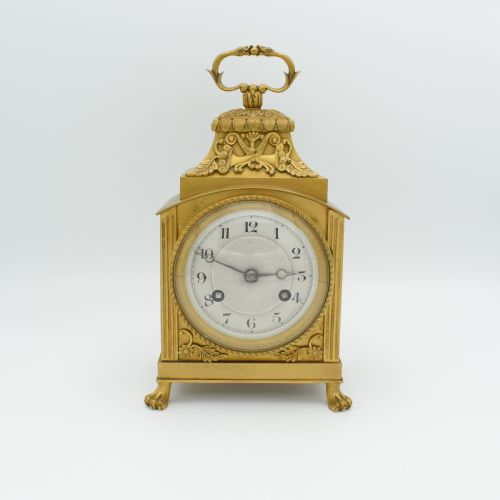

Gilded Bronze Carriage Clock
A gilded bronze carriage clock offers precise nineteenth-century mechanical craft within an ornate metal and glass case.
Gilded Bronze Carriage Clock
A gilded bronze carriage clock is a portable timepiece designed for travel or domestic placement during the nineteenth century. These objects combine heavy metal casting with glass panels to display the internal escapement and dial. Buyers searching this phrase encounter nineteenth-century examples spanning the Victorian period and French decorative styles.
The pieces listed on this page predominantly take the form of French carriage clocks, four-glass mantel clocks, and pendule d'officier models. Makers housed these movements in cases styled after French Empire, Rococo Revival, and French Neoclassical designs. Many examples feature enamel dials and distinctive bronze panels alongside the core metal framework.
Originating largely from French workshops during the 1850s to 1900s, these clocks reflect the industrial and decorative ambitions of the era. The surviving pieces show a clear preference for gilt brass, ormolu, and bronze housings fitted with bevelled glass. Collectors find that these timepieces serve as functional mantel ornaments as well as historical mechanical artefacts.
How they were made
Artisans constructed these clocks using cast bronze, brass, and gilt metals finished with mercury gilding or modern electroplating to achieve the characteristic bright surface. The metal frames were cast, chased, and polished by hand before being fitted with thick, bevelled glass panes on multiple sides. This construction allowed light to flood the movement while protecting the delicate gear train from dust.
Dial faces were typically produced in white enamel with black Roman or Arabic numerals, sometimes complemented by painted porcelain or gilt accents. The internal mechanisms relied on brass gear wheels, steel arbors, and escapements designed for portable use, often incorporating strike and repeat complications. Craftsmen integrated decorative cast bronze or ormolu mounts directly onto the structural brass plate housing.
Gilded Bronze Carriage Clock Retail Price Guide 2026
Typical asking prices for gilded bronze carriage clock among the pieces listed under this phrase on Sellingantiques today, from the lower quarter to the upper quarter. They describe what is for sale here now, not the wider market.
Some clocks were built so ruggedly for officers on campaign that they could survive a canter across a muddy European battlefield and still chime the hour.
What varies in quality
The refinement of the cast bronze and ormolu mounts sets superior examples apart, showing crisp chasing and deep relief rather than soft, mass-produced detailing. High-grade movements often include complicated strike and repeat mechanisms or bear the signature of established makers like E.J. Dent or Paul Garnier. The quality of the enamel dial, free from hairline cracks and fading, also dictates the desirability of the piece.
Proportion and architectural balance within the four-glass or pendule d'officier format influence overall visual success. Superior models maintain original gilding integrity and clean, unpolished bevelled glass panes that secure tightly into the heavy metal frame. The integration of specialised bronze panels or porcelain inserts marks the upper tier of nineteenth-century production.
E.J. Dent·Paul Garnier
The Gilded Bronze Carriage Clock Glossary
- Ormolu
- Gilded bronze produced by applying a mixture of gold and mercury to a bronze base and heating it until the mercury vaporised. This historic technique created a rich, durable golden finish found on nineteenth-century French luxury goods.
- Pendule d'Officier
- A specific style of military or travel clock featuring a distinctive arched or handled top case. These clocks were originally invented for officers on campaign during the Napoleonic era.
- Four-Glass Clock
- A mantel clock housed within a brass and glass case that permits a clear view of the movement from all sides. The design became popular during the Victorian period for displaying intricate escapements.
- Strike and Repeat
- A mechanical clock complication that allows the timepiece to sound the hours upon demand via a button or cord. This feature was essential for telling time in the dark during travel.
Gilded Bronze Carriage Clock: Frequently Asked Questions
What is a pendule d'officier?
A pendule d'officier is an early form of portable timepiece with a distinctive arched case and a sturdy carrying handle designed for military campaigns. These clocks bridge the gap between pocket watches and large domestic mantel clocks.
They are celebrated for their robust construction and association with Napoleon Bonaparte's officer corps.
Why are some panels bronze?
Makers incorporated cast bronze panels into the exterior of certain carriage and mantel clocks to add decorative relief and architectural weight. These panels often displayed classical motifs or floral scrollwork cast in high detail.
The heavy bronze elements also provided structural rigidity to the brass and glass frame.
How do I date a Victorian carriage clock?
Dating relies on examining the style of the case, the typography on the enamel dial, and any maker signatures stamped on the brass backplate. Victorian and late nineteenth-century pieces often exhibit refined ormolu mounts and sophisticated escapements.
Comparing the escapement type, such as a platform lever, helps narrow down the production decade between 1850 and 1900.