



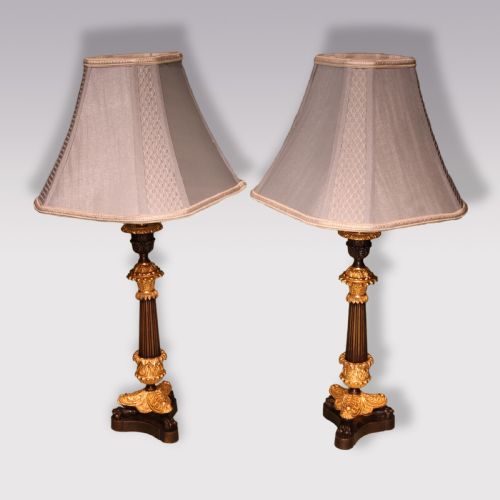


Gilded Bronze Candlestick Lamp
These gilded bronze candlestick lamp examples bring monumental French and English weight to a room through cast metal and rich surface gilding.
Gilded Bronze Candlestick Lamp
A gilded bronze candlestick lamp combines sturdy nineteenth century metalwork with practical domestic illumination, forming a grand centrepiece for a table or sideboard. These pieces originate across Victorian, Regency, and early twentieth century workshops, drawing heavily on classical French and English design idioms.
The most frequent form on this page is the adapted altar candlestick or classical column, shifting from ritual or manual lighting to electrical use. Surviving examples often appear as matched pairs, utilising robust brass, marble, and patinated bronze alongside prominent gilt enrichment.
Makers leaned heavily into historical revivals, producing heavy cast metal bodies shaped in Louis XV, Rococo, and Neoclassical styles. Buyers will encounter both converted antique altar pieces and dedicated lamp bases built to hold fabric shades.
Materials and construction methods
Casting forms the structural core of each piece, utilising heavy brass, bronze, and base metals shaped into Rams head motifs, fluted columns, and elaborate scrollwork. Artisans applied mercury gilding or modern electroplating to achieve the bright ormolu surface finish characteristic of the period.
Marble elements frequently anchor the heavier bases, adding substantial weight and contrasting texture to the polished metallic components. Later conversions involved boring through solid metal shafts to accommodate modern wiring without disturbing the historic exterior.
Ram heads peek from several nineteenth century column mounts, watching over sideboards with fixed metallic expressions.
The markers of superior execution
The sharpness of the original chasing separates standard production from finer workshop output, as skilled artisans hand-tooled the cast bronze before gilding. Crisp relief in acanthus leaves, animal heads, and floral mounts indicates a higher standard of period craftsmanship.
Surface preservation dictates overall desirability, with intact fire gilding holding a warm, buttery lustre that differs sharply from flat modern paint or worn plating. The structural integrity of heavy marble bases and the precision of the original metal joints further distinguish finer examples.
The Gilded Bronze Candlestick Lamp Glossary
- Ormolu
- Gilded bronze produced by applying a mercury and gold amalgam to a bronze object and heating it until the mercury vaporised. This historic technique leaves a durable, rich golden surface.
- Patinated bronze
- Bronze that has been treated chemically or aged naturally to produce a darkened surface colour. This dark tone contrasts effectively with bright ormolu mounts.
- Neoclassical
- A design style inspired by classical Greece and Rome that emphasises symmetry, columns, and restraint. It dominates many nineteenth century lighting forms.
- Altar candlestick
- A tall, heavy candlestick originally designed for church altars and later converted for domestic lighting. These pieces provide exceptional height and architectural presence.
- Rococo Revival
- A nineteenth century decorative style characterised by asymmetrical scrollwork, naturalistic shell motifs, and flowing curves. It appears frequently in French inspired lamp bases.
Gilded Bronze Candlestick Lamp: Frequently Asked Questions
What is a gilded bronze candlestick lamp?
These objects are heavy metal lighting fixtures created by mounting nineteenth century candlesticks or candelabra with electrical fittings. They combine sculptural metalwork with functional home illumination.
Most examples utilise brass, bronze, and gilt finishes derived from French or English decorative traditions spanning the Regency to the Edwardian eras.
How do I identify a converted candlestick?
Conversion involves drilling a vertical channel through the original metal stem to pass electrical wiring, often adding a switch or lamp holder to the top socket. Historic altar pieces and table sticks show plugged wick holes or threaded adaptors where the original spike once stood.
Examining the base and interior reveals how the mounting hardware secures the old metal body to the modern electrical components.
Are these lamps usually sold as pairs?
Many listings feature matching pairs of lamp bases, originating from grand nineteenth century interiors where symmetrical placement on sideboards or mantelpieces was standard practice. Single pieces also appear, often representing altar sticks or larger standard lamps.
Matching pairs share identical casting moulds, patination styles, and decorative mounts.
How do I care for antique ormolu?
Ormolu surfaces require gentle dusting with a soft, dry cloth to prevent accumulation of grit in the chased recesses. Avoid abrasive cleaning agents or harsh metal polishes that strip away the historic gold layer.
Maintaining a stable indoor humidity prevents corrosion on the underlying bronze and protects any integrated marble or fabric components.