




German Jugendstil Glasses
German Jugendstil glasses are expressive vessels of the Art Nouveau movement, bringing sinuous botanical motifs and organic forms straight to your table.
German Jugendstil Glasses
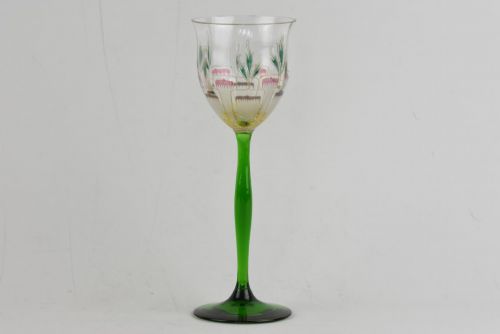
German Jugendstil glasses encompass a range of delicate tableware and decorative vessels, including hock glasses, wine glasses, cordial glasses, and chalices. These pieces emerge primarily from the turn of the twentieth century, aligning with the height of the continental Art Nouveau movement.
Most examples you encounter feature blown glass bodies ornamented with vibrant enamel decoration, often depicting floral motifs or botanical subjects. Alongside standalone drinking vessels, related tablewares integrate silvered pewter mounts and silver plate frames produced by prominent German metalwork studios.
Materials and construction
The foundation of these pieces relies on blown glass, crystal, or cameo glass, shaped by hand into fluid organic silhouettes. Makers utilised techniques such as polychrome enamel decoration and gold leaf to bring surface patterns to life.
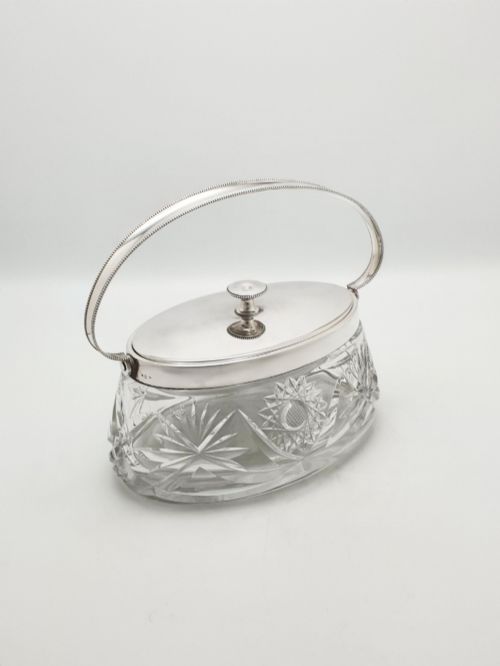
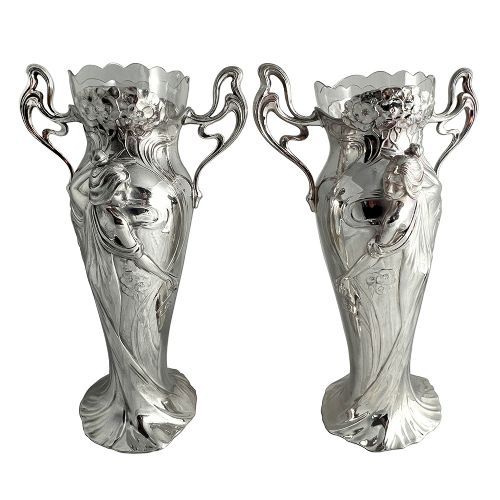
Many glass vessels are combined with structural mounts in silvered pewter or silver plate. These metal frames often display characteristic whiplash lines and figural motifs produced through specialised casting and plating methods.
Materials recur across glass, crystal, silvered pewter, and hand-applied enamel.
Assessing quality and execution
Quality rests upon the crispness of the glass blowing and the precision of the hand-applied enamel work. Superior examples display finely rendered polychrome details and balanced proportions that respect the organic tenets of the style.
The integration between the glass body and any metal mount also dictates overall excellence. Finer pieces demonstrate seamless casting in the silvered pewter or silver plate, ensuring the metalwork complements rather than overpowers the glass.
Theresienthal·Frits Heckert·WMF·Ferdinand von Poschinger·Orivit·Adelbert Niemeyer
The German Jugendstil Glasses Glossary
- Jugendstil
- The German manifestation of Art Nouveau, named after the Munich art magazine Die Jugend. It prioritises dynamic, linear curves and plant-inspired forms.
- Roemer
- A traditional Germanic wine glass featuring a wide bowl atop a cylindrical, studded stem and a conical foot. They frequently appear in pale green glass with enamel painting.
- Hock glass
- A tall-stemmed wine glass traditionally used for German white wine. They often feature coloured crystal bowls decorated with intricate enamel work.
- Silvered pewter
- An alloy of tin that has been treated or plated to give a bright silver finish. It was widely utilised by German metalwork firms for mountings and decorative vessels.
- Cameo glass
- Glass formed with multiple layers of different colours, where portions of the top layer are carved away to reveal the contrasting colour beneath.
German Jugendstil Glasses: Frequently Asked Questions
How do I clean antique enamel glasses?
Wash these pieces gently by hand using lukewarm water and a mild soap. Avoid soaking them or using abrasive sponges that might damage the delicate enamel decoration.
Dry them immediately with a soft, lint-free cloth to protect both the glass and any applied gold leaf.
Were these glasses meant for daily use?
While originally created as functional tableware for wine and cordials, their age and delicate enamel work make them better suited for careful display.
If you do use them for dining, handle them gently and keep them away from modern dishwashers.
What is the difference between Jugendstil and Art Nouveau?
Jugendstil is simply the specific German-language term for the broader Art Nouveau movement that swept across Europe around nineteen hundred.
Both share a focus on organic lines and natural motifs, though German design often leans towards geometric structure alongside floral curves.
How do I identify a piece by WMF?
Look for the manufacturer's stamped hallmarks usually found on the metal bases, handles, or pewter mounts of the objects.
WMF items often combine glass liners with silvered pewter or silver-plated frames featuring distinct botanical designs.