
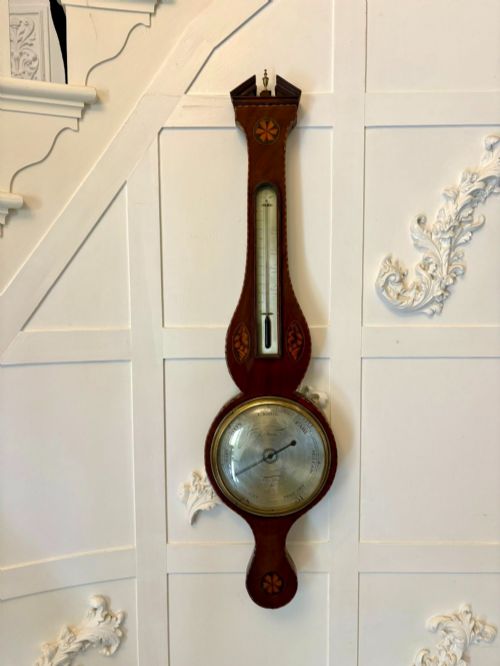
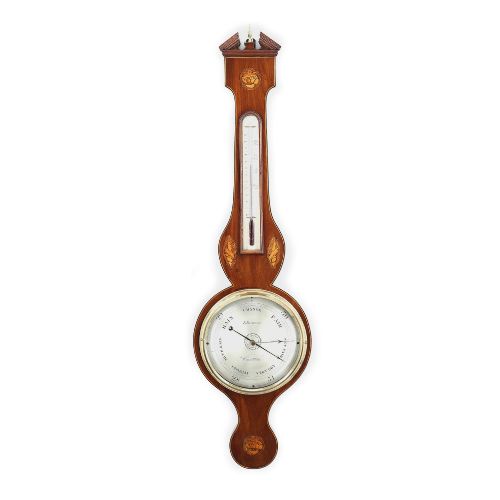
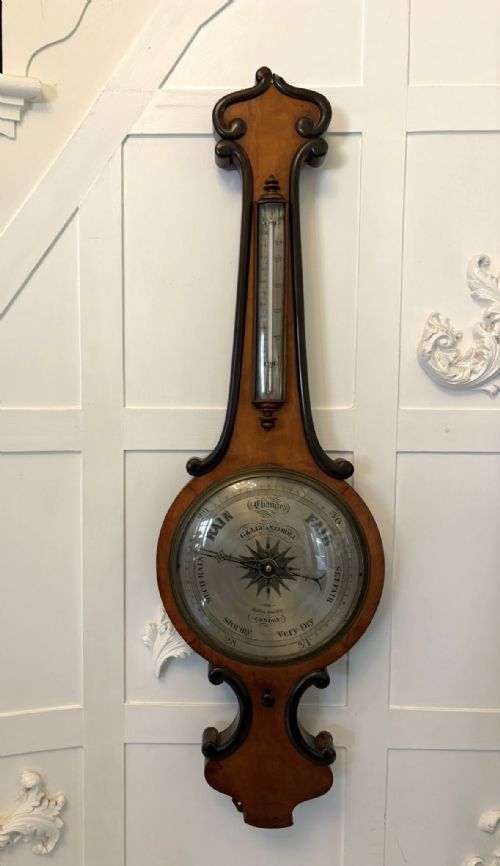


Georgian Wheel Barometer
A georgian wheel barometer brings the domestic weather office of the late eighteenth and nineteenth centuries into a hallway.
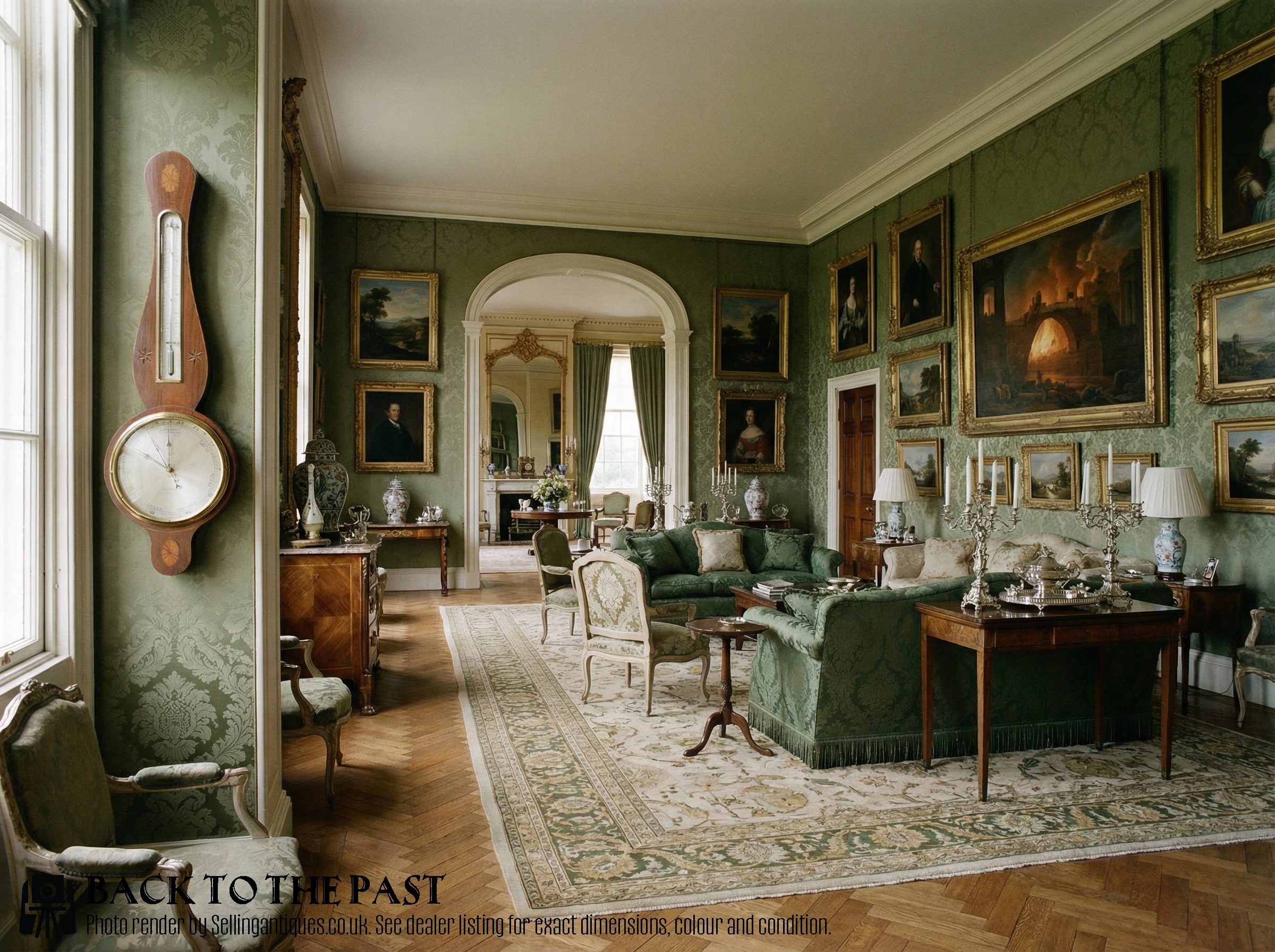
Georgian Wheel Barometer
A georgian wheel barometer is a mercurial wall instrument designed to track atmospheric pressure through a dial mechanism connected to a siphon tube. These wall barometers combine practical weather forecasting with furniture-grade cabinetry intended for prominent display.
The version most frequently found on this page takes the form of a banjo barometer, housed in a mahogany or rosewood case with a swan-neck pediment and a round dial at the base. Makers often integrated additional instruments into the case, such as spirit levels, hygrometers, thermometers, and occasional clock movements.
Examples span the Georgian, Regency, and early Victorian periods, drawing on centuries of craftsmanship established by immigrant Italian instrument makers working across English towns and cities.

Materials and Construction
Cases rely heavily on dense hardwoods like mahogany and rosewood, frequently accented with boxwood and shell inlay, mother of pearl, or contrasting stringing around the edges. Dial faces are typically formed from silvered metal, protected behind curved glass held in brass bezels.
Internal mechanics depend on mercury moving within sealed glass tubes, transmitting weight changes through a fine silk thread or chain to a brass pulley and indicator hand. The woodwork requires precise joinery to house the fragile glass column securely while allowing easy access to the internal cistern.
Georgian Wheel Barometer Retail Price Guide 2026
Typical asking prices for georgian wheel barometer among the pieces listed under this phrase on Sellingantiques today, from the lower quarter to the upper quarter. They describe what is for sale here now, not the wider market.
Many itinerant Italian instrument makers who signed these dials walked the roads of Britain with barometers strapped to their backs.
Assessing Quality and Execution
Quality rests in the crispness of the cabinetmaker's inlay, the depth of the timber's grain, and the elegance of the case proportions rather than mere size. Superior pieces feature finely engraved silvered dials with distinctive maker signatures and detailed floral or shell pattering.
The sophistication of the movement and the inclusion of auxiliary instruments like hygrometers or matching thermometer scales elevate an example. Original brasswork, intact mercury columns, and unblemished glass bezels separate ordinary utility pieces from finer parlour instruments.
B. Besozzi of Weymouth·G & L Guanziroli London·Ganthony of London·Prada of High Wycombe·Molton of Norwich·Luisetti of London·Fagioli of Clerkenwell London·Giana Shrewsbury·Jenkins Of Old Swindon·L Casatelli of Liverpool·Watkins·Roncoroni·H Marks Bloomsbury·Hayward of Ashford·Vecchio & Co Shaftsbury·Bianchi Ipswich·A. Rivolta·J Groce York·Bassi·F Salteri & Co Nottingham·Dominic Gatty·Russell of Liverpool·L. Malacrida Holborn London·George Dollond of London·Volenterio
The Georgian Wheel Barometer Glossary
- Banjo barometer
- A wall barometer featuring a rounded dial at the base and a long tapering trunk, resembling the shape of a banjo. This form became the standard domestic layout during the Georgian and Regency periods.
- Silvered metal
- A brass or copper dial plate treated to achieve a bright, reflective silver finish before being engraved with weather scales and maker details. The fine black wax infill highlights the graduation markings.
- Mercurial barometer
- An instrument that measures atmospheric pressure using liquid mercury sealed within a glass tube. Changes in air pressure push the column up or down, turning the mechanical dial via a float.
- Hygrometer
- A secondary instrument fitted into the case to measure atmospheric humidity, often styled as a smaller dial matching the main barometer face.
- Pediment
- The decorative architectural crowning element at the top of the barometer case, commonly found in architectural scroll, swan-neck, or triangular forms.
Georgian Wheel Barometer: Frequently Asked Questions
How do I read a wheel barometer?
The main dial displays pressure readings ranging from stormy through change to fair, tracked by the primary pointer. Tapping the glass gently settles the mercury before noting the reading.
A secondary pointer, adjusted by an external brass knob, can be set directly over the current hand to record whether pressure rises or falls over the day.
Can these barometers be hung near a radiator?
Wall barometers require stable indoor environments away from direct heat sources, damp walls, and strong sunlight. Sudden temperature shifts warp the timber case and affect the glass tube.
Hanging the instrument on an interior partition wall ensures the mercury responds accurately to true atmospheric pressure changes rather than room drafts.
How do I tell an 18th century barometer from a Victorian one?
Earlier eighteenth-century examples often favour simpler architectural lines with restrained mahogany veneers and delicate handwritten dial signatures. Victorian models frequently feature heavier walnut or rosewood cases with more elaborate shell inlay and stamped brasswork.
Examining the construction of the backboard and the style of the dial typography helps establish the manufacturing period.
Are these antique barometers still accurate?
Many surviving instruments maintain correct barometric function if the sealed glass tube retains its vacuum and mercury column intact. Professional adjustment of the internal pulley and counterweight may be required.
Even when mechanical calibration drifts over centuries, the instrument remains a striking domestic fixture.