

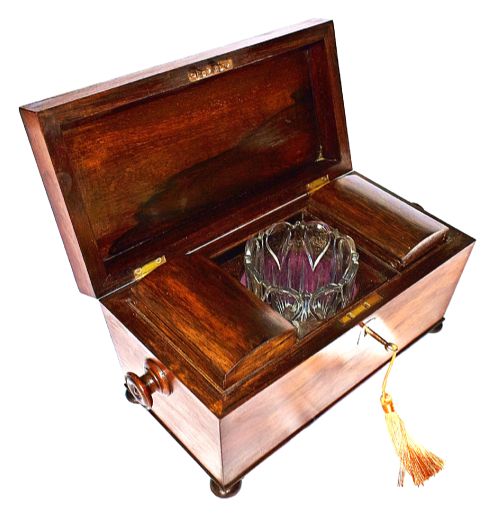


Georgian Tea Chest Glass
Georgian tea chest glass pieces are fitted interior mixing bowls that bring the authentic period ritual of blending loose leaves right to your table.
Georgian Tea Chest Glass
When you search for georgian tea chest glass, you are looking at fitted interior vessels designed for wooden tea caddies and boxes. These items typically appear alongside mahogany, satinwood, and rosewood containers from the Georgian, Regency, and 18th Century periods.
The glass component itself served as a mixing bowl or rinsing bowl within double or single compartment caddies. Most examples found on this page belong to Regency and 18th Century forms, frequently accompanying sarcophagus or box shaped containers.
How they were made
These glass bowls were produced to fit snugly inside wooden cabinetry alongside materials like brass, mahogany, and satinwood. Makers utilised cut glass techniques to create faceted rims and sides that caught the candlelight during evening tea service.
Georgian Tea Chest Glass Retail Price Guide 2026
Typical asking prices for georgian tea chest glass among the pieces listed under this phrase on Sellingantiques today, from the lower quarter to the upper quarter. They describe what is for sale here now, not the wider market.
Current listings feature items spanning the 18th Century, Georgian, and Regency periods, constructed from mahogany, satinwood, glass, and brass.
What varies in quality
The distinction between standard examples and superior pieces rests on the weight and clarity of the glass. Heavier metal content and precise, deep cutting set the finer mixing bowls apart from simpler, plain-moulded alternatives.
The Georgian Tea Chest Glass Glossary
- Mixing glass
- A glass bowl fitted inside a tea caddy used for blending different tea leaves or diluting brewed tea. These vessels sit securely in dedicated internal compartments.
- Sarcophagus form
- A box design characterised by a steep, hinged lid and a tapered, coffin-like body resting on small feet or bun bases. This style became popular during the Regency period.
- Parquetry
- A geometric mosaic of wood veneers arranged in decorative patterns on the exterior of a box. This technique showcases contrasting timbers such as satinwood and rosewood.
- Canister
- A separate lidded compartment within a tea chest designed to hold a single variety of dry leaf safely away from moisture and light.
Georgian Tea Chest Glass: Frequently Asked Questions
What was the glass bowl used for?
The glass bowl served as a mixing vessel where different grades of loose tea leaves could be blended together before brewing. It was also utilised to rinse leaves or wash porcelain teaspoons during the formal tea ceremony.
These bowls sat directly inside a dedicated circular recess carved into the wooden interior of the caddy, surrounded by lidded canisters.
How do I date a tea chest?
Dating relies on observing the cabinet timber, construction methods, and overall architectural style. Pieces from the 18th century often display simpler rectilinear proportions, whereas Regency examples frequently adopt sarcophagus shapes with bracket feet and intricate brass ring handles.
The presence of specific decorative techniques like penwork or parquetry inlay further helps narrow down the manufacturing window to the early nineteenth century.
Are the glass bowls usually original?
Finding a glass bowl that matches the exact age and wear of the surrounding wooden tea chest is a key consideration for collectors. Many surviving caddies lost their original glass inserts over centuries of use, leading to replacement vessels being fitted later.
An authentic pairing shows consistent signs of age, such as matching lime scale deposits, base wear, and correct dimensions that fill the internal wooden aperture without excess clearance.