
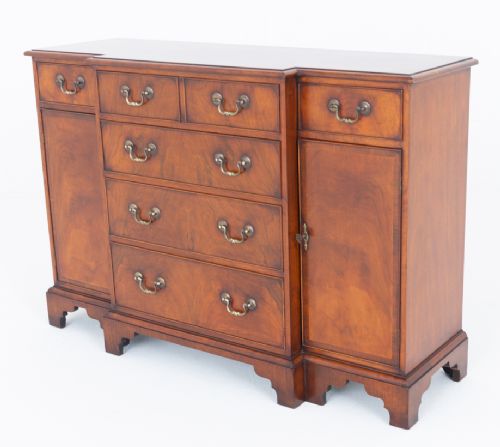


Georgian Style Walnut Credenza
These georgian style walnut credenza selections bring substantial timber storage and refined period presence to a room.
Georgian Style Walnut Credenza
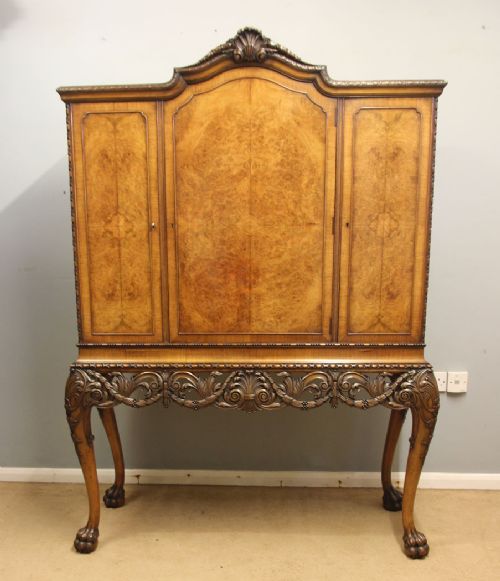
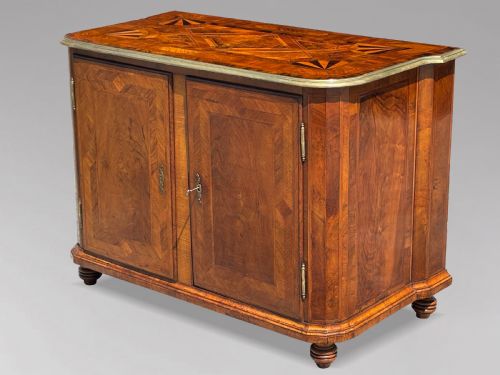
When you search for a georgian style walnut credenza, you encounter heavy timber storage furniture spanning side cabinets, sideboards, breakfront bookcases, and dresser bases. The selection here leans heavily towards twentieth-century revivals alongside eighteenth-century Italian and Maltese examples.
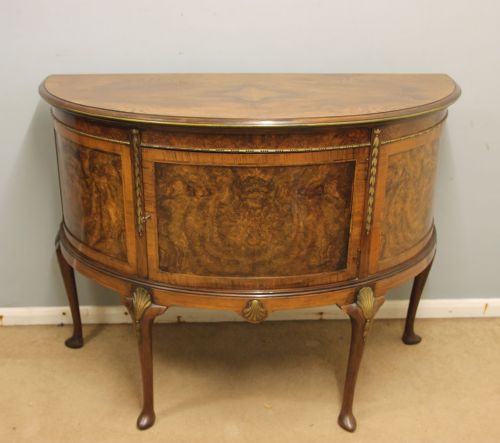
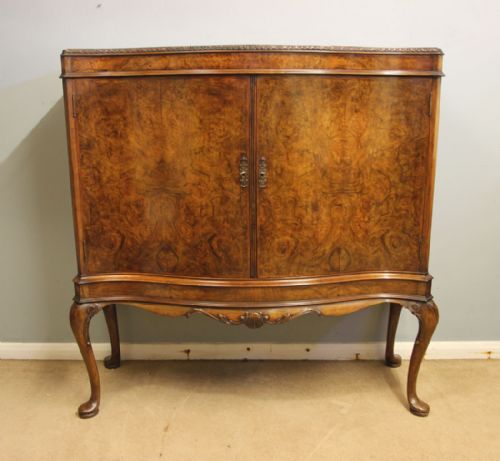
Forms vary from demi lune side cabinets and three-door sideboards to breakfront bookcases with drawers and country house storage cabinets. These items serve primarily as display and storage furniture within principal rooms.
The aesthetic bridges Queen Anne styling, Baroque flourishes, and Neoclassical lines. Makers utilise revival periods from the nineteenth and twentieth centuries to echo earlier craftsmanship.
How they were made
Construction relies upon solid walnut and decorative veneers, particularly burr walnut and figured walnut, mounted to create striking grain patterns across large surfaces. Crossbanding often frames the principal timber panels.
Metal mounts in brass and iron provide structural support and operational hardware for doors and drawers. These components complement the rich brown tones of the walnut timber.
Listings feature walnut timber alongside brass and iron, spanning the eighteenth, nineteenth, and twentieth centuries.
What varies in quality
The refinement of the timber selection marks the primary difference across these items, distinguishing plain walnut boards from highly figured burr veneers and intricate crossbanding. Execution of revival styles also varies from straightforward functional pieces to grand breakfront commissions.
Origin and period depth influence the character of each piece, ranging from eighteenth-century continental workshops to twentieth-century British cabinet makers such as Maple & Co.
Maple & Co.
The Georgian Style Walnut Credenza Glossary
- Burr walnut
- A prized timber harvested from tree growths that produces intricate, swirling grain patterns. It is typically sliced into veneers for decorative cabinet fronts.
- Breakfront
- A piece of furniture where the central section projects forward from the flanking wings. This architectural arrangement creates depth and shadow.
- Crossbanding
- A strip of veneer laid around the border of a panel with the grain running at right angles to the central timber. This technique creates a neat framing effect.
- Demi lune
- A half-moon shape used to describe furniture with a curved front and flat back designed to sit against a wall. Such silhouettes soften room layouts.
Georgian Style Walnut Credenza: Frequently Asked Questions
What is a georgian style walnut credenza?
These pieces comprise large timber storage units, side cabinets, and sideboards sharing historical revival characteristics. They incorporate walnut timbers and traditional cabinet forms.
Items range from twentieth-century revival pieces to eighteenth-century continental examples. Each serves as a substantial focal point for storage and display.
What materials should I expect?
Construction primarily utilises walnut, featuring burr walnut and figured walnut veneers to create decorative surfaces. Crossbanding and brass or iron hardware frequently appear.
Timbers are finished to highlight natural grain patterns and rich brown colour variations across the cabinet doors and drawers.
How do I distinguish the periods?
Dating relies upon construction techniques, timber preparation, and stylistic markers associated with Queen Anne, Baroque, or Neoclassical revivals. Eighteenth-century pieces carry distinct continental origins.
Nineteenth and twentieth-century revival items adapt these historical idioms using contemporary workshop methods of their respective decades.