

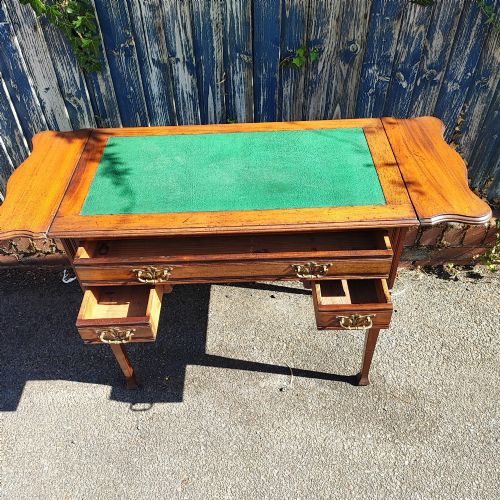




Georgian Style Ladies Desk
A georgian style ladies desk offers compact elegance for correspondence, drawing heavily on eighteenth-century revival designs made for domestic writing.
Georgian Style Ladies Desk
A georgian style ladies desk encompasses writing tables, compact bureaux, and refined bonheur du jour pieces created across the nineteenth and early twentieth centuries. These forms reflect earlier aesthetic ideals adapted for smaller domestic spaces.
The selection here includes Edwardian interpretations alongside earlier revival pieces, often featuring fitted upper tiers, small drawers, and writing surfaces inset with leather. These variations show how cabinetmakers continually reinterpreted classic proportions.
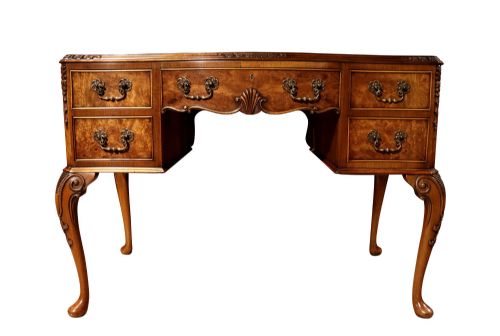
Buyers seeking a georgian style ladies desk find various configurations, from cylinder bureaux to delicate kidney-shaped writing tables. Each form prioritises refined utility alongside decorative woodwork.
Materials and construction
Cabinetmakers utilised rich timbers such as mahogany, satinwood, and walnut, often applying delicate marquetry inlay to enhance the primary surfaces. These woods provided both durability and a fine canvas for decorative banding.
Working details include brass handles, leather writing inserts, and intricate stringing that delineates drawer fronts and tabletops. Construction methods combined structural stability with refined decorative finishing.
Listings span periods from the eighteenth century through to the 1930s, featuring revival styles alongside earlier pieces in mahogany, satinwood, and walnut.
Judging quality
Quality rests in the precision of the timber selection and the crispness of any inlaid marquetry rather than elaborate ornamentation. Finer examples display carefully matched grain patterns across primary surfaces and drawer fronts.
The execution of small interior compartments and the smoothness of drawer operation distinguish higher grade pieces from simpler commercial productions. Attention to secondary timbers inside drawers also indicates careful workshop standards.
Shoolbred of London·John McLean
The Georgian Style Ladies Desk Glossary
- Bonheur du jour
- A light writing desk featuring a small cabinet or set of drawers on the upper surface. This French form became popular during revival periods for domestic boudoirs.
- Carlton House desk
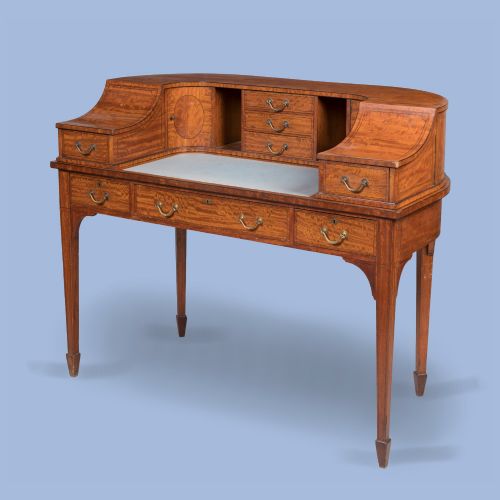
- A distinctive horseshoe-shaped writing desk with a stepped superstructure of small drawers and pigeonholes. It provides numerous compartments arranged in a graceful curve around the writer.
- Marquetry inlay
- Decorative patterns formed by fitting contrasting veneers into a prepared wooden ground. Cabinetmakers used geometric motifs and floral designs to enrich tabletops and drawer fronts.
- Bureau on stand
- A drop-front writing compartment raised on an open frame with legs. This configuration lightens the visual weight of storage furniture.
- Satinwood
- A pale, lustrous timber native to the tropics, frequently used for veneering and inlay work during the eighteenth and revival periods. Its golden hue brightened refined interior settings.
Georgian Style Ladies Desk: Frequently Asked Questions
What is a bonheur du jour?
A bonheur du jour is a light writing table equipped with a small superstructure of drawers or a cabinet on top. It served as an elegant piece for correspondence in private rooms.
Such pieces gained immense favour during the late nineteenth and early twentieth-century revival periods, combining decorative appeal with practical storage for stationery.
Where were these desks used?
These desks were primarily designed for private withdrawing rooms, bedrooms, or boudoirs where full-sized library furniture proved too heavy or large. Their compact proportions suited domestic correspondence.
Today, they function well in home studies or living spaces as compact writing surfaces that double as decorative furniture.
What woods are commonly found?
The listings feature mahogany, satinwood, and walnut as primary cabinet timbers. Many examples incorporate rosewood, kingwood, and intricate marquetry inlay for decorative contrast.
These varied timbers reflect both eighteenth-century preferences and the revival movements of the Victorian and Edwardian eras.