

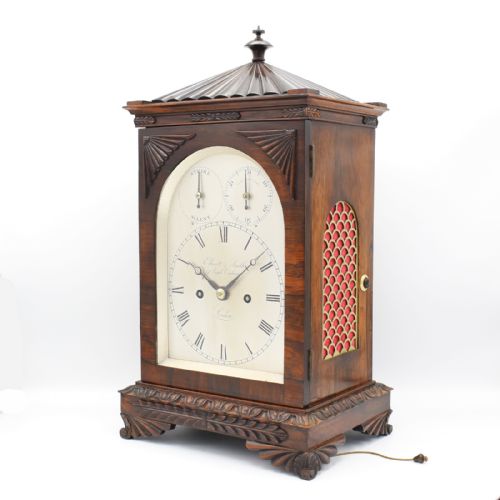


Georgian Striking Table Clock
A georgian striking table clock commands attention with precise mechanical craft, elegant wood cases, and deep acoustic chimes that mark the hours.
Georgian Striking Table Clock
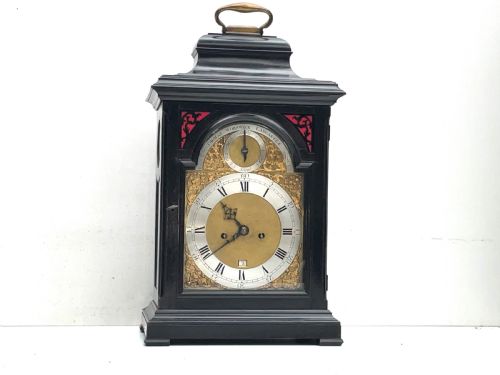
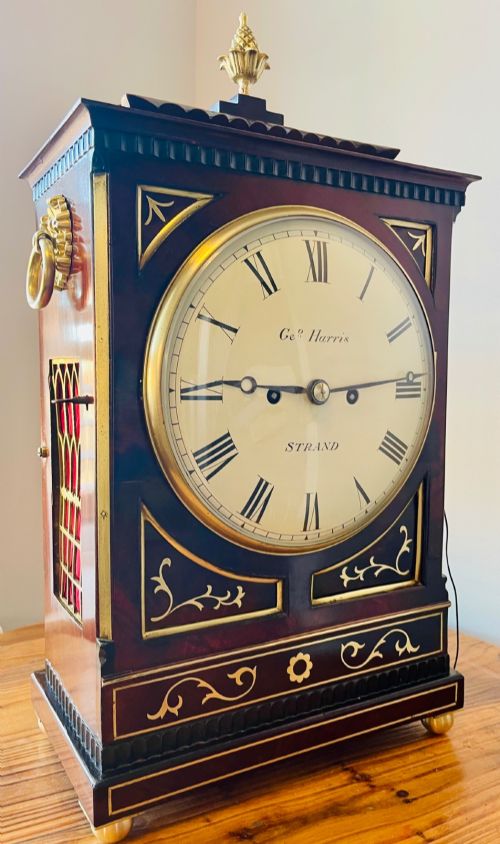
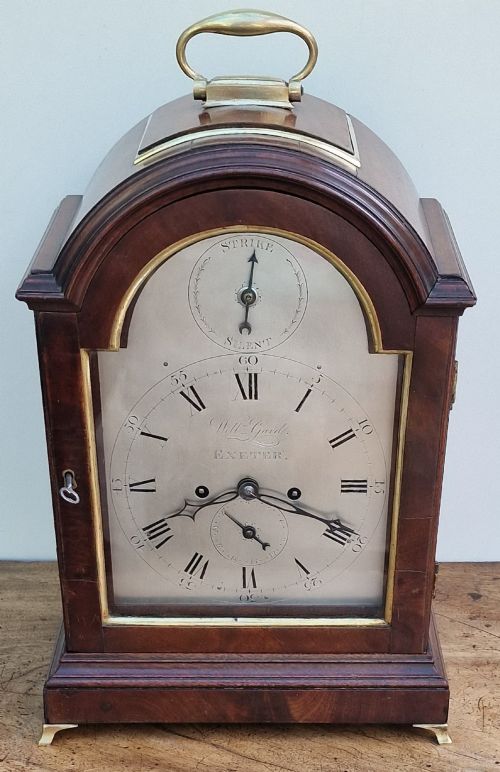
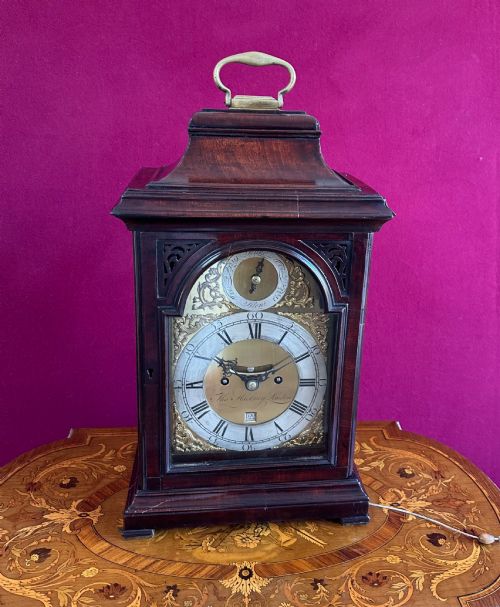
A georgian striking table clock sits as a substantial mechanical timekeeper, designed for domestic interiors during the eighteenth and early nineteenth centuries. These pieces appear most often as bracket clocks or table clocks housed in architectural wooden cases.
The selection on this page draws heavily from the Georgian and Regency periods, spanning the eighteenth and nineteenth centuries. Mahogany and ebonised wood dominate the visible finishes, complemented by brass mounts and silvered dials.
Forms range from bell-top and inverted bell-top designs to balloon cases and lacquered finishes. Makers from London feature prominently alongside regional makers from Exeter, Hereford, and Scotland.
How They Were Made
Cases utilise dense hardwoods like mahogany and ebonised wood, frequently decorated with brass handles, frets, and ormolu mounts. Lacquered surfaces in red and gold or green and gold appear on specialised pieces.
Movements rely on fusee mechanisms to equalize power delivery from the mainspring as it unwinds. Verge escapements and anchor escapements regulate the gear train, while striking mechanisms sound hours and quarters on internal bells.
The listings span the eighteenth, nineteenth, and twentieth centuries, featuring wood, brass, enamel, and tortoiseshell materials.
What Varies in Quality
The refinement of the movement engraving and the precision of the gear train separate standard production from masterwork output. Signed dials by noted makers carry greater horological significance.
Cabinetwork quality shows in the choice of veneer, the crispness of brass casting, and the preservation of original finishes like bell-top hoods and glazed side panels.
William Gard·Mappin & Webb·Ellicott & Smith·John Witherston·Des Granges·Louis Recordon·Somersall·Agar Of Malton·Frodsham & Baker·William Withers·John Taylor·James Smith·Chater & Son·Robert Higgs·John Leroux·John McGregor·John Fletcher·John Ellicott·Isaac Hurley·Joseph Lum·John Rapton·Barwise·Watson·William Smith·Percy Webster
The Georgian Striking Table Clock Glossary
- Fusee
- A conical pulley used in spring-driven clocks to maintain equal force on the gear train as the mainspring unwinds. This mechanism ensures consistent timekeeping as the clock runs down.
- Verge escapement
- An early type of escapement mechanism that controls the rotation of the escape wheel. It provides the characteristic rapid tick associated with eighteenth-century movements.
- Bracket clock
- A portable spring-driven clock originally designed to sit on a wall bracket or a table. Many examples include carrying handles on top of the wooden case.
- Bell-top
- A distinctive case shape featuring a stepped or domed upper section resembling a bell. This silhouette was popular on bracket clocks during the eighteenth century.
- Silvered dial
- A brass clock face treated with a silver solution to create a matte white metallic finish. Numerals and maker signatures are typically engraved and blackened for legibility.
Georgian Striking Table Clock: Frequently Asked Questions
Where did people place these clocks?
These clocks sat on sturdy wooden tables, mantelpieces, or dedicated wall brackets within main rooms of a house. Their portable nature allowed owners to move them between studies, drawing rooms, and bedrooms.
The loud striking mechanisms ensured the hours could be heard across multiple rooms before the widespread use of personal pocket watches.
How do twin fusee movements function?
Twin fusee movements utilise two separate gear trains driven by individual fusee cones and mainsprings. One train powers the timekeeping mechanism while the second train drives the striking or chiming sequence.
This separation prevents the striking mechanism from interfering with the precision of the escapement and gear train.
What indicates an eighteenth century date?
Eighteenth century pieces frequently employ verge escapements, brass backplates with floral scroll engraving, and bell-top wooden cases veneered in mahogany or ebonised wood. Maker signatures on the dial or movement backplate often trace to specific working decades.
Later nineteenth century examples tend toward anchor escapements and simpler dial layouts without intricate backplate engraving.
How should I wind a fusee clock?
Winding requires inserting a key into the dial winding holes and turning clockwise until the spring reaches tension. Care must be taken not to overwind the mechanism, stopping as soon as resistance increases.
Most eight day movements require winding once a week to maintain continuous operation and accurate timekeeping.