


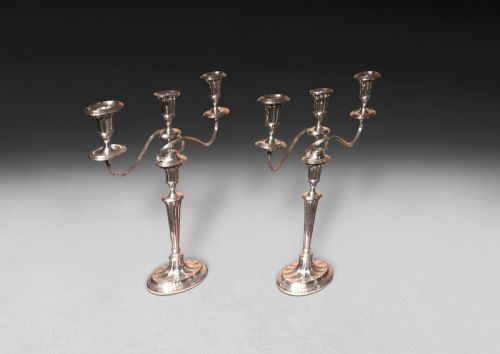

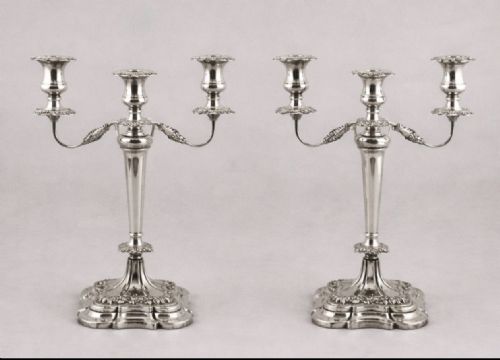

Georgian Silver Table Candelabra
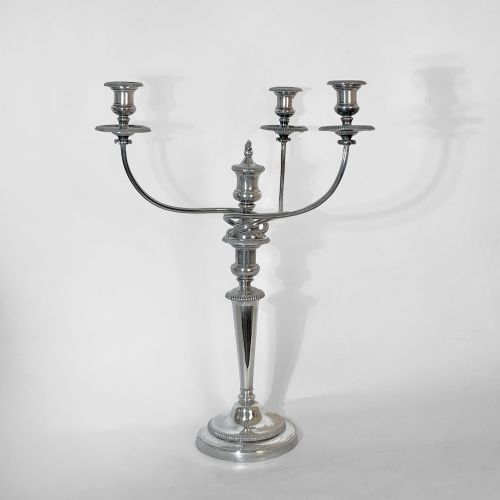
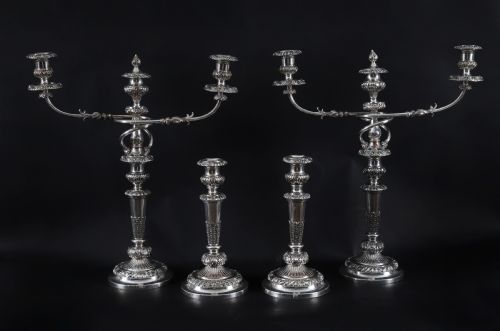
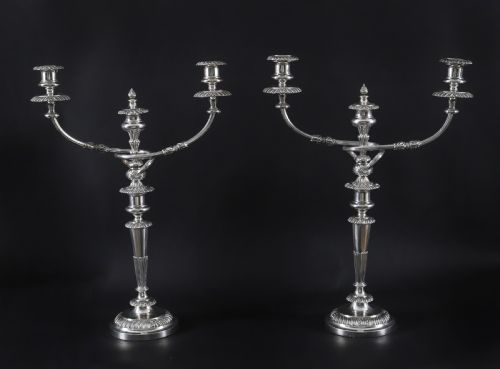
These georgian silver table candelabra combine refined illumination with commanding presence, bringing period architectural weight to a dining surface.
Georgian Silver Table Candelabra
When searching for georgian silver table candelabra, buyers encounter multi-light lighting pieces designed to grace dining tables and sideboards during the eighteenth and nineteenth centuries, alongside later revivals. The form typically supports two, three, or four lights arranged across branching arms that emerge from a central stem.
Pieces on this page span the eighteenth century and Regency periods, stretching through later reproductions from the nineteenth and twentieth centuries. Examples emerge in sterling silver, old Sheffield plate, and standard silver plate, reflecting both domestic British manufacture and continental European workshops.
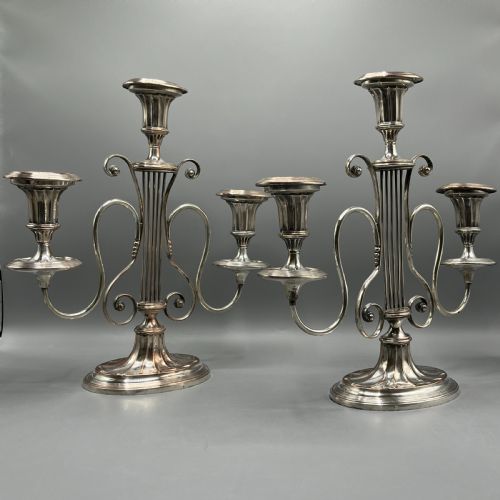
The most common configurations are pairs of three-light candelabra featuring circular or lyre-shaped bases, often executed in Old Sheffield Plate. These range from substantial George III suites to later Georgian style pieces produced in sterling silver.
How they were made
Makers constructed early pieces using Old Sheffield Plate, fusing a thin sheet of silver onto a heavier copper core, a technique that produces characteristic warm highlights where the base metal gently telegraphs through. Sterling silver examples utilise traditional casting and smithing methods to form heavy, solid structural elements.
Arms and branches are engineered to detach from the main column, allowing the pieces to function as standard candlesticks when the branching superstructure is removed. Bases are weighted or filled to provide stability for the heavy branching arms above.
Many multi-light pieces double as everyday candlesticks by simply lifting off their branching arms, offering versatile dining room illumination.
What varies in quality
Quality reveals itself in the crispness of chased and cast ornament, from neoclassical swags to rococo scrollwork, where sharper definition indicates superior tooling. The integrity of the plating on plated examples matters greatly, particularly how well the silver layer survives across high-friction areas like socket rims and drip pans.
Proportion and balance define the superior end of the range, ensuring the branching arms sit securely without listing. Weight distribution across the base dictates whether a piece feels substantial in the hand and stands firmly on the dining surface.
Matthew Boulton·Blagden, Hodgson & Co.
The Georgian Silver Table Candelabra Glossary
- Old Sheffield Plate
- A composite material formed by fusing a sheet of silver to a copper ingot, developed in the eighteenth century before electroplating. This technique produces distinct edge seams and subtle copper undertones.
- Candelabrum
- A branched lighting fixture designed to hold multiple candles, distinguished from a single-stick candlestick by its removable arms. The plural form candelabra is frequently applied to pairs.
- Regency
- A style period spanning the early nineteenth century, characterised by bold neoclassical lines, classical revival motifs, and architectural restraint. Pieces from this era often feature clean geometric forms.
- Lyre-shaped
- A design motif incorporating the symmetrical, curved outline of a stringed musical instrument into the central column or support. This shape appears frequently in Regency platework.
- Sterling silver
- A silver alloy containing a fixed proportion of pure silver combined with other metals to ensure durability for domestic objects. Items meeting this standard bear official assay hallmarks.
Georgian Silver Table Candelabra: Frequently Asked Questions
How do I clean my candelabra?
Clean silver components using a gentle, non-abrasive polish applied with a soft cloth to protect intricate chased details. Old Sheffield Plate requires particular caution to avoid wearing through the thin silver layer down to the underlying copper.
Avoid liquid dips entirely, as harsh chemicals strip the patination and damage soldered joints. Regular dusting with a dry microfiber cloth prevents tarnish buildup in recessed decorative areas.
Are these pieces safe to use with candles?
These pieces function reliably with standard taper candles, provided the sockets match the candle diameter snugly. Secure placement prevents melting wax from dripping onto delicate metal surfaces or surrounding furniture.
Monitor burning candles closely and extinguish them before the flame reaches the metal drip pan. Excess heat can compromise historical solder joints within the branching arm assembly.
How do I distinguish old Sheffield plate from sterling?
Old Sheffield plate often reveals a thin line of reddish copper where the silver layer has worn away along edges or high points. Sterling silver pieces maintain a uniform white metal colour throughout and typically feature government assay hallmarks.
Magnification helps identify the characteristic lap joints on plated items where the fused metal sheet was bent around a form. Sterling items are cast or hammered as solid silver rather than layered over a copper core.
Can the branching arms be removed?
Most multi-light examples feature a central nozzle or screw fitting that allows the upper branch assembly to detach from the main column. This modular construction enables the base to serve as a standalone single candlestick.
Care should be taken when separating components to avoid straining the central threaded rod or damaging the fitted sockets. Ensure the threads are clean and aligned properly before reattaching the arms.