

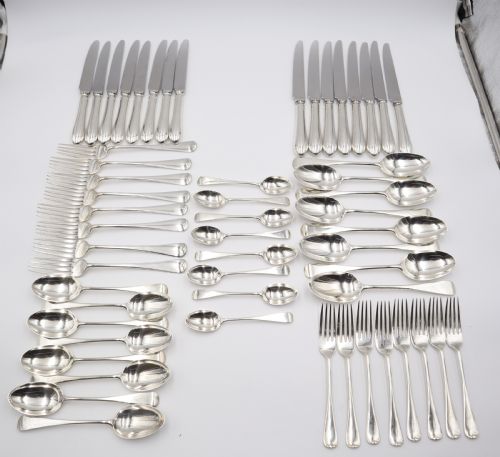


Georgian Silver Fork
A georgian silver fork brings tangible craftsmanship to the table, offering tactile weight and historical design that modern cutlery lacks.
Georgian Silver Fork
A georgian silver fork encompasses a range of domestic dining implements, from standard table forks and dessert pieces to specialised fruit, oyster, and serving variants.
The material output spans the eighteenth and early nineteenth centuries, reflecting styles such as Hanoverian, Kings, and Coburg patterns alongside plain silver shafts.
Buyers frequently encounter folding fruit forks with mother of pearl or tortoiseshell handles, as well as robust dinner and dessert forks bearing provincial or London hallmarks.
Materials and construction
Silversmiths utilised sterling silver alongside steel for tines, mounting functional parts with organic materials like mother of pearl, horn, tortoise shell, and agate.
Early examples demonstrate hand-beaten methods and distinct three-pronged configurations, while later nineteenth-century pieces incorporate complex casting and patterned handles.
Georgian Silver Fork Retail Price Guide 2026
Typical asking prices for georgian silver fork among the pieces listed under this phrase on Sellingantiques today, from the lower quarter to the upper quarter. They describe what is for sale here now, not the wider market.
Listings feature sterling silver, steel, horn, mother of pearl, and tortoiseshell across Georgian and Victorian periods.
Distinctions in craftsmanship
Quality rests upon the crispness of hallmarks, the retention of original engraving or armorial crests, and the structural integrity of handle mountings.
Makers such as Paul Storr or E Coker represent higher levels of execution, where proportional balance and detailed chasing elevate standard utility items into accomplished metalwork.
E Coker·Paul Storr·William Ward·Bateman
The Georgian Silver Fork Glossary
- Hallmark
- A series of official marks stamped on precious metals indicating maker, standard of purity, assay office, and year of production.
- Dognose
- An early style of fork featuring a spatula-like terminal curving upward, popular around the turn of the eighteenth century.
- Hanoverian
- A pattern characterised by a central ridge running down the front of the handle stem, originating in the early Georgian era.
- Campaign cutlery
- Portable dining sets designed for travel or military use, frequently fitted into compact leather or wooden cases.
Georgian Silver Fork: Frequently Asked Questions
How do I clean antique silver forks?
Wash them gently in warm soapy water using a soft cloth, avoiding harsh abrasive dips that strip the natural patina accumulated over centuries.
Dry them immediately with a soft towel to prevent water spots and store them in dry, tarnish-resistant environments.
Can I use these forks for daily dining?
Many solid silver and steel-tined pieces remain structurally sound for regular use, provided they are hand-washed rather than put into modern dishwashers.
Delicate folding fruit forks with mother of pearl or tortoiseshell handles suit careful occasional handling better than robust daily service.
What is the difference between table and dessert forks?
Table forks are larger and heavier, designed for the main course of a formal meal, whereas dessert forks are scaled down for lighter courses.
Dessert variants often pair with fruit knives and frequently incorporate decorative handles made from organic materials.
How do I date a Georgian silver fork?
The assay office marks and date letters stamped into the silver provide the exact year of manufacture according to regional hallmarking records.
Stylistic cues such as three-pronged tines or Dognose terminals also point toward the earlier decades of the eighteenth century.