
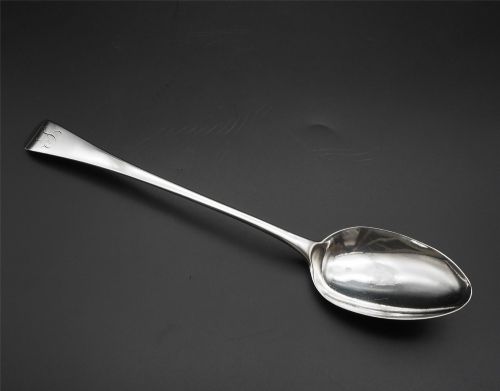
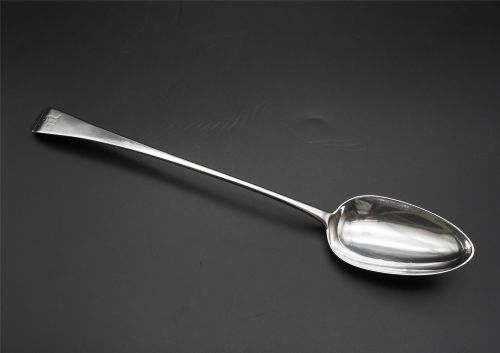
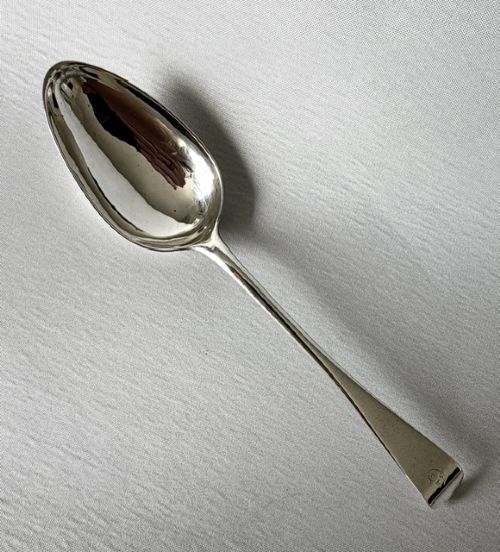
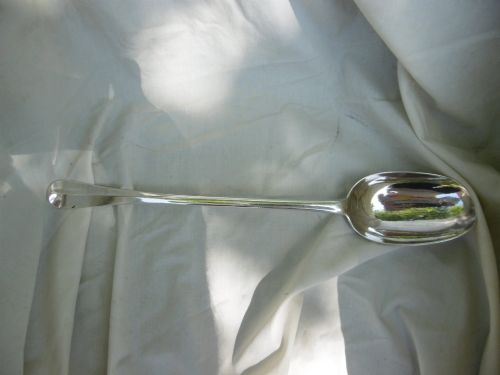


Georgian Silver Basting Spoon
A georgian silver basting spoon is a substantial flatware piece designed for service at the dining table.
Georgian Silver Basting Spoon
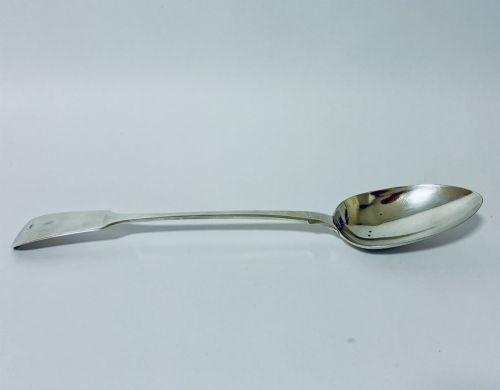
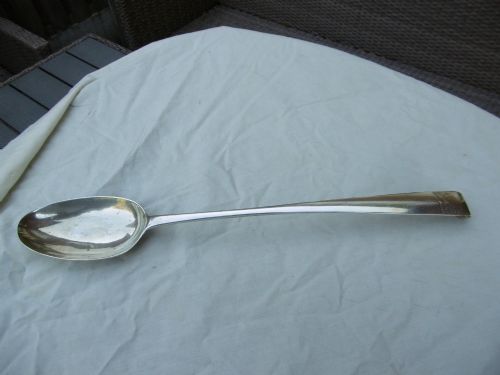
A georgian silver basting spoon serves as a large implement found within cutlery collections, often referred to alternatively as a hash or stuffing spoon. These pieces measure considerably longer than standard table spoons to reach deep into roasting pans and serving bowls.
The pieces on this page span the eighteenth and early nineteenth centuries, covering the reigns of George I through to George III and beyond. Regional variations appear frequently, originating from provincial English assay towns, Scottish burghs, and Irish workshops in Dublin.
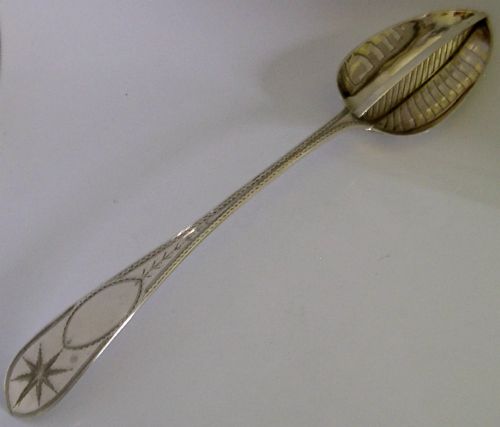
Standard serving forms predominate alongside specialised variants featuring integral strainers or pierced bowls. Collectors encounter plain Old English patterns, Fiddle patterns, and occasional hook-end terminals designed to hang from the edge of a vessel.
Materials and technique
Silversmiths hammered these implements from sterling silver or, in earlier examples from the early eighteenth century, the higher-purity Britannia silver standard. Metal thickness was maintained to provide rigidity across lengths exceeding thirty centimetres.
Makers struck assay office marks, maker's marks, and date letters directly into the reverse of the stem. Bowls were shaped by hand-beating, while handles incorporated engraved family crests or monograms applied by specialist heraldic engravers.
Several Irish spoons feature clever hook-end terminals designed to hang securely from the rim of a gravy boat without sliding into the sauce.
Quality and distinction
Substance and weight separate robust serving implements from worn examples that have suffered decades of vigorous polishing. A heavy gauge of silver preserves the crispness of maker's marks and the original profile of the stem.
Provenance and regional origin elevate certain pieces, particularly provincial Scottish or Irish items carrying clear local assay marks. The inclusion of specialised straining functions or matched pairs adds significant interest for advanced collectors.
Andrew Archer·John Craig·William Scarlett·John Locker·John Wilks·Robert Gordon·Alexander Henderson·The Bateman family
The Georgian Silver Basting Spoon Glossary
- Hash spoon
- An alternative historical term for a very large serving or basting spoon used in large dining households. These items frequently exceed thirty centimetres in length.
- Strainer spoon
- A variation featuring a pierced partition or internal barrier within the bowl to separate gravy from solids during service.
- Britannia standard
- A compulsory higher grade of silver purity introduced in England in 1696, comprising ninety-five point eight percent pure silver. Pieces from this standard carry distinct hallmarks showing a seated figure.
- Old English pattern
- A traditional flatware handle style characterised by a downward-turning terminal and a crisp central ridge along the stem.
- Provincial silver
- Items manufactured outside the major official assay towns such as London, bearing local maker's marks from Scottish burghs or regional English cities.
Georgian Silver Basting Spoon: Frequently Asked Questions
What is the difference between a basting spoon and a gravy spoon?
A basting spoon is generally larger and was originally intended for culinary service and kitchen use, whereas a gravy spoon relates specifically to table service.
In practice, eighteenth-century households utilised these large sterling silver implements interchangeably for serving meat, vegetables, and pan juices.
How can I date a georgian silver basting spoon?
Dating relies upon the sequence of hallmarks stamped into the reverse of the handle stem, which typically include a maker's mark, a lion passant, and a date letter.
Additional chronological clues appear in the handle style, such as the early duck-nose bowl or the later nineteenth-century Fiddle pattern.
Were these spoons used exclusively in the kitchen?
While intended for food preparation and basting joints in roasting pans, heavy silver serving pieces frequently moved to the dining room sideboard.
Their substantial size made them ideal for serving large portions from deep bowls directly to guests at formal dinners.
Why do some spoons feature holes in the bowl?
Strainer spoons incorporate pierced grilles to allow liquid gravy to pass through while retaining solid ingredients like herbs or vegetables.
These integrated strainers were essential tools for serving boiled meats and roasted poultry accompanied by rich pan reductions.