
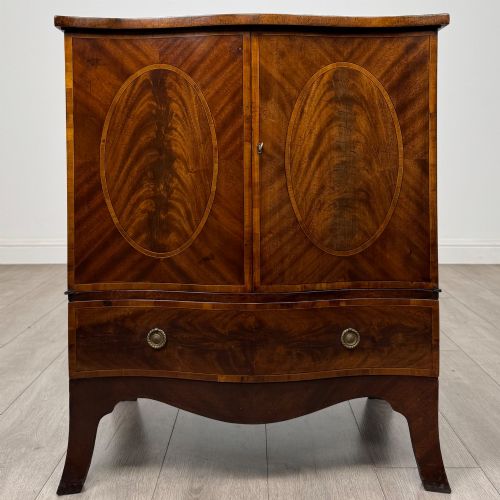
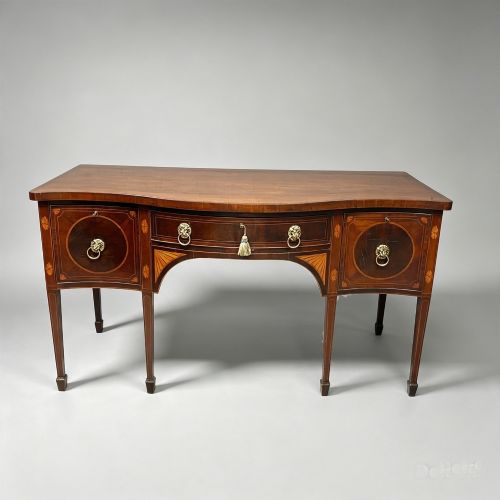
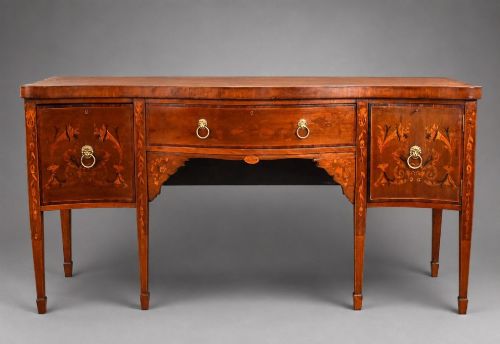
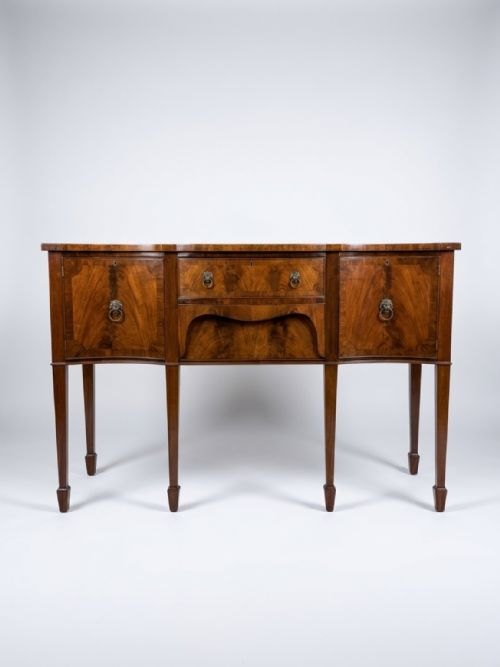
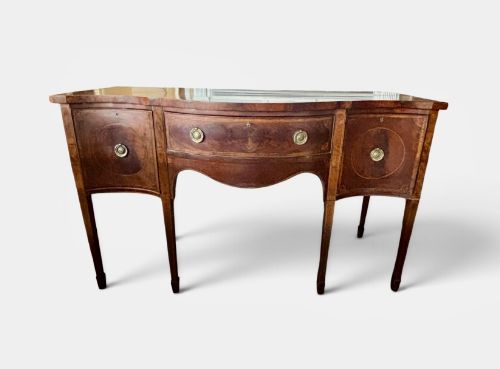
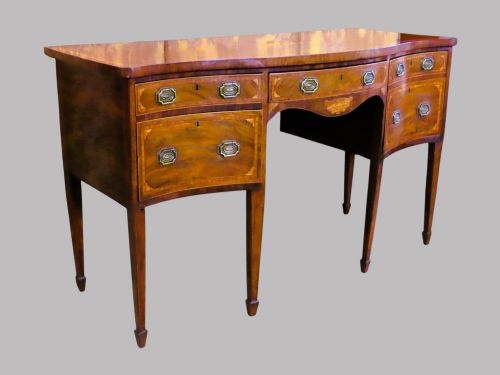


Georgian Serpentine Front Sideboard
A georgian serpentine front sideboard brings effortless architectural curve and deep mahogany grain to a formal dining room.

Georgian Serpentine Front Sideboard
A georgian serpentine front sideboard is a substantial dining room serving piece defined by a gently undulating convex and concave frontal sweep. These items emerge primarily from the eighteenth century, though revival interpretations from the edwardian era and later nineteenth century appear frequently.
Makers designed these forms to anchor large dining spaces, offering surface area for serving alongside deep drawers and cupboards for silver and linen. The configuration typically involves a central drawer flanked by deep cellaret drawers or cupboards behind pedestals.
The versions most common on this page span genuine eighteenth century pieces alongside later sheraton revival interpretations from the early twentieth century. Buyers encounter everything from compact serving tables to massive storage servers built with identical curved fronts.
Materials and construction methods
Cabinetmakers relied on solid mahogany and flame mahogany veneer laid over secondary timbers, shaping the undulating front edge from thick stock to maintain structural integrity. The curved sweep requires precise joinery to ensure drawers and doors follow the exact contour without binding.
Surface enrichment relies heavily on boxwood inlay, satinwood stringing, and marquetry details that trace the curved outlines and drawer borders. Brass hardware, including original drop handles and backplates, punctuates the polished timber surfaces across both georgian and revival examples.
Many sideboards hide deep cellaret drawers built specifically to keep eighteenth century wine bottles cool against the wood.
Distinguishing quality across periods
Quality rests upon the crispness of the serpentine sweep and the choice of timber, particularly the depth and figure of flame mahogany veneers. Superior examples display seamless grain matching across curved drawer fronts and intricate, tight boxwood inlay rather than painted substitutes.
Structural harmony separates the finest pieces from lesser alternatives, visible in the proportion of tapered legs and the precise fit of internal drawer dividers. Original brasses and untouched secondary woods elevate an item far above those altered during later restorations.
The Georgian Serpentine Front Sideboard Glossary
- Serpentine front
- A furniture facade featuring a convex centre flanked by concave curves, creating an undulating silhouette.
- Flame mahogany
- A highly figured timber veneer showing a distinctive flickering flame pattern derived from branch forks or specific tree cuts.
- Cellaret
- A deep interior drawer or compartment designed originally to hold wine bottles upright within a sideboard.
- Stringing
- A narrow strip of contrasting wood inlay used to outline drawers, panels, and tabletops in geometric designs.
- Sheraton revival
- A late nineteenth and early twentieth century design movement replicating the lighter neoclassical forms associated with thomas sheraton.
Georgian Serpentine Front Sideboard: Frequently Asked Questions
How do I spot a true period piece?
Examine the secondary woods inside the drawers, such as oak or pine, alongside hand-cut dovetails that show irregular spacing and tool marks.
Original timber shrinkage and hand-polished wax patination develop organically over centuries, distinguishing authentic eighteenth century construction from later revival copies.
Where should I place this sideboard?
These pieces require a prominent wall in a dining room or wide hallway where the curved front remains fully visible from multiple angles.
Ensure adequate clearance around the piece so the serpentine drawers and flanking cupboard doors open freely without obstruction from nearby furniture.
How do I clean mahogany safely?
Dust the polished surfaces regularly with a soft, dry lint-free cloth and apply traditional beeswax sparingly to nourish the dry timber.
Avoid modern silicone sprays or household liquid cleaners, as these agents penetrate old finishes and create a cloudy buildup over the veneer.
What is a cellaret drawer?
A cellaret is a deep lower compartment built specifically to store wine bottles and decanters securely beneath the main serving surface.
Many georgian examples feature partitioned interiors or lead-lined inserts intended to hold ice alongside cooling bottles during long dinner parties.