
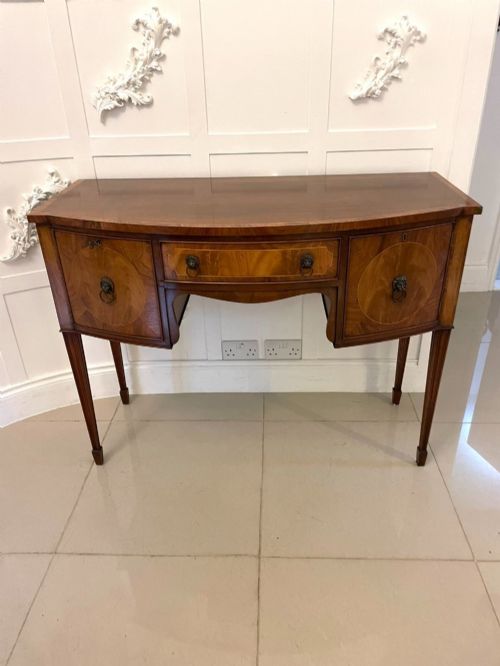
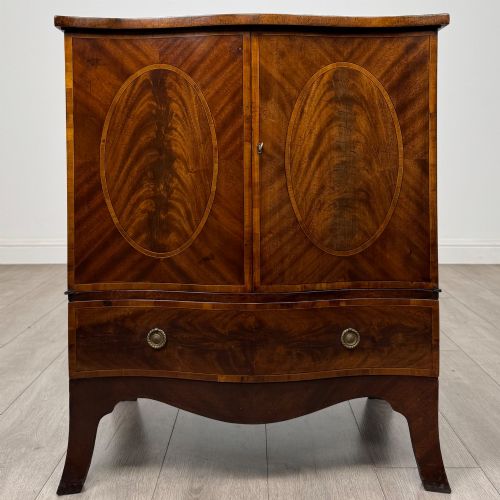
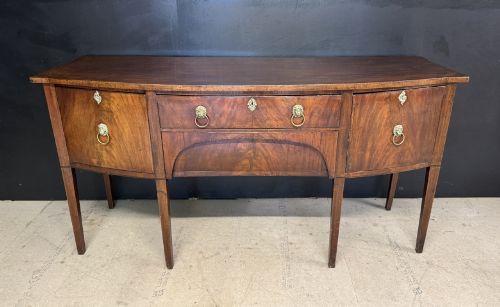
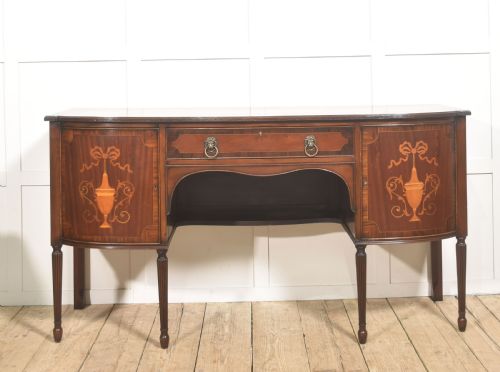


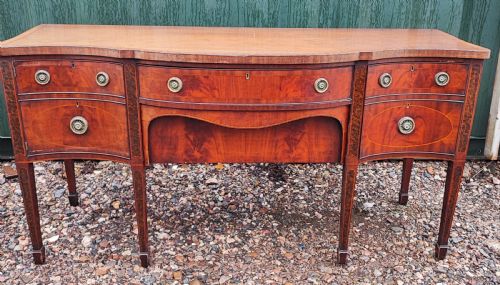


Hepplewhite Style Mahogany Sideboard
A hepplewhite style mahogany sideboard brings architectural grace to a dining room through sweeping serpentine curves and delicate stringing.
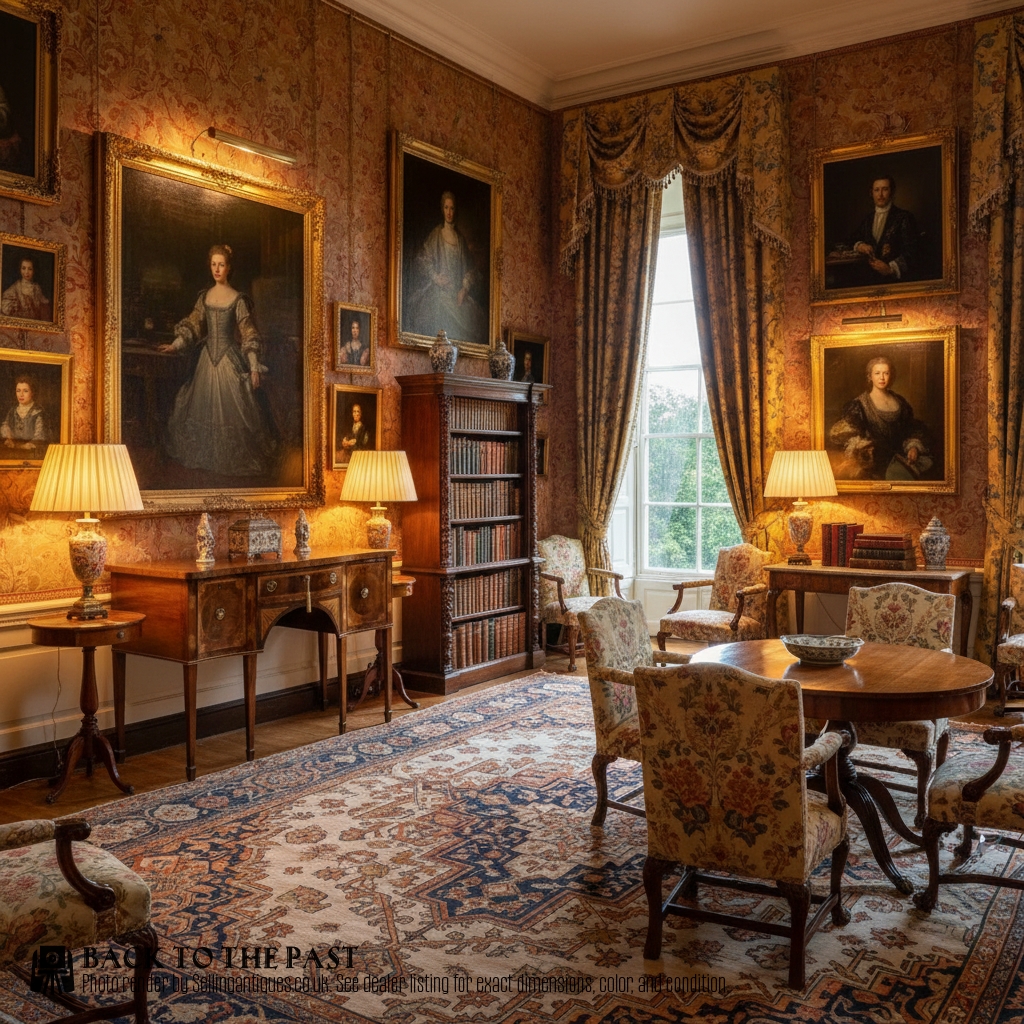
Hepplewhite Style Mahogany Sideboard
A hepplewhite style mahogany sideboard forms the centrepiece of a formal dining room, designed for serving food and displaying silver. The pieces gathered here range from authentic eighteenth century originals to later revival items made during the Victorian and Edwardian eras.
The most common formats on this page are bowfront and serpentine shapes, which soften the rigidity of the dining space. These forms trace back to the designs published by George Hepplewhite, whose pattern books influenced generations of cabinet makers.
Makers working in the Georgian style favoured balanced proportions, often incorporating pedestals, drawers, and cupboards beneath a generous serving surface. You will also encounter related serving tables and occasional cutlery urns that complete the formal dining suite.
Materials and construction
Mahogany serves as the primary timber across these pieces, selected for its rich grain and stability. Cabinet makers utilised solid planks for structural frames and carefully matched veneers for the expansive top surfaces and drawer fronts.
Satinwood, boxwood, and marquetry inlay provide contrasting borders and decorative motifs. These light woods create delicate geometric lines and floral patterns that define the neoclassical aesthetic.
Brass hardware, including ring handles, backplates, and occasional galleries, adds functional contrast to the dark timber. Joinery relies on traditional techniques such as dovetailing for drawer construction and pegged mortise and tenon frames.
Some sideboards feature hidden cellarette drawers deep enough to cradle old wine bottles, complete with lead-lined compartments for melting ice.
Factors of quality
The precision of the timber inlay marks the division between standard workshop production and master cabinet work. Sharp, unbroken lines in the satinwood and boxwood banding demonstrate superior hand cutting.
The handling of the serpentine or bowfront curve reveals the maker's skill. Superior pieces feature continuous grain matching across multiple drawers and disciplined shaping of the solid mahogany frame.
Original brass hardware and well-preserved secondary timbers, such as oak drawer linings, indicate an undisturbed pedigree. Later replacements or heavy restorations alter the integrity of the piece.
Gillow
The Hepplewhite Style Mahogany Sideboard Glossary
- Serpentine
- A front profile characterised by a convex centre flanked by concave curves. This shape requires advanced woodworking skill to execute properly on a sideboard front.
- Bowfront
- A convex, outward-curving front that projects from the corners towards the centre. It offers additional interior storage space while maintaining a graceful room profile.
- Stringing
- Thin lines of contrasting lighter wood, such as boxwood, inlaid into grooves on the mahogany surface. This technique outlines drawers, legs, and tabletops.
- Marquetry
- Elaborate decorative patterns formed by fitted veneers of various woods. It appears on premium surfaces to create pictorial or symmetrical designs.
- Cutlery urn
- A tall, vase-shaped wooden vessel placed upon or beside a sideboard to store flatware. These matched accessories are highly sought after by collectors.
Hepplewhite Style Mahogany Sideboard: Frequently Asked Questions
How do I spot a true eighteenth century piece?
Examine the secondary timbers inside the drawers, such as oak or pine, and check the hand-cut dovetails. Eighteenth century construction shows tool marks and irregularities absent in later machine-made revival pieces.
Look closely at the aged patina of the mahogany and the wear patterns around the drawer pulls. Genuine pieces exhibit decades of subtle handling rather than uniform factory finishing.
Where should I place a serpentine sideboard?
These pieces require adequate wall space to allow their curved fronts and proportions to breathe. Avoid cramped hallways or narrow dining alcoves where the sweeping lines get lost.
Keep them away from direct sunlight and heat sources to prevent the mahogany veneer from drying and lifting. A stable indoor climate preserves the timber and the delicate boxwood inlay.
What is the difference between Georgian and revival pieces?
Georgian pieces date from the reigns of the Georges, spanning the eighteenth and early nineteenth centuries. They represent the original period of design and hand craftsmanship.
Revival pieces date from the Victorian and Edwardian eras, when cabinet makers recreated earlier styles. While well made, these later items often feature machine-cut elements and different secondary woods.
How do I care for antique mahogany wood?
Dust the surface regularly with a soft, dry cloth to prevent grit accumulation. Avoid modern silicone sprays, which penetrate the open grain and ruin the historical polish.
Apply a traditional beeswax polish sparingly once or twice a year to nourish the timber. Buffing the wax brings out the natural depth and warm red tones of the mahogany.