
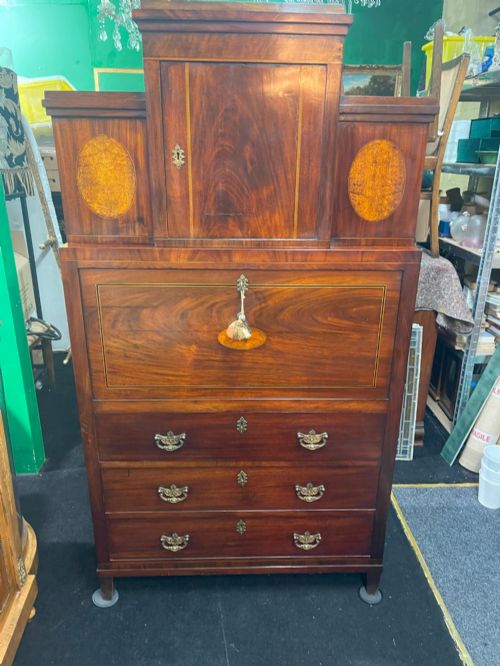
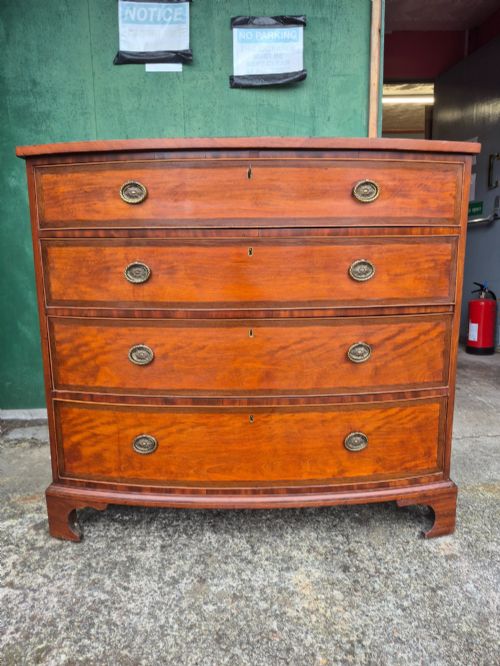


Georgian Satinwood Inlaid Drawers
Georgian satinwood inlaid drawers combine rich timber and precise detail, offering functional storage with refined decorative presence.
Georgian Satinwood Inlaid Drawers
Georgian satinwood inlaid drawers encompass chests, desks, writing tables, and secretaire bookcases originating across the Georgian, Regency, and Edwardian periods. Buyers searching this phrase look primarily for case furniture and writing pieces featuring contrasting light wood details against darker carcase timbers.
The pieces on this page span the eighteenth, nineteenth, and early twentieth centuries, including George III originals and later Sheraton Revival interpretations. Chests of drawers and bureau forms appear alongside occasional tables and dressing table mirrors.
Makers and workshops of various scales produced these items, utilising regional cabinet-making traditions from eighteenth-century origins through to twentieth-century revivals. The selection reflects both formal proportions of the Georgian era and lighter decorative treatments from Edwardian workshops.
Materials and Technique
Cabinet-makers constructed the primary carcases using mahogany, walnut, or satinwood, applying satinwood inlay and line banding to create geometric or floral patterns. Secondary timbers provided internal support for drawers and backboards while the exterior surfaces received polished finishes.
Inlaid decoration involved precise cutting of contrasting veneers, including kingwood, tulipwood, and harewood, fitted meticulously into channels carved within the primary timber. Brass handles, escutcheons, and glass elements completed the construction of desks, bookcases, and chests.
Listings feature satinwood, mahogany, walnut, and satin birch alongside brass hardware and leather writing inserts.
Craftsmanship and Construction
The standard of execution in the inlay work separates ordinary pieces from superior examples, visible in the tightness of the joints and the sharpness of the contrasting lines. Superior cabinet-making shows careful selection of figured timber veneers that match across drawer fronts and surfaces.
Proportion and structural integrity dictate the standing of a piece, with finer examples retaining original brass hardware, smooth-running drawers, and well-preserved timber patination without excessive restoration.
Edwards and Roberts·Gillows
The Georgian Satinwood Inlaid Drawers Glossary
- Satinwood
- A durable tropical hardwood known for its golden-yellow sheen and smooth grain. It serves as a primary veneer or inlay material on eighteenth and nineteenth-century furniture.
- Line Inlay
- A narrow strip of contrasting wood inserted into a shallow groove on a furniture surface. This technique creates delicate borders around drawer fronts and tabletops.
- Bow-Fronted
- A furniture design featuring a convex, curved front elevation. This shape softens the profile of chests and cabinets.
- Cross-Banding
- A border of veneer laid with the grain running perpendicular to the surrounding surface. It frames panels and tabletops to add decorative contrast.
- Serpentine
- A shape characterised by a double curve, concave in the centre and convex at the ends. It appears frequently on commodes and chests of drawers.
Georgian Satinwood Inlaid Drawers: Frequently Asked Questions
What is satinwood inlay?
Satinwood inlay involves setting thin pieces of pale, figured satinwood into the surface of a darker timber like mahogany or walnut. This technique creates contrasting borders, geometric patterns, and decorative motifs.
Cabinet-makers used this method to highlight the structural lines of drawers, tabletops, and cabinet doors during the Georgian and later revival periods.
How do I identify a George III chest?
George III pieces typically display balanced proportions, high-quality timber selection, and restrained decorative elements such as cockbeading around drawer edges. They often feature dovetailed drawer construction and original brass hardware.
Later nineteenth-century and Edwardian copies often replicate these forms but utilise machine-cut elements or different secondary woods inside the carcase.
Where were these pieces used?
These items functioned primarily in principal rooms such as bedrooms, drawing rooms, and studies. Chests and dressing table mirrors served private quarters, while desks and secretaire bookcases equipped libraries and writing rooms.
Their decorative inlay allowed them to sit in formal entertaining spaces as well as private family areas.
How should I care for satinwood furniture?
Keep these items away from direct sunlight and heat sources to prevent the timber from drying out or the veneer from lifting. Gentle dusting with a dry, soft cloth preserves the polished surface.
Avoid using silicone-based polishes or harsh chemical cleaners that can damage historic finishes and delicate inlaid sections.